Summary Exam Perception, Attention and Decision-Making
Class 1 – Introduction
Lecture
What is the use of perception?
→ Problem solving for interacting and surviving in the immediate environment:
• Navigating the environment
• Manipulating objects
• (Symbolic) Decision-making
• Making and executing plans
How and why do we do it?
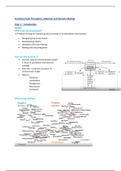
• Humans require environmental models
(= basis of perception and decision-
making)
• Raw info + coherent structure →
environment model
• Aspects:
- Attention
- Localization
- Recognition
- Abstraction
- Constancy
What are you sensing?
,Attention
• = The taking possession by the mind, in clear and vivid form, of one out of what may seem
several simultaneously possible objects or trains of thought. It implies withdrawal from
some things in order to deal effectively with others – William James
• Focused attention = Respond to specific cues in discrete manner
• Sustained attention = Maintain a consistent response
• Divided/Alternating attention = Respond to two or more cues (simultaneously or
independently)
• Selective attention = Maintain a consistent response during distraction
• Mindfulness = maintain (= response) awareness of the moment
Decision-Making
• Process of identifying and choosing between alternatives
- Based on clear criterion
- Best fits with our goals/laws/values etc.
- Resulting in an outcome with highest probability of success or effectiveness
• Process of sufficiently reducing uncertainty
- Information-gathering function
- Uncertainty is reduced rather than eliminated
- No uncertainty, decision is null
• Unconscious decisions?
Literature
(None)
,Class 2 – Decision-making and the brain
Lecture 2
Introduction: Decision-making in the brain:
• Prefrontal cortex:
- ACC: Evaluation
- OFC: Probability
- vmPFC: Value
- dlPFC: Working memory
• Basal ganglia:
- Dorsal striatum (caudate nucleus + putamen): Action selection & Habit formation
→ Which parts of the cortex gets “the green light”
- Ventral striatum (nucleus accumbens): Reward
Perceptual decisions:
• Formal model = How processes work internally trying to explain our behavior
- Behavioral data
- Cognitive process
- Brain data
• The drift diffusion model (DDM) = Choice RT based on evidence accumulation
- We use a stimulus, we show a bunch of random dots on the screen
- Some are indeed very random, and others move in a certain direction (left or right)
- People are asked to push on a button when they know which way the dots are
moving
- Decision threshold = The amount of information that we need to make a decision
- What happens if you give people another task: “It is okay to make a mistake, but you
should be quick” → We can see that the decision threshold decreases, and the
amount of errors/wrong answers increases
- Area MT: If stuff moves, area MT will light up → Associated with motion
, - Area LIP: The stronger the signal is (so the more dots move coherently to one side of
the screen), the steeper the slope
Commercial decisions:
• In our day to day life, we are confronted with a lot of options
• DDM to predict consumer choice → Each of the response alternatives were given a separate
DDM
• Researchers gave subjects an eye tracker, in order to predict which item they would choose
Behavioral economics:
• Expected value = The multiplication of the probability of getting something with the value
something has
→ However, economics were wrong in this regard
• Expected utility = Our personal value (not the absolute value)
- We as humans tend to be risk averse; Things that tend to be uncertain, the less likely
we make that choice
- Decrease in the utility function: When we go from 1 to 1000 euros, it has a big
impact on our lives, whereas going from 100.000 to 101.000 it does not so much
impact our lives
• Prospect theory:
- Loss aversion = When it is already yours, and you risk losing it, we respond
differently in comparison to when we can gain something.
Class 1 – Introduction
Lecture
What is the use of perception?
→ Problem solving for interacting and surviving in the immediate environment:
• Navigating the environment
• Manipulating objects
• (Symbolic) Decision-making
• Making and executing plans
How and why do we do it?
• Humans require environmental models
(= basis of perception and decision-
making)
• Raw info + coherent structure →
environment model
• Aspects:
- Attention
- Localization
- Recognition
- Abstraction
- Constancy
What are you sensing?
,Attention
• = The taking possession by the mind, in clear and vivid form, of one out of what may seem
several simultaneously possible objects or trains of thought. It implies withdrawal from
some things in order to deal effectively with others – William James
• Focused attention = Respond to specific cues in discrete manner
• Sustained attention = Maintain a consistent response
• Divided/Alternating attention = Respond to two or more cues (simultaneously or
independently)
• Selective attention = Maintain a consistent response during distraction
• Mindfulness = maintain (= response) awareness of the moment
Decision-Making
• Process of identifying and choosing between alternatives
- Based on clear criterion
- Best fits with our goals/laws/values etc.
- Resulting in an outcome with highest probability of success or effectiveness
• Process of sufficiently reducing uncertainty
- Information-gathering function
- Uncertainty is reduced rather than eliminated
- No uncertainty, decision is null
• Unconscious decisions?
Literature
(None)
,Class 2 – Decision-making and the brain
Lecture 2
Introduction: Decision-making in the brain:
• Prefrontal cortex:
- ACC: Evaluation
- OFC: Probability
- vmPFC: Value
- dlPFC: Working memory
• Basal ganglia:
- Dorsal striatum (caudate nucleus + putamen): Action selection & Habit formation
→ Which parts of the cortex gets “the green light”
- Ventral striatum (nucleus accumbens): Reward
Perceptual decisions:
• Formal model = How processes work internally trying to explain our behavior
- Behavioral data
- Cognitive process
- Brain data
• The drift diffusion model (DDM) = Choice RT based on evidence accumulation
- We use a stimulus, we show a bunch of random dots on the screen
- Some are indeed very random, and others move in a certain direction (left or right)
- People are asked to push on a button when they know which way the dots are
moving
- Decision threshold = The amount of information that we need to make a decision
- What happens if you give people another task: “It is okay to make a mistake, but you
should be quick” → We can see that the decision threshold decreases, and the
amount of errors/wrong answers increases
- Area MT: If stuff moves, area MT will light up → Associated with motion
, - Area LIP: The stronger the signal is (so the more dots move coherently to one side of
the screen), the steeper the slope
Commercial decisions:
• In our day to day life, we are confronted with a lot of options
• DDM to predict consumer choice → Each of the response alternatives were given a separate
DDM
• Researchers gave subjects an eye tracker, in order to predict which item they would choose
Behavioral economics:
• Expected value = The multiplication of the probability of getting something with the value
something has
→ However, economics were wrong in this regard
• Expected utility = Our personal value (not the absolute value)
- We as humans tend to be risk averse; Things that tend to be uncertain, the less likely
we make that choice
- Decrease in the utility function: When we go from 1 to 1000 euros, it has a big
impact on our lives, whereas going from 100.000 to 101.000 it does not so much
impact our lives
• Prospect theory:
- Loss aversion = When it is already yours, and you risk losing it, we respond
differently in comparison to when we can gain something.