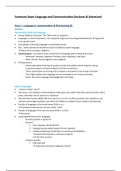
Summary Exam Language and Communication (Lectures & Literature)
Class 1 – Language vs. communication & Rule learning (1)
Lecture 1
Non-human animals and language:
• Doctor Dolittle’s Delusion: The “Why only us” question
• Language is a kind of behavior, not a physical organ (such as wings/echolocation) → Argument
from genetics fails
• According to Chomsky language is exclusively human
• But… Some animals are known to have the ability to learn language
→ Zebra finch, monkeys, dolphins
• Vocal learners = Are able to learn some form of language with training and a tutor
- Mammals: Humans, dolphins & whales, bats, elephants, and seals
- Birds: Parrots, hummingbirds, and songbirds
• Primate brains:
- Action-perception learning of speech sounds and spoken words requires strong,
reciprocal superior temporal-inferior frontal connections
- These connections are strong only in humans and weak in non-human primates
- This might explain why language has not emerged in non-human primates
- Kanzi: Has some language knowledge (but not really)
What is language?
• “I know it when I see it”
• The issue is not whether communication takes place, but rather how that communication takes
place, and what sort of system it is based on
• The distinctly human ability that has arisen in us is not, as often assumed, the capacity to use
arbitrary meaningful symbols, but rather the ability to combine those symbols syntactically
• Faculty of language in the broad sense (FLB) = us +
→ Conceptual-intentional, sensory-motor, other
• Faculty of language in the narrow sense (FLN) = us only
→ Recursion
• Learning mechanisms for language:
- Domain-specific or general?
- General:
▪ Fast mapping: Words & facts
▪ Categorical perception (speech & non-speech)
▪ Statistical learning: Sensitivity to transitional probabilities
→ Used to find words in continuous speech
(→ See intro course)
- Domain-specific:
▪ Rule learning
→ Especially sensitive to linguistic stimuli
,What does language acquisition involve?
• Phonemes → Words → Word order
• Words are categories: How do we categorize and generalize rules?
• Nativist view:
- Language-specific learning mechanism
- Learner has innate expectations about language structure
- Language acquisition = parameter setting/constraint ranking
- Learning involves manipulation of discrete symbols
• Empiricist view:
- General associative learning mechanism
- Learner is “blank slate”
- Learning is constrained by processing abilities, perceptual preferences, and memory
- Learning is a stochastic process over distributed input: Statistical learning
→ Probably a bit of both
• Units: Phonemes/words
→ learning mechanism: Statistical learning
• Rules: Combining units into larger, grammatical entities (words/phrases)
→ Learning mechanism: Algebraic rule-learning
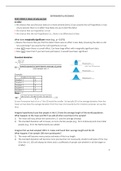
Behavioral methods: Studying language acquisition
• Dependent variable: Looking time
- Visual fixation
- Head-turn
- Looking time = attention
• Usual procedure:
- Training: Familiarization or habituation to a specific pattern
- Test: Items that are consistent or inconsistent with that pattern
• Expected result: Statistically significant difference in looking time between the two conditions
• How it is tested:
- Novelty preference: Looking time is robustly longer for the items that are inconsistent
with the training stimuli
- Familiarity preference: Longer looking times for consistent stimuli
• What happens during familiarization?
• Bottom line of looking time preference:
- If infant participant has been able to represent and categorize the stimuli during
familiarization, during test the mind is free to start paying attention to new things →
Novelty preference
- Attention remains with the familiar items until categorization is accomplished →
Familiarity preference
,• Beware: It is a dynamic process!
- Learning does not stop after training phase
- Participants can still learn from test items
- Effect: familiarity preference in initial test phase & novelty preference in later test phase
- Final effect: Early and late looking times cancel each other out → Null result
Rule learning
• Key feature of language: Abstraction & generalization
• Discrete infinity:
- Discrete = A (limited) set of fixed units
→ Relation between specific elements = statistical learning
- Infinity = Relations between variables
→ = Rule learning
→ Leap from observed stimuli to novel stimuli that follow the same rules
• Study:
• Big questions:
, - How does rule learning work?
- Is algebraic rule learning domain-specific?
- Is rule learning a shared property between human and non-human animals?
→ language evolution
- Under which circumstances is rule-learning facilitated/hindered?
• Question 1: Domain-specific?
-
-
-
Class 1 – Language vs. communication & Rule learning (1)
Lecture 1
Non-human animals and language:
• Doctor Dolittle’s Delusion: The “Why only us” question
• Language is a kind of behavior, not a physical organ (such as wings/echolocation) → Argument
from genetics fails
• According to Chomsky language is exclusively human
• But… Some animals are known to have the ability to learn language
→ Zebra finch, monkeys, dolphins
• Vocal learners = Are able to learn some form of language with training and a tutor
- Mammals: Humans, dolphins & whales, bats, elephants, and seals
- Birds: Parrots, hummingbirds, and songbirds
• Primate brains:
- Action-perception learning of speech sounds and spoken words requires strong,
reciprocal superior temporal-inferior frontal connections
- These connections are strong only in humans and weak in non-human primates
- This might explain why language has not emerged in non-human primates
- Kanzi: Has some language knowledge (but not really)
What is language?
• “I know it when I see it”
• The issue is not whether communication takes place, but rather how that communication takes
place, and what sort of system it is based on
• The distinctly human ability that has arisen in us is not, as often assumed, the capacity to use
arbitrary meaningful symbols, but rather the ability to combine those symbols syntactically
• Faculty of language in the broad sense (FLB) = us +
→ Conceptual-intentional, sensory-motor, other
• Faculty of language in the narrow sense (FLN) = us only
→ Recursion
• Learning mechanisms for language:
- Domain-specific or general?
- General:
▪ Fast mapping: Words & facts
▪ Categorical perception (speech & non-speech)
▪ Statistical learning: Sensitivity to transitional probabilities
→ Used to find words in continuous speech
(→ See intro course)
- Domain-specific:
▪ Rule learning
→ Especially sensitive to linguistic stimuli
,What does language acquisition involve?
• Phonemes → Words → Word order
• Words are categories: How do we categorize and generalize rules?
• Nativist view:
- Language-specific learning mechanism
- Learner has innate expectations about language structure
- Language acquisition = parameter setting/constraint ranking
- Learning involves manipulation of discrete symbols
• Empiricist view:
- General associative learning mechanism
- Learner is “blank slate”
- Learning is constrained by processing abilities, perceptual preferences, and memory
- Learning is a stochastic process over distributed input: Statistical learning
→ Probably a bit of both
• Units: Phonemes/words
→ learning mechanism: Statistical learning
• Rules: Combining units into larger, grammatical entities (words/phrases)
→ Learning mechanism: Algebraic rule-learning
Behavioral methods: Studying language acquisition
• Dependent variable: Looking time
- Visual fixation
- Head-turn
- Looking time = attention
• Usual procedure:
- Training: Familiarization or habituation to a specific pattern
- Test: Items that are consistent or inconsistent with that pattern
• Expected result: Statistically significant difference in looking time between the two conditions
• How it is tested:
- Novelty preference: Looking time is robustly longer for the items that are inconsistent
with the training stimuli
- Familiarity preference: Longer looking times for consistent stimuli
• What happens during familiarization?
• Bottom line of looking time preference:
- If infant participant has been able to represent and categorize the stimuli during
familiarization, during test the mind is free to start paying attention to new things →
Novelty preference
- Attention remains with the familiar items until categorization is accomplished →
Familiarity preference
,• Beware: It is a dynamic process!
- Learning does not stop after training phase
- Participants can still learn from test items
- Effect: familiarity preference in initial test phase & novelty preference in later test phase
- Final effect: Early and late looking times cancel each other out → Null result
Rule learning
• Key feature of language: Abstraction & generalization
• Discrete infinity:
- Discrete = A (limited) set of fixed units
→ Relation between specific elements = statistical learning
- Infinity = Relations between variables
→ = Rule learning
→ Leap from observed stimuli to novel stimuli that follow the same rules
• Study:
• Big questions:
, - How does rule learning work?
- Is algebraic rule learning domain-specific?
- Is rule learning a shared property between human and non-human animals?
→ language evolution
- Under which circumstances is rule-learning facilitated/hindered?
• Question 1: Domain-specific?
-
-
-