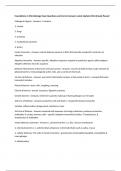
Foundations in Microbiology Exam Questions and Correct Answers Latest Update 2024 Already Passed
Pathogenic Agents - Answers 1. bacteria
2. viruses
3. fungi
4. protozoa
5. multicellular parasites
6. prions
Innate Immunity - Answers natural defenses present at birth that provide nonspecific resistance to
infection
Adaptive Immunity - Answers specific. Adaptive responses respond to particular agents called antigens.
Adaptive defenses must be acquired.
Defense Mechanisms of the host's immune system - Answers 3 Levels of defense that create network of
physical barriers, immunologically active cells, and a variety of chemicals
1st Line of Defense - Answers any barrier that blocks invasion at the portal of entry = nonspecific(innate
immunity) includes:
Physical Barriers- tears, skin, coughing, sneezing
Chemical Barriers- low pH, lysozyme, digestive enzymes
Genetic Barriers- resistance inherent in genetic makeup of host (pathogen can't invade)
2nd Line of Defense - Answers protective cells and fluids = nonspecific (innate immunity)
Includes: inflammation, phagocytosis, interferon, fever
3rd Line of Defense - Answers acquired with exposure to foreign substance; produces protective
antibodies & creates memory cells = specific (adaptive immunity) Includes: T lymphocytes, B
lymphocytes & antibodies
Innate Defenses Summary - Answers 1. physical barriers: i.e, skin, mucous membranes
2. chemical barriers: i.e, antimicrobial substances in the body fluids such as saliva, mucus
3. cellular defenses: The cells of innate immunity = granulocytes (neutrophils,basophils, eosinophils) &
macrophages.
4. inflammation
, 5. fever
6. molecular & genetic defenses: i.e, interferons, complement system.
physical & anatomical barriers (1st line of defense) - Answers 1)Skin and mucous membranes of
respiratory, urogenital, eyes, and digestive tracts. 2)Outermost layer of skin is composed of epithelial
cells compacted, cemented together, and impregnated with keratin; few pathogens can penetrate if
intact. 3)Flushing effect of sweat glands. 4)Damaged cells are rapidly replaced. 5)Mucous coat impedes
attachment and entry of bacteria
6)Blinking and tear production. 7)Stomach acid. 8)Nasal hair traps larger particles
Nonspecific chemical barriers (2nd line of defense) - Answers Include: 1)Sebaceous secretions
2)Lysozyme, an enzyme that hydrolyzes the cell wall of bacteria, in tears
3)High lactic acid & electrolyte concentration in sweat
4)Skin's acidic pH 5)Hydrochloric acid in stomach
6)Digestive juices and bile of intestines
7)Semen contains an antimicrobial chemical
8)Vagina has acidic pH
White Blood Cells (WBCs) or Luekocytes - Answers Leukocytes are formed in the bone marrow and then
enter the blood circulation as motile, migratory, defensive cells that wander through the body and have
an innate capacity to recognize & differentiate any foreign material in the body. Able to distinguish
between self & non self.
Immune Cell Homes - Answers 1. lymphatic tissues: that is lymph nodes, spleen, tonsils, MALT, GALT,
lymphatic nodules.
2. select organs: alveolar of the lungs, brain, liver.
3. epithelial layer of the skin
4. connective tissue
collective cytokines - Answers Soluble products of immune cells that play various roles in defending the
body against pathogens. Used to regulate, stimulate, suppress or control many aspects of cell
development, inflammation & immunity
Major cytokines:
1. interleukins (ILs)
2. tumor necrosis factor (TNF)
Pathogenic Agents - Answers 1. bacteria
2. viruses
3. fungi
4. protozoa
5. multicellular parasites
6. prions
Innate Immunity - Answers natural defenses present at birth that provide nonspecific resistance to
infection
Adaptive Immunity - Answers specific. Adaptive responses respond to particular agents called antigens.
Adaptive defenses must be acquired.
Defense Mechanisms of the host's immune system - Answers 3 Levels of defense that create network of
physical barriers, immunologically active cells, and a variety of chemicals
1st Line of Defense - Answers any barrier that blocks invasion at the portal of entry = nonspecific(innate
immunity) includes:
Physical Barriers- tears, skin, coughing, sneezing
Chemical Barriers- low pH, lysozyme, digestive enzymes
Genetic Barriers- resistance inherent in genetic makeup of host (pathogen can't invade)
2nd Line of Defense - Answers protective cells and fluids = nonspecific (innate immunity)
Includes: inflammation, phagocytosis, interferon, fever
3rd Line of Defense - Answers acquired with exposure to foreign substance; produces protective
antibodies & creates memory cells = specific (adaptive immunity) Includes: T lymphocytes, B
lymphocytes & antibodies
Innate Defenses Summary - Answers 1. physical barriers: i.e, skin, mucous membranes
2. chemical barriers: i.e, antimicrobial substances in the body fluids such as saliva, mucus
3. cellular defenses: The cells of innate immunity = granulocytes (neutrophils,basophils, eosinophils) &
macrophages.
4. inflammation
, 5. fever
6. molecular & genetic defenses: i.e, interferons, complement system.
physical & anatomical barriers (1st line of defense) - Answers 1)Skin and mucous membranes of
respiratory, urogenital, eyes, and digestive tracts. 2)Outermost layer of skin is composed of epithelial
cells compacted, cemented together, and impregnated with keratin; few pathogens can penetrate if
intact. 3)Flushing effect of sweat glands. 4)Damaged cells are rapidly replaced. 5)Mucous coat impedes
attachment and entry of bacteria
6)Blinking and tear production. 7)Stomach acid. 8)Nasal hair traps larger particles
Nonspecific chemical barriers (2nd line of defense) - Answers Include: 1)Sebaceous secretions
2)Lysozyme, an enzyme that hydrolyzes the cell wall of bacteria, in tears
3)High lactic acid & electrolyte concentration in sweat
4)Skin's acidic pH 5)Hydrochloric acid in stomach
6)Digestive juices and bile of intestines
7)Semen contains an antimicrobial chemical
8)Vagina has acidic pH
White Blood Cells (WBCs) or Luekocytes - Answers Leukocytes are formed in the bone marrow and then
enter the blood circulation as motile, migratory, defensive cells that wander through the body and have
an innate capacity to recognize & differentiate any foreign material in the body. Able to distinguish
between self & non self.
Immune Cell Homes - Answers 1. lymphatic tissues: that is lymph nodes, spleen, tonsils, MALT, GALT,
lymphatic nodules.
2. select organs: alveolar of the lungs, brain, liver.
3. epithelial layer of the skin
4. connective tissue
collective cytokines - Answers Soluble products of immune cells that play various roles in defending the
body against pathogens. Used to regulate, stimulate, suppress or control many aspects of cell
development, inflammation & immunity
Major cytokines:
1. interleukins (ILs)
2. tumor necrosis factor (TNF)