LRAFB SFPC – NATIONAL INDUSTRIAL
SECURITY PROGRAM (NISP) REPORTING
REQUIREMENTS TEST QUESTIONS AND
ANSWERS
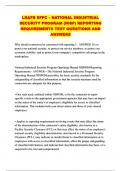
Why should contractors be concerned with reporting? - ANSWER It's to
protect our national security, to protect our service members, to protect our
economic stability, and to protect your company's competitive advantage in the
marketplace.
National Industrial Security Program Operating Manual NISPOM Reporting
Requirements - ANSWER • The National Industrial Security Program
Operating Manual NISPOM prescribes the basic security standards for the
safeguarding of classified information so that the security measures used by
contractors are adequate for that purpose.
• One such need, outlined within NISPOM, is for the contractor to report
specific events to the appropriate government agencies that may have an impact
on the status of the entity's or employee's eligibility for access to classified
information. This includes both your observations and those of your cleared
employees.
• Applies to reporting requirements involving events that may affect the status
of the determination of the contractor's entity eligibility, also known as a
Facility Security Clearance (FCL) or that may affect the status of an employee's
national security eligibility determination, also known as a Personnel Security
Clearance (PCL); may indicate an insider threat to classified information or to
employees with access to classified information; affect the proper safeguarding
of classified information, and indicate that classified information has been, or is
suspected to be, lost and compromised.
, What to report? - ANSWER • Events to be reported are listed in the NISPOM.
• The most understandable approach to reviewing these reports is to categorize
them by where majority of the reports will be submitted.
• Per the NISPOM, majority of reports are submitted to either the Federal
Bureau of Investigation (FBI) or the Cognizant Security Agency (CSA).
• The CSA reports are submitted to the Defense Counterintelligence and
Security Agency (DCSA) through the DOD personnel security system of record
with the appropriate reports sent to your DCSA Industrial Security
Representative (IS Rep).
Facility Security Officer Reporting Requirements (1) - ANSWER • On the
industry side, each cleared contractor facility designates an Facility Security
Officer who oversees and provides guidance for the implementation of
appropriate NISPOM and related government security requirements for
safeguarding classified information.
• The FSO serves as the interface between government and industry.
• One of the FSO's responsibilities is to ensure that appropriate reports are made
in a timely manner.
Facility Security Officer (FSO) Reporting Requirements (2) - ANSWER • The
Facility Security Officer (FSO) is responsible for reporting events they have
directly witnessed, and ensuring their cleared employees are making the
appropriate required reports.
SECURITY PROGRAM (NISP) REPORTING
REQUIREMENTS TEST QUESTIONS AND
ANSWERS
Why should contractors be concerned with reporting? - ANSWER It's to
protect our national security, to protect our service members, to protect our
economic stability, and to protect your company's competitive advantage in the
marketplace.
National Industrial Security Program Operating Manual NISPOM Reporting
Requirements - ANSWER • The National Industrial Security Program
Operating Manual NISPOM prescribes the basic security standards for the
safeguarding of classified information so that the security measures used by
contractors are adequate for that purpose.
• One such need, outlined within NISPOM, is for the contractor to report
specific events to the appropriate government agencies that may have an impact
on the status of the entity's or employee's eligibility for access to classified
information. This includes both your observations and those of your cleared
employees.
• Applies to reporting requirements involving events that may affect the status
of the determination of the contractor's entity eligibility, also known as a
Facility Security Clearance (FCL) or that may affect the status of an employee's
national security eligibility determination, also known as a Personnel Security
Clearance (PCL); may indicate an insider threat to classified information or to
employees with access to classified information; affect the proper safeguarding
of classified information, and indicate that classified information has been, or is
suspected to be, lost and compromised.
, What to report? - ANSWER • Events to be reported are listed in the NISPOM.
• The most understandable approach to reviewing these reports is to categorize
them by where majority of the reports will be submitted.
• Per the NISPOM, majority of reports are submitted to either the Federal
Bureau of Investigation (FBI) or the Cognizant Security Agency (CSA).
• The CSA reports are submitted to the Defense Counterintelligence and
Security Agency (DCSA) through the DOD personnel security system of record
with the appropriate reports sent to your DCSA Industrial Security
Representative (IS Rep).
Facility Security Officer Reporting Requirements (1) - ANSWER • On the
industry side, each cleared contractor facility designates an Facility Security
Officer who oversees and provides guidance for the implementation of
appropriate NISPOM and related government security requirements for
safeguarding classified information.
• The FSO serves as the interface between government and industry.
• One of the FSO's responsibilities is to ensure that appropriate reports are made
in a timely manner.
Facility Security Officer (FSO) Reporting Requirements (2) - ANSWER • The
Facility Security Officer (FSO) is responsible for reporting events they have
directly witnessed, and ensuring their cleared employees are making the
appropriate required reports.