

Linda van Mulken
6903142
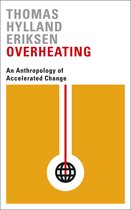
Overheating about overheating
Author: Thomas Hylland Eriksen
Publisher: Pluto Press
Engels Paperback, 9780745336343, Printing: the first of June 2016, 192 pages, €27,99
This book gives you a lot think about. Eriksen gives in his book updates about his previous statements
about the present state of globalization, including the time spacetime compression and acceleration.
The structure and style of the book gives a good idea about the content. The world is indeed the
place in which Eriksen places his book. He argues that this is a trop plein. Everything is accelerating
on a very fast level, people, processes and products. This book is about the world moving, he uses
modification of statistics to outline the larger problems with the ethnographic vignettes causing him
the same problem at lower levels. Eriksen starts with a chapter about the enormous growth of the
world population. He then discusses a conceptual vocabulary. He is really involved in the issues of
globalization. Chapters 3 to 7 deal with energy, mobility, cities, waste and information overload. In
the very last chapter of the book, he pulls these things together in a vision about how they collide.
There have been enormous changes in the last century, the world population has grown from two
billion to around seven billion. This change has enormous consequences, for example more and more
people are living in the city. The question is how this urbanization influences our lifestyle. On the one
hand, exchanging information is very easy, the culture differences are also transcended. But at the
same time new conflicts are emerging, isolated groups that are leading to an ever faster overheating
of the world. According to Eriksen, it will all be too much. The information overload that we have
been confronted with in recent decades often make our lives more difficult than easier. Due to the
rise of mobile phones, tablets and the internet, we have been responding almost all day to maintain
our social status. Eriksen describes this quaintly with examples of people gathering in the US at local
McDonalds and Starbucks locations since these were the only places where, after Hurricane Sandy,
was internet. Eriksen defines these effects with the term 'overheating'. The runaway processes,
double bonds and flexibility problems all indicate the loss of local agency, stability and control, this is
happening globally. In his final chapter Erikson explains that this will also lead to global problems of
trust, uncertainty and instability.
Erikson's ethnographic vignettes show how people around the world are looking for and finding ways
to live in a normal way. The complexity of daily life is increasing in economic, social and cultural
ways. Solutions that were previously used can no longer be used in this 'new world'. Because,
according to Eriksen, processes on a larger scale are now becoming much more tangible than effects
on daily life, a growing tension is typical for the modern world. “Tension, typical of modernity,
between the system world and the life-world, between the standardized and the unique, the
universal and the particular”
Eriksen often implicitly makes the point that scale is important. The number of tourist trips has
doubled from before the 1990s to now. This is a cultural, social and economic phenomenon in which
new cultural encounters take place and new forms of urban design. Think, for example, of new forms
of infrastructure, which are designed for the needs of visitors. According to Erikson, a scale shift is a
qualitative shift, which transforms the phenomena themselves and does not leave the older
structures intact.
6903142
Overheating about overheating
Author: Thomas Hylland Eriksen
Publisher: Pluto Press
Engels Paperback, 9780745336343, Printing: the first of June 2016, 192 pages, €27,99
This book gives you a lot think about. Eriksen gives in his book updates about his previous statements
about the present state of globalization, including the time spacetime compression and acceleration.
The structure and style of the book gives a good idea about the content. The world is indeed the
place in which Eriksen places his book. He argues that this is a trop plein. Everything is accelerating
on a very fast level, people, processes and products. This book is about the world moving, he uses
modification of statistics to outline the larger problems with the ethnographic vignettes causing him
the same problem at lower levels. Eriksen starts with a chapter about the enormous growth of the
world population. He then discusses a conceptual vocabulary. He is really involved in the issues of
globalization. Chapters 3 to 7 deal with energy, mobility, cities, waste and information overload. In
the very last chapter of the book, he pulls these things together in a vision about how they collide.
There have been enormous changes in the last century, the world population has grown from two
billion to around seven billion. This change has enormous consequences, for example more and more
people are living in the city. The question is how this urbanization influences our lifestyle. On the one
hand, exchanging information is very easy, the culture differences are also transcended. But at the
same time new conflicts are emerging, isolated groups that are leading to an ever faster overheating
of the world. According to Eriksen, it will all be too much. The information overload that we have
been confronted with in recent decades often make our lives more difficult than easier. Due to the
rise of mobile phones, tablets and the internet, we have been responding almost all day to maintain
our social status. Eriksen describes this quaintly with examples of people gathering in the US at local
McDonalds and Starbucks locations since these were the only places where, after Hurricane Sandy,
was internet. Eriksen defines these effects with the term 'overheating'. The runaway processes,
double bonds and flexibility problems all indicate the loss of local agency, stability and control, this is
happening globally. In his final chapter Erikson explains that this will also lead to global problems of
trust, uncertainty and instability.
Erikson's ethnographic vignettes show how people around the world are looking for and finding ways
to live in a normal way. The complexity of daily life is increasing in economic, social and cultural
ways. Solutions that were previously used can no longer be used in this 'new world'. Because,
according to Eriksen, processes on a larger scale are now becoming much more tangible than effects
on daily life, a growing tension is typical for the modern world. “Tension, typical of modernity,
between the system world and the life-world, between the standardized and the unique, the
universal and the particular”
Eriksen often implicitly makes the point that scale is important. The number of tourist trips has
doubled from before the 1990s to now. This is a cultural, social and economic phenomenon in which
new cultural encounters take place and new forms of urban design. Think, for example, of new forms
of infrastructure, which are designed for the needs of visitors. According to Erikson, a scale shift is a
qualitative shift, which transforms the phenomena themselves and does not leave the older
structures intact.

