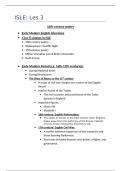
ISLE: Les 3
16th-century poetry
Early Modern English Literature
4 (or 5) classes in ISLE
1. 16th-century poetry
2. Shakespeare’s Twelfth Night
3. 17th-century poetry
4. Milton’s Paradise Lost & Behn’s Oroonoko
5. Swift & Gray
Early Modern Period (ca. 16th-17th centuries)
During Medieval times
During Renaissance
The Wars of Roses; in the 15th century
A series of civil wars fought over control of the English
throne
Lead to Ascent of the Tudors
The rise to power and prominence of the Tudor
dynasty in England
Important figures
Henry VIII
Elizabeth I
16th century: English Reformation:
The series of events in the 16th century when England
broke away from the authority of the Roman Catholic
Church. It was initiated by King Henry VIII.
17th century: English Civil War:
A conflict between supporters of the monarchy and
those favoring Parliament.
Key issues included disputes over power, religion, and
governance.
, The literary market
Refers to literature written with the primary goal of
making a profit
Social classes in the literary market are divided into
Higher class: writing in manuscript
Lower class: writing to earn a living
Lower classes often published their works in
print due to the availability of the book press,
which made mass production of books possible.
Two Forms of Publication:
Manuscript: Handwritten copies of literary works.
Printed: Mass-produced copies using a printing press
Different book formats:
Full Sheet:
A complete, uncut sheet of paper.
Folio:
A full sheet folded in half, creating two leaves (four
pages).
Quarto:
A folio folded in half, resulting in four leaves (eight
pages).
Octavo:
A quarto folded in half, producing eight leaves
(sixteen pages). It's considered portable and suitable
for poetry.
Paper Production:
, Paper was traditionally made from old rags
Copyright and Censorship in History:
Copyright, as we understand it today, did not exist in
the past.
Instead of copyright, printers had control over the
right to print the works they sold, not the authors.
Censorship was enforced, especially concerning
religious texts that did not align with the accepted
beliefs. The same bodies overseeing copyright often
handled censorship.
Patronage:
Patrons, individuals with wealth, played a crucial role
in supporting writers.
Example: Wriothesley, mentioned as a patron
of Shakespeare, would have used his wealth to
provide financial support to the playwright.
, English Literature in the Renaissance
Italian influences and European influences
High-class individuals who traveled to other countries
brought cultural influences back to England.
Writers with multilingual abilities contributed to the
transfer of ideas across languages.
English influences
Rhetorical culture
Rhetorical culture involves considerations of how language
sounds and is structured.
English writers, influenced by classical education (Latin and
Greek studies), incorporated rhetorical elements into their
works, such as monologues and first-person perspectives.
Form
During the Renaissance, there was a conscious effort to
experiment with and refine literary forms. Writers sought
to express their ideas through well-crafted structures,
giving careful consideration to the arrangement of words
and themes.
The sonnet, a 14-line poetic form, gained popularity during
this period.
Elaborate, ornate style
The Renaissance saw a shift towards a more ornate and
elaborate style of writing.
Writers aimed to create works that were not only
intellectually stimulating but also aesthetically rich and
sophisticated.
Vocality and musicality
English poetry, rooted in music and song traditions evolved
from being sung to being read.
The transition from sung to printed culture was significant
in the development of literature.
Innovations of genre
16th-century poetry
Early Modern English Literature
4 (or 5) classes in ISLE
1. 16th-century poetry
2. Shakespeare’s Twelfth Night
3. 17th-century poetry
4. Milton’s Paradise Lost & Behn’s Oroonoko
5. Swift & Gray
Early Modern Period (ca. 16th-17th centuries)
During Medieval times
During Renaissance
The Wars of Roses; in the 15th century
A series of civil wars fought over control of the English
throne
Lead to Ascent of the Tudors
The rise to power and prominence of the Tudor
dynasty in England
Important figures
Henry VIII
Elizabeth I
16th century: English Reformation:
The series of events in the 16th century when England
broke away from the authority of the Roman Catholic
Church. It was initiated by King Henry VIII.
17th century: English Civil War:
A conflict between supporters of the monarchy and
those favoring Parliament.
Key issues included disputes over power, religion, and
governance.
, The literary market
Refers to literature written with the primary goal of
making a profit
Social classes in the literary market are divided into
Higher class: writing in manuscript
Lower class: writing to earn a living
Lower classes often published their works in
print due to the availability of the book press,
which made mass production of books possible.
Two Forms of Publication:
Manuscript: Handwritten copies of literary works.
Printed: Mass-produced copies using a printing press
Different book formats:
Full Sheet:
A complete, uncut sheet of paper.
Folio:
A full sheet folded in half, creating two leaves (four
pages).
Quarto:
A folio folded in half, resulting in four leaves (eight
pages).
Octavo:
A quarto folded in half, producing eight leaves
(sixteen pages). It's considered portable and suitable
for poetry.
Paper Production:
, Paper was traditionally made from old rags
Copyright and Censorship in History:
Copyright, as we understand it today, did not exist in
the past.
Instead of copyright, printers had control over the
right to print the works they sold, not the authors.
Censorship was enforced, especially concerning
religious texts that did not align with the accepted
beliefs. The same bodies overseeing copyright often
handled censorship.
Patronage:
Patrons, individuals with wealth, played a crucial role
in supporting writers.
Example: Wriothesley, mentioned as a patron
of Shakespeare, would have used his wealth to
provide financial support to the playwright.
, English Literature in the Renaissance
Italian influences and European influences
High-class individuals who traveled to other countries
brought cultural influences back to England.
Writers with multilingual abilities contributed to the
transfer of ideas across languages.
English influences
Rhetorical culture
Rhetorical culture involves considerations of how language
sounds and is structured.
English writers, influenced by classical education (Latin and
Greek studies), incorporated rhetorical elements into their
works, such as monologues and first-person perspectives.
Form
During the Renaissance, there was a conscious effort to
experiment with and refine literary forms. Writers sought
to express their ideas through well-crafted structures,
giving careful consideration to the arrangement of words
and themes.
The sonnet, a 14-line poetic form, gained popularity during
this period.
Elaborate, ornate style
The Renaissance saw a shift towards a more ornate and
elaborate style of writing.
Writers aimed to create works that were not only
intellectually stimulating but also aesthetically rich and
sophisticated.
Vocality and musicality
English poetry, rooted in music and song traditions evolved
from being sung to being read.
The transition from sung to printed culture was significant
in the development of literature.
Innovations of genre