

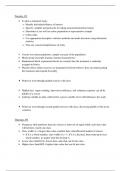
Tuesday, 9/3
➢ To plan a statistical study:
→ Identify individuals/objects of interest
→ Specify variables and protocols for taking measurements/observations
→ Determine if you will use entire population or representative sample
→ Collect data
→ Use appropriate descriptive statistics methods and make decisions using inferential
statistics
→ Note any concerns/implications of study
➢ Census uses entire population, sample uses part of the population
➢ Block-group of people sharing common characteristics
➢ Randomized block experiment-blocks are created, then the treatment is randomly
assigned to blocks
➢ Placebo effect-subject receives no treatment but falsely believes they are indeed getting
the treatment and respond favorably
Professor went through guided exercise with class
➢ Hidden bias, vague wording, interviewer influence, and voluntary response can all be
pitfalls of a survey
➢ Lurking variable-no data collected for a given variable, but it still influences the study
Professor went through second guided exercise with class, discussing pitfalls of the given
scenarios
Thursday, 9/5
➢ Frequency table partitions data into classes or intervals of equal width; each data value
will fall into exactly one class
➢ Class width: k = (largest data value-smallest data value)/Desired number of classes
→ If k is a whole number, class width is k + 1. If it is a decimal, then round up to next
whole number, no matter what the decimal is
➢ Lower class limit(LCL)-lowest data value that can fit into class
➢ Higher class limit(HCL)-highest data value that can fit into class
➢ To plan a statistical study:
→ Identify individuals/objects of interest
→ Specify variables and protocols for taking measurements/observations
→ Determine if you will use entire population or representative sample
→ Collect data
→ Use appropriate descriptive statistics methods and make decisions using inferential
statistics
→ Note any concerns/implications of study
➢ Census uses entire population, sample uses part of the population
➢ Block-group of people sharing common characteristics
➢ Randomized block experiment-blocks are created, then the treatment is randomly
assigned to blocks
➢ Placebo effect-subject receives no treatment but falsely believes they are indeed getting
the treatment and respond favorably
Professor went through guided exercise with class
➢ Hidden bias, vague wording, interviewer influence, and voluntary response can all be
pitfalls of a survey
➢ Lurking variable-no data collected for a given variable, but it still influences the study
Professor went through second guided exercise with class, discussing pitfalls of the given
scenarios
Thursday, 9/5
➢ Frequency table partitions data into classes or intervals of equal width; each data value
will fall into exactly one class
➢ Class width: k = (largest data value-smallest data value)/Desired number of classes
→ If k is a whole number, class width is k + 1. If it is a decimal, then round up to next
whole number, no matter what the decimal is
➢ Lower class limit(LCL)-lowest data value that can fit into class
➢ Higher class limit(HCL)-highest data value that can fit into class

