©THEBRIGHT EXAM SOLUTIONS
11/8/2024 12:08 PM
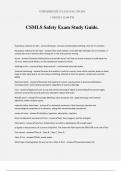
CSMLS Safety Exam Study Guide.
Hazardous material on skin - answer✔shower, remove contaminated clothing, rinse for 15 minutes
Hazardous material to the eyes - answer✔eye wash station, rinse with lids held open for 15 minutes, if
contact lens are in remove after rinsing for 1 min and continue rinsing
burns - answer✔remove clothing from around the burn ( not from on burn) immerse in cold water for
10 mins, never burst blister, no oily substances keep burn moist
clothing on fire - answer✔stop, drop and roll .. cool burned area with water
chemical poisoning - answer✔ensure the location is safe for rescue, move victim outside, place on back,
head to side, keep warm, do not induce vomitting, attempt to find out poison, contact pcc, provide
MSDS
Electrical shock - answer✔Ascertain that electrical current causing shock is disconnected before
touching victim, seek medical assistance regardless of external damage.
Cuts - answer✔Apply pressure to cut with sterile dressing( if object is protruding from wound apply
pressure around the wound and try to elevated it above the heart.
Needle sticks - answer✔Encourage bleeding, clean puncture site , apply dressing, seek medical
attention, make incident report
material safety data sheet - answer✔is a technical summary of the chemical, physical and
toicoxcological properties of a subtance, along with recommended procedures.
routes of entry - answer✔inhalation, ingestion, absorption, injection
three components necessary for fire - answer✔heat, fuel, oxygen ( aka fire triangle)
Flash point - answer✔minimum temperature at which a liquid gives off enough vapor
to ignite in the presence of a source of ignition. The lower the flash point the GREATER is the risk of fire
Fire classes - answer✔Class A , Class B , Class C, Class D
Class A Fire - answer✔Cloth, wood, paper
What type of extinguisher do you use for a Class A fire? - answer✔Pressurized water (A)
, ©THEBRIGHT EXAM SOLUTIONS
11/8/2024 12:08 PM
Dry Chemical (ABC)
Class B Fire - answer✔Flammable or combustible liquids
What type of extinguisher do you use for a Class B fire? - answer✔CO2 (BC)
Dry Chemical (ABC)
Class C Fire - answer✔Electrical equipment
What type of extinguisher do you use for a Class C fire? - answer✔CO2 (BC)
Dry Chemical (ABC)
Class D Fire - answer✔Combustible metals
What type of extinguisher do you use for a Class D fire? - answer✔Dry Chemical (D)
What class of fires do CO2 extinguishers work on? - answer✔Classes B and C
proper order of PPE - answer✔grown, mask, gloves
protective isoaltion - answer✔reverse isolation - protecting the patient from the worker
nosocomial infection - answer✔hospital -acquired infection or injury
formites - answer✔are in animate object capable of transmitting pathogens
droplet - answer✔Transmission via airborne droplets
PPE - answer✔Personal Protective Equipment i.e. gloves, mask, safety glasses and clinical attire
biological hazards - answer✔any materials that are dangerous to ones health any items contaminated by
blood or body fluids go in the container marked BIOHAZARD WASTE
Chemical hazards - answer✔chemicals that are flammable, caustic, poisonous and carcinogenic, include
cleaners, sanitizers, polishes machine lubricants, and toxic metals.
Physical hazards - answer✔CATEGORY OF HAZARDS THAT INCLUDE: NOISE, IONIZING RADIATION,
ELECTRICITY, INJURY TO THE BODY, FIRE, AND EXPLOSION
biohazard sharps - answer✔container, ALL needles with or without syringes should go into this
container, color coded yellow, labeled with bioharzard symbol, lids that can be tightly secured
balance centrifuge - answer✔same size tubes, volume, opposite one another, same stopper
Insidious hazards - answer✔aerosols, ionizing radiation, carcinogen/ mutagen clastogen
centrifuge - answer✔machine that works on the principal of gravity
11/8/2024 12:08 PM
CSMLS Safety Exam Study Guide.
Hazardous material on skin - answer✔shower, remove contaminated clothing, rinse for 15 minutes
Hazardous material to the eyes - answer✔eye wash station, rinse with lids held open for 15 minutes, if
contact lens are in remove after rinsing for 1 min and continue rinsing
burns - answer✔remove clothing from around the burn ( not from on burn) immerse in cold water for
10 mins, never burst blister, no oily substances keep burn moist
clothing on fire - answer✔stop, drop and roll .. cool burned area with water
chemical poisoning - answer✔ensure the location is safe for rescue, move victim outside, place on back,
head to side, keep warm, do not induce vomitting, attempt to find out poison, contact pcc, provide
MSDS
Electrical shock - answer✔Ascertain that electrical current causing shock is disconnected before
touching victim, seek medical assistance regardless of external damage.
Cuts - answer✔Apply pressure to cut with sterile dressing( if object is protruding from wound apply
pressure around the wound and try to elevated it above the heart.
Needle sticks - answer✔Encourage bleeding, clean puncture site , apply dressing, seek medical
attention, make incident report
material safety data sheet - answer✔is a technical summary of the chemical, physical and
toicoxcological properties of a subtance, along with recommended procedures.
routes of entry - answer✔inhalation, ingestion, absorption, injection
three components necessary for fire - answer✔heat, fuel, oxygen ( aka fire triangle)
Flash point - answer✔minimum temperature at which a liquid gives off enough vapor
to ignite in the presence of a source of ignition. The lower the flash point the GREATER is the risk of fire
Fire classes - answer✔Class A , Class B , Class C, Class D
Class A Fire - answer✔Cloth, wood, paper
What type of extinguisher do you use for a Class A fire? - answer✔Pressurized water (A)
, ©THEBRIGHT EXAM SOLUTIONS
11/8/2024 12:08 PM
Dry Chemical (ABC)
Class B Fire - answer✔Flammable or combustible liquids
What type of extinguisher do you use for a Class B fire? - answer✔CO2 (BC)
Dry Chemical (ABC)
Class C Fire - answer✔Electrical equipment
What type of extinguisher do you use for a Class C fire? - answer✔CO2 (BC)
Dry Chemical (ABC)
Class D Fire - answer✔Combustible metals
What type of extinguisher do you use for a Class D fire? - answer✔Dry Chemical (D)
What class of fires do CO2 extinguishers work on? - answer✔Classes B and C
proper order of PPE - answer✔grown, mask, gloves
protective isoaltion - answer✔reverse isolation - protecting the patient from the worker
nosocomial infection - answer✔hospital -acquired infection or injury
formites - answer✔are in animate object capable of transmitting pathogens
droplet - answer✔Transmission via airborne droplets
PPE - answer✔Personal Protective Equipment i.e. gloves, mask, safety glasses and clinical attire
biological hazards - answer✔any materials that are dangerous to ones health any items contaminated by
blood or body fluids go in the container marked BIOHAZARD WASTE
Chemical hazards - answer✔chemicals that are flammable, caustic, poisonous and carcinogenic, include
cleaners, sanitizers, polishes machine lubricants, and toxic metals.
Physical hazards - answer✔CATEGORY OF HAZARDS THAT INCLUDE: NOISE, IONIZING RADIATION,
ELECTRICITY, INJURY TO THE BODY, FIRE, AND EXPLOSION
biohazard sharps - answer✔container, ALL needles with or without syringes should go into this
container, color coded yellow, labeled with bioharzard symbol, lids that can be tightly secured
balance centrifuge - answer✔same size tubes, volume, opposite one another, same stopper
Insidious hazards - answer✔aerosols, ionizing radiation, carcinogen/ mutagen clastogen
centrifuge - answer✔machine that works on the principal of gravity