Biochemistry Test Hassan Alibhai
February 13th, 2017 Page B1
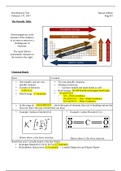
The Periodic Table
Electronegativity is the
measure of the tendency
of an atom to attract to a
bonding pair of
electrons.
The trend follows
nonmetallic character in
the trends to the right.
Chemical Bonds
Ionic Covalent
• One metallic and one non- • Two non-metallic elements
metallic element • Sharing of electrons
• Transfer of electrons ◦ Can have double and triple bonds as well
• Δ EN >1.6 • Bond Energy: 50-100 kcal/mol (strongest bond type)
• Bond Energy: 3-7 kcal/mol • 0< Δ EN <2.0
◦ Δ 0 → Pure Covalence
◦ 0< Δ EN < 0.5→ Non−Polar Covalence
◦ 0.5< Δ EN <2 → Polar Covalence
• In the range of 1.6<Δ EN <2.0 , check the types of elements that you’re bonding and use the
first rule: that’s the type of bond that you have.
• Example: Sodium Chloride (KI) • Example: Carbon Dioxide (CO2)
Shown above is the lewis structure. Shown above is the lewis structure.
Bonds that aren’t actually bonds: (Van Der Walls)
• Hydrogen Bonds (H-O, H-N, H-Fl) (3-7 kcal/mol)
• Hydrophobic Interactions (1-2 kcal/mol) → London Dispersion and Dipole Dipole
, Biochemistry Test Hassan Alibhai
February 13th, 2017 Page B2
Properties of Water
• Colourless, Tasteless, Odourless
• Inter-atom covalent bonding
• The negative oxygen really pulls the
electrons towards itself, resulting in
a net “partial negative charge”
• Hydrogen bonding occurs between
entire water molecules, at a
maximum of 4 molecules bonded to
a single other water molecule
• Intermolecular forces
◦ London-dispersion
◦ Dipole-Dipole
◦ Hydrogen Bonding
• Hydration Shell
◦ A shell of water molecules form around the ions of a dissolved
ionic compound, preventing the solute from re-bonding.
• Compounds in Water
◦ Nonpolar molecules that repel the water molecules are said to be
hydrophobic; molecules forming ionic or a hydrogen bond with
the water molecule are said to be hydrophilic.
◦ Miscible Liquids: will combine to form a solution with no external components
◦ Immiscible Liquids: will only be partial solutions or will not fully combine to be solutions.
• Water Facts
◦ 70-75% of Earth is covered by water
◦ 70-90% of all Living things are water
◦ 70% of both Humans and Elephants are water
• Water as a buffer controls the acid base balance in our blood, using hydrolysis and condensation
• Cohesion and Adhesion
◦ Cohesion is when water molecules are attracted to themselves
◦ Adhesion happens when water molecules are attracted to the molecules of other surfaces
◦ Cohesion and Adhesion both cause water molecules to move up the xylem ducts of a tree.
◦ Transpiration is the process by which moisture is carried through plants from roots to small
pores on the underside of leaves, where it changes to vapor and is released to the
atmosphere.
◦ Water striders trap air between the hair of their legs, creating enough surface tension (the
liquid is attracted to itself and the area decreases) to allow them to walk on water.
◦ Soap also lowers the surface tension on water.
• Water as the liquid of life: GRADUAL CHANGE
◦ High specific heat capacity (only ammonia is higher), meaning that despite a quick
temperature change in the environment, bodies of water change temperature slowly and this
is important for the survival of marine life.
◦ High specific latent heat of vaporization: heat needed to change the substance from a liquid
at its boiling point into vapour at the same temperature (for water, this is 100°C) →2258
◦ High specific latent heat of fusion: heat required to change 1 kg of water to ice without a
change in temperature (for water, the stable temperature is 0°C) →337
February 13th, 2017 Page B1
The Periodic Table
Electronegativity is the
measure of the tendency
of an atom to attract to a
bonding pair of
electrons.
The trend follows
nonmetallic character in
the trends to the right.
Chemical Bonds
Ionic Covalent
• One metallic and one non- • Two non-metallic elements
metallic element • Sharing of electrons
• Transfer of electrons ◦ Can have double and triple bonds as well
• Δ EN >1.6 • Bond Energy: 50-100 kcal/mol (strongest bond type)
• Bond Energy: 3-7 kcal/mol • 0< Δ EN <2.0
◦ Δ 0 → Pure Covalence
◦ 0< Δ EN < 0.5→ Non−Polar Covalence
◦ 0.5< Δ EN <2 → Polar Covalence
• In the range of 1.6<Δ EN <2.0 , check the types of elements that you’re bonding and use the
first rule: that’s the type of bond that you have.
• Example: Sodium Chloride (KI) • Example: Carbon Dioxide (CO2)
Shown above is the lewis structure. Shown above is the lewis structure.
Bonds that aren’t actually bonds: (Van Der Walls)
• Hydrogen Bonds (H-O, H-N, H-Fl) (3-7 kcal/mol)
• Hydrophobic Interactions (1-2 kcal/mol) → London Dispersion and Dipole Dipole
, Biochemistry Test Hassan Alibhai
February 13th, 2017 Page B2
Properties of Water
• Colourless, Tasteless, Odourless
• Inter-atom covalent bonding
• The negative oxygen really pulls the
electrons towards itself, resulting in
a net “partial negative charge”
• Hydrogen bonding occurs between
entire water molecules, at a
maximum of 4 molecules bonded to
a single other water molecule
• Intermolecular forces
◦ London-dispersion
◦ Dipole-Dipole
◦ Hydrogen Bonding
• Hydration Shell
◦ A shell of water molecules form around the ions of a dissolved
ionic compound, preventing the solute from re-bonding.
• Compounds in Water
◦ Nonpolar molecules that repel the water molecules are said to be
hydrophobic; molecules forming ionic or a hydrogen bond with
the water molecule are said to be hydrophilic.
◦ Miscible Liquids: will combine to form a solution with no external components
◦ Immiscible Liquids: will only be partial solutions or will not fully combine to be solutions.
• Water Facts
◦ 70-75% of Earth is covered by water
◦ 70-90% of all Living things are water
◦ 70% of both Humans and Elephants are water
• Water as a buffer controls the acid base balance in our blood, using hydrolysis and condensation
• Cohesion and Adhesion
◦ Cohesion is when water molecules are attracted to themselves
◦ Adhesion happens when water molecules are attracted to the molecules of other surfaces
◦ Cohesion and Adhesion both cause water molecules to move up the xylem ducts of a tree.
◦ Transpiration is the process by which moisture is carried through plants from roots to small
pores on the underside of leaves, where it changes to vapor and is released to the
atmosphere.
◦ Water striders trap air between the hair of their legs, creating enough surface tension (the
liquid is attracted to itself and the area decreases) to allow them to walk on water.
◦ Soap also lowers the surface tension on water.
• Water as the liquid of life: GRADUAL CHANGE
◦ High specific heat capacity (only ammonia is higher), meaning that despite a quick
temperature change in the environment, bodies of water change temperature slowly and this
is important for the survival of marine life.
◦ High specific latent heat of vaporization: heat needed to change the substance from a liquid
at its boiling point into vapour at the same temperature (for water, this is 100°C) →2258
◦ High specific latent heat of fusion: heat required to change 1 kg of water to ice without a
change in temperature (for water, the stable temperature is 0°C) →337