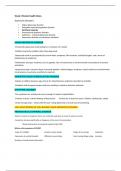
Week 3 Mental Health Notes
Depressive Disorders
• Major depressive disorder
• Disruptive mood dysregulation disorder
• Dysthymic disorder
• Premenstrual dysphoric disorder
• Substance – induced depressive disorder
• Depressive disorder not elsewhere classified
MAJOR DEPRESSIVE DISORDER
-Persistently depressed mood lasting for a minimum of 2 weeks.
-Children tend to be irritable rather than depressed.
-Depressed mood is accompanied by several other symptoms, like insomnia, suicidal thoughts, and a sense of
hopelessness & emptiness.
-Melancholic sub-type- Insomnia, loss of appetite, lack of reactiveness to environmental circumstances & marked
anhedonia.
-Atypical sub-type- excessive sleep, increased appetite, marked fatigue, weakness, mood reactive to environmental
circumstances, & extreme sensitivity to rejection.
DISRUPTIVE MOOD DYSREGULATION DISORDER
-Relates to children between ages of 6 & 18 -Mood between outbursts described as irritable.
-Situations with frequent temper tantrums resulting in verbal or behavior outbursts.
DYSTHYMIC DISORDER
-The symptoms are usually not severe enough to require hospitalization.
-Contains at least 3 clinical findings of depression. -Persists for at least two years- Children, adolescents, adults.
-Onset teenage years- “always felt this way” being depressed is normal way of functioning.
MAY HAVE PERIODS OF FULL-BLOWN MAJOR DEPRESSIVE EPISODES.
PREMENSTRUAL DYSPHORIC DISORDER
-Refers to cluster of symptoms that occur in the last week prior to onset of woman’s period.
-Symptoms decrease significantly or disappear w/the onset of menstruation.
+Physical discomfort & emotional symptoms like MDD.
What are the symptoms of PMDD?
-Anger & irritability. -Anxiety & panic attacks. Fatigue & low energy Headaches
-Depression & suicidal thoughts. -Difficulty concentrating. Food cravings/binge eating Insomnia
Symptoms include physical discomfort.
, emotional symptoms like major depression like emotional lability, persistent or severe anger and irritability, lack of energy,
overeating, and difficulty concentrating that are severe enough to interfere with the ability of a woman to work or interact with
others.
- it is in the luteal phase of the menstrual cycle.
Substance-Induced Mood (Depressive) Disorder
-Symptoms of major depressive disorder is characterized by marked mood changes from a person’s baseline mood associated
w/the persons exposure to substance or medication.
-Onset of symptoms occurs during or w/in 1 mon of a pt initiating use of a substance or medication.
-Depressing persisting past a drug w/drawl period is also considered substance-/medication-induced depressive disorder.
-Duration of symptoms depends on the drug, dose, half-life, & duration of use before onset of symptoms.
DEPRESSIVE DISORDER ASSOCIATED W/ANOTHER MEDICAL CONDITION
-Result of changes that are directly related to certain illnesses.
-Kidney failure; Parkinson’s disease; Alzheimer’s disease.
EPIDEMIOLOGY
-Depression is the leading cause of disability in the US. 1 in every 20 people in the US suffer from depression.
-6.7% Prevalence in Adults
-8.3% Prevalence in Children 12-17
-B/C symptoms vary by age & circumstance, depression in children, until recently, has been under-recognized.
-Infants can display symptoms of depression.
-If the 1st episode of depression occurs in childhood, the likelihood of recurrence is high.
-11.2% Prevalence of depression in children & adolescents 13-18
-3.3& have a severe form of the illness.
-Although depression in older adults is common, it is nota normal result of aging.
-Risk of depression in the elderly increases as health deteriorates.
-Older individuals suffering from depressing are at risk for being untreated, & this is especially true for minorities.
Many older adults suffer from sub-syndromal depression experience some symptoms of major depressive episodes, but they are
at risk of developing major depression.
Many are likely to die by suicide
COMORBIDITY
-A depressive syndrome frequently accompanies other psychiatric disorders.
Depressive Disorders
• Major depressive disorder
• Disruptive mood dysregulation disorder
• Dysthymic disorder
• Premenstrual dysphoric disorder
• Substance – induced depressive disorder
• Depressive disorder not elsewhere classified
MAJOR DEPRESSIVE DISORDER
-Persistently depressed mood lasting for a minimum of 2 weeks.
-Children tend to be irritable rather than depressed.
-Depressed mood is accompanied by several other symptoms, like insomnia, suicidal thoughts, and a sense of
hopelessness & emptiness.
-Melancholic sub-type- Insomnia, loss of appetite, lack of reactiveness to environmental circumstances & marked
anhedonia.
-Atypical sub-type- excessive sleep, increased appetite, marked fatigue, weakness, mood reactive to environmental
circumstances, & extreme sensitivity to rejection.
DISRUPTIVE MOOD DYSREGULATION DISORDER
-Relates to children between ages of 6 & 18 -Mood between outbursts described as irritable.
-Situations with frequent temper tantrums resulting in verbal or behavior outbursts.
DYSTHYMIC DISORDER
-The symptoms are usually not severe enough to require hospitalization.
-Contains at least 3 clinical findings of depression. -Persists for at least two years- Children, adolescents, adults.
-Onset teenage years- “always felt this way” being depressed is normal way of functioning.
MAY HAVE PERIODS OF FULL-BLOWN MAJOR DEPRESSIVE EPISODES.
PREMENSTRUAL DYSPHORIC DISORDER
-Refers to cluster of symptoms that occur in the last week prior to onset of woman’s period.
-Symptoms decrease significantly or disappear w/the onset of menstruation.
+Physical discomfort & emotional symptoms like MDD.
What are the symptoms of PMDD?
-Anger & irritability. -Anxiety & panic attacks. Fatigue & low energy Headaches
-Depression & suicidal thoughts. -Difficulty concentrating. Food cravings/binge eating Insomnia
Symptoms include physical discomfort.
, emotional symptoms like major depression like emotional lability, persistent or severe anger and irritability, lack of energy,
overeating, and difficulty concentrating that are severe enough to interfere with the ability of a woman to work or interact with
others.
- it is in the luteal phase of the menstrual cycle.
Substance-Induced Mood (Depressive) Disorder
-Symptoms of major depressive disorder is characterized by marked mood changes from a person’s baseline mood associated
w/the persons exposure to substance or medication.
-Onset of symptoms occurs during or w/in 1 mon of a pt initiating use of a substance or medication.
-Depressing persisting past a drug w/drawl period is also considered substance-/medication-induced depressive disorder.
-Duration of symptoms depends on the drug, dose, half-life, & duration of use before onset of symptoms.
DEPRESSIVE DISORDER ASSOCIATED W/ANOTHER MEDICAL CONDITION
-Result of changes that are directly related to certain illnesses.
-Kidney failure; Parkinson’s disease; Alzheimer’s disease.
EPIDEMIOLOGY
-Depression is the leading cause of disability in the US. 1 in every 20 people in the US suffer from depression.
-6.7% Prevalence in Adults
-8.3% Prevalence in Children 12-17
-B/C symptoms vary by age & circumstance, depression in children, until recently, has been under-recognized.
-Infants can display symptoms of depression.
-If the 1st episode of depression occurs in childhood, the likelihood of recurrence is high.
-11.2% Prevalence of depression in children & adolescents 13-18
-3.3& have a severe form of the illness.
-Although depression in older adults is common, it is nota normal result of aging.
-Risk of depression in the elderly increases as health deteriorates.
-Older individuals suffering from depressing are at risk for being untreated, & this is especially true for minorities.
Many older adults suffer from sub-syndromal depression experience some symptoms of major depressive episodes, but they are
at risk of developing major depression.
Many are likely to die by suicide
COMORBIDITY
-A depressive syndrome frequently accompanies other psychiatric disorders.