Chapter 1 Circuit Variables and Elements
1.1 Electric Current
Definition Current is the rate of flow of electric charge.
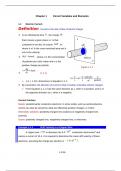
In an infinitesimal time dt , the charge dq
that crosses a given plane xx is that x
contained in the disc of volume Audt m3, udt u
where A m is the cross-sectional area and u
2
m/s is the velocity.
dq= Aunedt . , where n is the concentration
Area A
of particles per cubic meter and e is the x
positive charge per particle.
Figure 1.1.1
dq
i= = Aune
dt (1.1.1)
C m particles C
A= =m2 . . .
1 A 1 C/s; dimensions in Equation 1.1.1: s s m 3 particle ,
By convention: the direction of current is that of motion of positive electric charges.
From Equation 1.1.1 i has the same direction as u, when e is positive, and is of
the opposite direction as u, when e is negative.
Current Carriers
Metals: predominantly conduction electrons; in some solids, such as semiconductors,
current can also be carried by what are effectively positive charges, or ‘holes’.
Electrolytic solutions: positively charged ions (cations) or negatively charged ions
(anions).
Gases: positively charged ions, negatively charged ions, or electrons.
Example 1.1.1 Drift Velocity in a Copper Wire
28
A copper wire 2 mm in diameter has 8.4 ¿ 10 conduction electrons/m3 and
carries a current of 10 A. It is required to determine the mean drift velocity of these
−19
electrons, assuming the charge per electron is −1. 6×10 C.
1-1/16
, π π
A= d 2 = ( 2×10⁻³ )2=
Solution: The cross-sectional area A of the wire is: 4 4
−6 2
3 .14×10 m . Assuming that the current is positive and uniformly distributed across the
cross-section of the wire, it follows from Equation 1.1.1 that:
10
u= =
3 .14×10−6 ×8 . 4×1028 (−1 . 6×10⁻¹⁹ ) −2. 37×10−4 m/s. The negative sign of
velocity signifies that the electrons move in a direction opposite that of the current.
1.2 Voltage
Definition The voltage between two points is the difference in electric
potential energy per unit charge, between these points.
If +dq is moved from B to A (Figure 1.2.1), vdq <dw< ( v +dv ) dq , where dw is the
work done against the electric field. + v –
Neglecting second order infinitesimals: x
A B
dw
v=
dq (1.2.1) +q –q
x
If a charge of +1 coulomb is moved to a region whose voltage is
1 volt is higher, the increase in electric potential energy is 1 Figure 1.2.1
joule.
Voltage is measured with respect to some arbitrary zero reference, commonly taken
as that of the earth.
Ground symbol: Figure 1.2.2a;
symbol for voltage reference other than ground: Figure 1.2.2b. (a) (b)
Figure 1.2.2
1.3 Electric Power and Energy
Definition Power, p, is the rate at which energy, w, is delivered or absorbed: p =
dw/dt.
dw dw dq
p= = =vi
dt dq dt (1.3.1)
If i is in amperes and v is in volts, p is in watts (W), or joules/s.
1-2/16
, When the switch is closed, the battery –I I
impresses a voltage of 3 V across the
a a
metallic filament of the lamp, with +
+ electron
terminal a at a positive voltage with Battery Lamp
VB = 3 V flow
respect to terminal b. – –
The conduction electrons in the b b
filament have a higher electric
I
potential energy at b than at a.
Figure 1.3.1
The force of the electric field will
therefore drive them down an electric potential energy difference from b to a
through the filament. This loss of electric potential energy is converted to heat in
the filament, causing it to glow and emit light.
In the battery, the chemical reactions of the battery expend energy to move the
electrons up an electric potential energy difference from a to b.
P = VBI = (3 V)(0.25 A) = 0.75 W.
Example 1.3.1 Flashlight Circuit
If the current is 0.25 A in the circuit of Figure 1.3.1, how many electrons, on
average, pass through the lamp per second? What is the electric potential energy of an
electron at a relative to that at b? How much energy does the battery deliver in 1 hour?
Solution: A current of +0.25 A in the direction shown corresponds to an electron flow
−19
through the lamp of −0 .25 C/s. Since the charge of the electron is −1. 6×10 C, it
−19
−0. 25 C −1. 6×10 C
/ =15 . 6×10¹⁷
follows that s electron electrons/s flow through the lamp, on
average.
The electric potential energy difference is the charge times the voltage.
Considering the electric potential energy at b to be at zero reference, the electric
-19 -19
potential energy of an electron at a is: (−1.6×10 C)×(3 V)=−4 .8×10 J. Because it
is negatively charged, the electron has greater potential energy at b than at a.
Since P = 0.75 W, the energy delivered in one hour is (0 .75 W )×(3600 s/hr )=
1-3/16
1.1 Electric Current
Definition Current is the rate of flow of electric charge.
In an infinitesimal time dt , the charge dq
that crosses a given plane xx is that x
contained in the disc of volume Audt m3, udt u
where A m is the cross-sectional area and u
2
m/s is the velocity.
dq= Aunedt . , where n is the concentration
Area A
of particles per cubic meter and e is the x
positive charge per particle.
Figure 1.1.1
dq
i= = Aune
dt (1.1.1)
C m particles C
A= =m2 . . .
1 A 1 C/s; dimensions in Equation 1.1.1: s s m 3 particle ,
By convention: the direction of current is that of motion of positive electric charges.
From Equation 1.1.1 i has the same direction as u, when e is positive, and is of
the opposite direction as u, when e is negative.
Current Carriers
Metals: predominantly conduction electrons; in some solids, such as semiconductors,
current can also be carried by what are effectively positive charges, or ‘holes’.
Electrolytic solutions: positively charged ions (cations) or negatively charged ions
(anions).
Gases: positively charged ions, negatively charged ions, or electrons.
Example 1.1.1 Drift Velocity in a Copper Wire
28
A copper wire 2 mm in diameter has 8.4 ¿ 10 conduction electrons/m3 and
carries a current of 10 A. It is required to determine the mean drift velocity of these
−19
electrons, assuming the charge per electron is −1. 6×10 C.
1-1/16
, π π
A= d 2 = ( 2×10⁻³ )2=
Solution: The cross-sectional area A of the wire is: 4 4
−6 2
3 .14×10 m . Assuming that the current is positive and uniformly distributed across the
cross-section of the wire, it follows from Equation 1.1.1 that:
10
u= =
3 .14×10−6 ×8 . 4×1028 (−1 . 6×10⁻¹⁹ ) −2. 37×10−4 m/s. The negative sign of
velocity signifies that the electrons move in a direction opposite that of the current.
1.2 Voltage
Definition The voltage between two points is the difference in electric
potential energy per unit charge, between these points.
If +dq is moved from B to A (Figure 1.2.1), vdq <dw< ( v +dv ) dq , where dw is the
work done against the electric field. + v –
Neglecting second order infinitesimals: x
A B
dw
v=
dq (1.2.1) +q –q
x
If a charge of +1 coulomb is moved to a region whose voltage is
1 volt is higher, the increase in electric potential energy is 1 Figure 1.2.1
joule.
Voltage is measured with respect to some arbitrary zero reference, commonly taken
as that of the earth.
Ground symbol: Figure 1.2.2a;
symbol for voltage reference other than ground: Figure 1.2.2b. (a) (b)
Figure 1.2.2
1.3 Electric Power and Energy
Definition Power, p, is the rate at which energy, w, is delivered or absorbed: p =
dw/dt.
dw dw dq
p= = =vi
dt dq dt (1.3.1)
If i is in amperes and v is in volts, p is in watts (W), or joules/s.
1-2/16
, When the switch is closed, the battery –I I
impresses a voltage of 3 V across the
a a
metallic filament of the lamp, with +
+ electron
terminal a at a positive voltage with Battery Lamp
VB = 3 V flow
respect to terminal b. – –
The conduction electrons in the b b
filament have a higher electric
I
potential energy at b than at a.
Figure 1.3.1
The force of the electric field will
therefore drive them down an electric potential energy difference from b to a
through the filament. This loss of electric potential energy is converted to heat in
the filament, causing it to glow and emit light.
In the battery, the chemical reactions of the battery expend energy to move the
electrons up an electric potential energy difference from a to b.
P = VBI = (3 V)(0.25 A) = 0.75 W.
Example 1.3.1 Flashlight Circuit
If the current is 0.25 A in the circuit of Figure 1.3.1, how many electrons, on
average, pass through the lamp per second? What is the electric potential energy of an
electron at a relative to that at b? How much energy does the battery deliver in 1 hour?
Solution: A current of +0.25 A in the direction shown corresponds to an electron flow
−19
through the lamp of −0 .25 C/s. Since the charge of the electron is −1. 6×10 C, it
−19
−0. 25 C −1. 6×10 C
/ =15 . 6×10¹⁷
follows that s electron electrons/s flow through the lamp, on
average.
The electric potential energy difference is the charge times the voltage.
Considering the electric potential energy at b to be at zero reference, the electric
-19 -19
potential energy of an electron at a is: (−1.6×10 C)×(3 V)=−4 .8×10 J. Because it
is negatively charged, the electron has greater potential energy at b than at a.
Since P = 0.75 W, the energy delivered in one hour is (0 .75 W )×(3600 s/hr )=
1-3/16