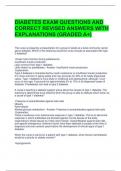
DIABETES EXAM QUESTIONS AND
CORRECT REVISED ANSWERS WITH
EXPLANATIONS (GRADED A+)
The nurse is preparing a presentation for a group of adults at a local community center
about diabetes. Which of the following would the nurse include as associated with type
2 diabetes?
Onset most common during adolescence
Insufficient insulin production
Less common than type 1 diabetes
Little relation to prediabetes - Answer- Insufficient insulin production
Explanation:
Type 2 diabetes is characterized by insulin resistance or insufficient insulin production.
It is more common in aging adults and now accounts for 20% of all newly diagnosed
cases. Type 1 diabetes is more likely in childhood and adolescence; although, it can
occur at any age. It accounts for approximately 5% to 10% of all diagnosed cases of
diabetes. Prediabetes can lead to type 2 diabetes.
A nurse is teaching a diabetic support group about the causes of type 1 diabetes. The
teaching is determined to be effective when the group is able to attribute which factor as
a cause of type 1 diabetes?
Presence of autoantibodies against islet cells
Obesity
Rare ketosis
Altered glucose metabolism - Answer- Presence of autoantibodies against islet cells
Explanation:
There is evidence of an autoimmune response in type 1 diabetes. This is an abnormal
response in which antibodies are directed against normal tissues of the body,
responding to these tissues as if they were foreign. Autoantibodies against islet cells
and against endogenous (internal) insulin have been detected in people at the time of
diagnosis and even several years before the development of clinical signs of type 1
diabetes.
When the nurse is caring for a patient with type 1 diabetes, what clinical manifestation
would be a priority to closely monitor?
Hypoglycemia
, Hyponatremia
Ketonuria
Polyphagia - Answer- Hypoglycemia
Explanation:
The therapeutic goal for diabetes management is to achieve normal blood glucose
levels (euglycemia) without hypoglycemia while maintaining a high quality of life.
A nurse is teaching a client with type 1 diabetes how to treat adverse reactions to
insulin. To reverse hypoglycemia, the client ideally should ingest an oral carbohydrate.
However, this treatment isn't always possible or safe. Therefore, the nurse should
advise the client to keep which alternate treatment on hand?
Epinephrine
Glucagon
50% dextrose
Hydrocortisone - Answer- Glucagon
Explanation:
During a hypoglycemic reaction, a layperson may administer glucagon, an
antihypoglycemic agent, to raise the blood glucose level quickly in a client who can't
ingest an oral carbohydrate. Epinephrine isn't a treatment for hypoglycemia. Although
50% dextrose is used to treat hypoglycemia, it must be administered I.V. by a skilled
health care professional. Hydrocortisone takes a relatively long time to raise the blood
glucose level and therefore isn't effective in reversing hypoglycemia.
A client with diabetes mellitus must learn how to self-administer insulin. The physician
has ordered 10 units of U-100 regular insulin and 35 units of U-100 isophane insulin
suspension (NPH) to be taken before breakfast. When teaching the client how to select
and rotate insulin injection sites, the nurse should provide which instruction?
"Inject insulin into healthy tissue with large blood vessels and nerves."
"Rotate injection sites within the same anatomic region, not among different regions."
"Administer insulin into areas of scar tissue or hypertrophy whenever possible."
"Administer insulin into sites above muscles that you plan to exercise heavily later that
day." - Answer- "Rotate injection sites within the same anatomic region, not among
different regions."
Explanation:
The nurse should instruct the client to rotate injection sites within the same anatomic
region. Rotating sites among different regions may cause excessive day-to-day
variations in the blood glucose level; also, insulin absorption differs from one region to
the next. Insulin should be injected only into healthy tissue lacking large blood vessels,
nerves, or scar tissue or other deviations. Injecting insulin into areas of hypertrophy may
delay absorption. The client shouldn't inject insulin into areas of lipodystrophy (such as
hypertrophy or atrophy); to prevent lipodystrophy, the client should rotate injection sites
systematically. Exercise speeds drug absorption, so the client shouldn't inject insulin
into sites above muscles that will be exercised heavily.
CORRECT REVISED ANSWERS WITH
EXPLANATIONS (GRADED A+)
The nurse is preparing a presentation for a group of adults at a local community center
about diabetes. Which of the following would the nurse include as associated with type
2 diabetes?
Onset most common during adolescence
Insufficient insulin production
Less common than type 1 diabetes
Little relation to prediabetes - Answer- Insufficient insulin production
Explanation:
Type 2 diabetes is characterized by insulin resistance or insufficient insulin production.
It is more common in aging adults and now accounts for 20% of all newly diagnosed
cases. Type 1 diabetes is more likely in childhood and adolescence; although, it can
occur at any age. It accounts for approximately 5% to 10% of all diagnosed cases of
diabetes. Prediabetes can lead to type 2 diabetes.
A nurse is teaching a diabetic support group about the causes of type 1 diabetes. The
teaching is determined to be effective when the group is able to attribute which factor as
a cause of type 1 diabetes?
Presence of autoantibodies against islet cells
Obesity
Rare ketosis
Altered glucose metabolism - Answer- Presence of autoantibodies against islet cells
Explanation:
There is evidence of an autoimmune response in type 1 diabetes. This is an abnormal
response in which antibodies are directed against normal tissues of the body,
responding to these tissues as if they were foreign. Autoantibodies against islet cells
and against endogenous (internal) insulin have been detected in people at the time of
diagnosis and even several years before the development of clinical signs of type 1
diabetes.
When the nurse is caring for a patient with type 1 diabetes, what clinical manifestation
would be a priority to closely monitor?
Hypoglycemia
, Hyponatremia
Ketonuria
Polyphagia - Answer- Hypoglycemia
Explanation:
The therapeutic goal for diabetes management is to achieve normal blood glucose
levels (euglycemia) without hypoglycemia while maintaining a high quality of life.
A nurse is teaching a client with type 1 diabetes how to treat adverse reactions to
insulin. To reverse hypoglycemia, the client ideally should ingest an oral carbohydrate.
However, this treatment isn't always possible or safe. Therefore, the nurse should
advise the client to keep which alternate treatment on hand?
Epinephrine
Glucagon
50% dextrose
Hydrocortisone - Answer- Glucagon
Explanation:
During a hypoglycemic reaction, a layperson may administer glucagon, an
antihypoglycemic agent, to raise the blood glucose level quickly in a client who can't
ingest an oral carbohydrate. Epinephrine isn't a treatment for hypoglycemia. Although
50% dextrose is used to treat hypoglycemia, it must be administered I.V. by a skilled
health care professional. Hydrocortisone takes a relatively long time to raise the blood
glucose level and therefore isn't effective in reversing hypoglycemia.
A client with diabetes mellitus must learn how to self-administer insulin. The physician
has ordered 10 units of U-100 regular insulin and 35 units of U-100 isophane insulin
suspension (NPH) to be taken before breakfast. When teaching the client how to select
and rotate insulin injection sites, the nurse should provide which instruction?
"Inject insulin into healthy tissue with large blood vessels and nerves."
"Rotate injection sites within the same anatomic region, not among different regions."
"Administer insulin into areas of scar tissue or hypertrophy whenever possible."
"Administer insulin into sites above muscles that you plan to exercise heavily later that
day." - Answer- "Rotate injection sites within the same anatomic region, not among
different regions."
Explanation:
The nurse should instruct the client to rotate injection sites within the same anatomic
region. Rotating sites among different regions may cause excessive day-to-day
variations in the blood glucose level; also, insulin absorption differs from one region to
the next. Insulin should be injected only into healthy tissue lacking large blood vessels,
nerves, or scar tissue or other deviations. Injecting insulin into areas of hypertrophy may
delay absorption. The client shouldn't inject insulin into areas of lipodystrophy (such as
hypertrophy or atrophy); to prevent lipodystrophy, the client should rotate injection sites
systematically. Exercise speeds drug absorption, so the client shouldn't inject insulin
into sites above muscles that will be exercised heavily.