QUIZRR 3
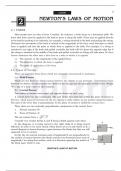
NEWTON’S LAWS OF MOTION
2
2 .1 FORCE
Most people have an idea of force. Consider, for instance, a book lying on a horizontal table. We
know that force must be applied to the book to move it along the table. Force may be applied directly
to the book by pushing it or indirectly, for example, a string attached to the book and pulling the string.
Obviously the movement of the book is related to the magnitude of the force used, direction in which
force is applied and also the point at which force is applied to the book. For example, if a string is
attached to one edge of the book and pulled vertically the book will tilt about the opposite edge but if
the string is attached to the middle of the book and pulled vertically no tilting will take place. So three
factors determine the effect that a force has on a body to which it is applied.
(a) The amount, or the magnitude of the applied force.
(b) The direction is which the force is applied.
(c) The point of application of the force.
2 .2 T y p e s o f Fo r c e s
There are basically three forces which are commonly encountered in mechanics.
(a ) Field Forces
These are the forces in which contact between two objects is not necessary. Gravitational force
between two bodies and electrostatic force between two charges are two examples of field forces. Weight
(W = mg) of a body comes in this category.
(b) Contact Forces
Two bodies in contact exert equal and opposite forces on each other.
A contact force has two components. The part of the force that lies within the plane of contact is
Friction, which must be overcome for the two objects to slide relative to one another along that plane.
The part of the force that is perpendicular to the plane of contact is called the normal force.
Thus, there are two mutually perpendicular components of the contact force :
1. Normal reaction (N)
2. Force of Friction (f)
The net contact force = N2 f 2
Consider two wooden blocks A and B being rubbed against each other.
A
In the diagram, A is being moved to the right while B is being moved
leftward. In order to see more clearly which forces act on A and which on B, a N F1
second diagram is drawn showing a space between the blocks but they are still
supposed to be in contact. f
In Fig. the two normal reactions each of magnitude N are perpendicular to f
the surface of contact between the blocks and the two frictional forces each of
F
magnitude f act along that surface, each in a direction opposing the motion of 2 N
the block upon which it acts. B
NEWTON’S LAWS OF MOTION
,4 QUIZRR
(c) Attachment to Another Body
Tension (T) in a string and spring force (F = kx) come in this group. Regarding the tension and
string, the following three points are important to remember.
1. If a string is inextensible the magnitude of
acceleration of any number of masses connected a a
through string is always same.
m m a
2. If a string is massless, the tension in it is same
everywhere. However, if a string has a mass, m a
tension at different points will be different. m
3. If there is friction between string and pulley, tension is different on two sides of the pulley, but
if there is no friction between pulley and string, tension will be same on both sides of the pulley.
Last two points can be understood in diagram as follows :
T1 T1 T1 T2
T T
m m m
T T2 T3
T T2 T4
m m m
Spring Force (F = kx) has been discussed in detail in the chapter of work, energy and power.
2 .3 FREE B ODY DI A GRA M
A free body diagram (FBD) consists of a diagrammatic representation of a
N
single body or a sub-system of bodies isolated from its surroundings showing
all the forces acting on it.
Consider, for example, a book lying on a horizontal surface.
A free body diagram of the book alone would consists of its weight W= mg
(W = mg), acting through the centre of gravity and the reaction (N) exerted on
the book by the surface.
Example : Draw the FBD in following cases :
rm
A B
1 2
Solution :
– N2 N1 –
2 1 2 2
A B
mg
NEWTON’S LAWS OF MOTION
, QUIZRR 5
Dumb Question
(1) Why is the normal acting like this ?
Ans. The direction of the normal force is always perpendicular to the surface of contact.
(2) Why is the tension direction like this ?
B
A
B
A
m
Ans. The direction of tension is always away from the point of contact.
TA A B TB
mg
Example : B is pulling A. If we need to draw FBD for both then ?
B T
A T
mg
mg
frictionless FBDfor A FBDfor B
2 .4 A L GEB RA I C FORCE RESOL U T I ON y
Given :
Four concurrent forces with the magnitudes and geometry shown. 20k 4 60k
3
Determine : 37°
x x
(a) the vertical and horizontal components of each of the forces
45° 30°
(b) the resultant algebraically
(c) the equilibrium 100k 50k
Solution : (a) First break each of the forces into its horizontal and y
vertical components, either by inspection or using the algebraic method.
The components can neatly be entered one by one into a chart similar to the one shown below.
Force Fx Fy
60 ă ă
50 ă ă
100 ă ă
20 ă ă
NEWTON’S LAWS OF MOTION
, 6 QUIZRR
The 20 k force is the most straightforward,, so enter its components into the chart first. Be careful
to enter the correct sign for each component or the overall result will be incorrect.
Force Fx Fy
60 ă ă
50 ă ă
100 ă ă
20 0 ă 20
4 3
The 60 k force can also be resolved by observation {as cos 37Ĉ =, sin 37Ĉ = } Fx = 4/5 (60 k)
5 5
= 48 k and Fy = 3/5 (60) = 36. Enter these numbers into the chart.
The last two forces are most efficiently resolved using the algebraic equations.
Force Fx Fy
60 48 36
50 ă ă
100 ă ă
20 0 ă 20
Fx = F cos
Fy = F sin
So, for the 50 k force, its components are
Fx = ă 50 k cos 30 = ă 50(.866) = ă 43.3k
Fy = 50k sin 30 = 50(.5) = 25k
and for the 100k force
Fx = ă 100 k cos 45 = ă 100(.707) = ă 70.7k
Fy = ă 100 k sin 45 = ă 100(.707) = ă 70.7k
Use these components to complete the chart.
Force Fx Fy
60 48 36
50 ă 43.3 25
100 ă 70.7 ă 70.7
20 0 ă 20
(b) The components of the resultant are equal to the sum of the columns of the completed chart.
Force Fx Fy
60 48 36
50 ă 43.3 25
100 ă 70.7 ă 70.7
20 0 ă 20
R ă 66.7 ă 29.7
The resultant is found using the Pythagorean Theorem :
= Fx2 Fy2
NEWTON’S LAWS OF MOTION
NEWTON’S LAWS OF MOTION
2
2 .1 FORCE
Most people have an idea of force. Consider, for instance, a book lying on a horizontal table. We
know that force must be applied to the book to move it along the table. Force may be applied directly
to the book by pushing it or indirectly, for example, a string attached to the book and pulling the string.
Obviously the movement of the book is related to the magnitude of the force used, direction in which
force is applied and also the point at which force is applied to the book. For example, if a string is
attached to one edge of the book and pulled vertically the book will tilt about the opposite edge but if
the string is attached to the middle of the book and pulled vertically no tilting will take place. So three
factors determine the effect that a force has on a body to which it is applied.
(a) The amount, or the magnitude of the applied force.
(b) The direction is which the force is applied.
(c) The point of application of the force.
2 .2 T y p e s o f Fo r c e s
There are basically three forces which are commonly encountered in mechanics.
(a ) Field Forces
These are the forces in which contact between two objects is not necessary. Gravitational force
between two bodies and electrostatic force between two charges are two examples of field forces. Weight
(W = mg) of a body comes in this category.
(b) Contact Forces
Two bodies in contact exert equal and opposite forces on each other.
A contact force has two components. The part of the force that lies within the plane of contact is
Friction, which must be overcome for the two objects to slide relative to one another along that plane.
The part of the force that is perpendicular to the plane of contact is called the normal force.
Thus, there are two mutually perpendicular components of the contact force :
1. Normal reaction (N)
2. Force of Friction (f)
The net contact force = N2 f 2
Consider two wooden blocks A and B being rubbed against each other.
A
In the diagram, A is being moved to the right while B is being moved
leftward. In order to see more clearly which forces act on A and which on B, a N F1
second diagram is drawn showing a space between the blocks but they are still
supposed to be in contact. f
In Fig. the two normal reactions each of magnitude N are perpendicular to f
the surface of contact between the blocks and the two frictional forces each of
F
magnitude f act along that surface, each in a direction opposing the motion of 2 N
the block upon which it acts. B
NEWTON’S LAWS OF MOTION
,4 QUIZRR
(c) Attachment to Another Body
Tension (T) in a string and spring force (F = kx) come in this group. Regarding the tension and
string, the following three points are important to remember.
1. If a string is inextensible the magnitude of
acceleration of any number of masses connected a a
through string is always same.
m m a
2. If a string is massless, the tension in it is same
everywhere. However, if a string has a mass, m a
tension at different points will be different. m
3. If there is friction between string and pulley, tension is different on two sides of the pulley, but
if there is no friction between pulley and string, tension will be same on both sides of the pulley.
Last two points can be understood in diagram as follows :
T1 T1 T1 T2
T T
m m m
T T2 T3
T T2 T4
m m m
Spring Force (F = kx) has been discussed in detail in the chapter of work, energy and power.
2 .3 FREE B ODY DI A GRA M
A free body diagram (FBD) consists of a diagrammatic representation of a
N
single body or a sub-system of bodies isolated from its surroundings showing
all the forces acting on it.
Consider, for example, a book lying on a horizontal surface.
A free body diagram of the book alone would consists of its weight W= mg
(W = mg), acting through the centre of gravity and the reaction (N) exerted on
the book by the surface.
Example : Draw the FBD in following cases :
rm
A B
1 2
Solution :
– N2 N1 –
2 1 2 2
A B
mg
NEWTON’S LAWS OF MOTION
, QUIZRR 5
Dumb Question
(1) Why is the normal acting like this ?
Ans. The direction of the normal force is always perpendicular to the surface of contact.
(2) Why is the tension direction like this ?
B
A
B
A
m
Ans. The direction of tension is always away from the point of contact.
TA A B TB
mg
Example : B is pulling A. If we need to draw FBD for both then ?
B T
A T
mg
mg
frictionless FBDfor A FBDfor B
2 .4 A L GEB RA I C FORCE RESOL U T I ON y
Given :
Four concurrent forces with the magnitudes and geometry shown. 20k 4 60k
3
Determine : 37°
x x
(a) the vertical and horizontal components of each of the forces
45° 30°
(b) the resultant algebraically
(c) the equilibrium 100k 50k
Solution : (a) First break each of the forces into its horizontal and y
vertical components, either by inspection or using the algebraic method.
The components can neatly be entered one by one into a chart similar to the one shown below.
Force Fx Fy
60 ă ă
50 ă ă
100 ă ă
20 ă ă
NEWTON’S LAWS OF MOTION
, 6 QUIZRR
The 20 k force is the most straightforward,, so enter its components into the chart first. Be careful
to enter the correct sign for each component or the overall result will be incorrect.
Force Fx Fy
60 ă ă
50 ă ă
100 ă ă
20 0 ă 20
4 3
The 60 k force can also be resolved by observation {as cos 37Ĉ =, sin 37Ĉ = } Fx = 4/5 (60 k)
5 5
= 48 k and Fy = 3/5 (60) = 36. Enter these numbers into the chart.
The last two forces are most efficiently resolved using the algebraic equations.
Force Fx Fy
60 48 36
50 ă ă
100 ă ă
20 0 ă 20
Fx = F cos
Fy = F sin
So, for the 50 k force, its components are
Fx = ă 50 k cos 30 = ă 50(.866) = ă 43.3k
Fy = 50k sin 30 = 50(.5) = 25k
and for the 100k force
Fx = ă 100 k cos 45 = ă 100(.707) = ă 70.7k
Fy = ă 100 k sin 45 = ă 100(.707) = ă 70.7k
Use these components to complete the chart.
Force Fx Fy
60 48 36
50 ă 43.3 25
100 ă 70.7 ă 70.7
20 0 ă 20
(b) The components of the resultant are equal to the sum of the columns of the completed chart.
Force Fx Fy
60 48 36
50 ă 43.3 25
100 ă 70.7 ă 70.7
20 0 ă 20
R ă 66.7 ă 29.7
The resultant is found using the Pythagorean Theorem :
= Fx2 Fy2
NEWTON’S LAWS OF MOTION