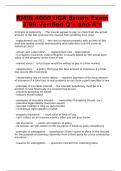
RMIN 4000 UGA Brown Exam
3|99 Verified Q’s and A’s
principle of indemnity - -The insurer agrees to pay no more than the actual
amount of the loss (prevent the insured from profiting from loss)
-replacement cost (RC) - -the cost to replace property with an item of like
kind and quality (similar workmanship and materials) (not the same as
historical cost!)
-actual cash value (ACV) - -- replacement cost - depreciation
- in property insurance, indemnification is usually based on the actual cash
value of the property at the time of loss
-market value - -price buyer would be willing to pay in a free market
-valued policy - -a policy that pays the face amount of insurance if a total
loss occurs (life insurance)
-valued policy law (in some states) - -requires payment of the face amount
of insurance if a total loss to real property occurs from a peril specified in law
-principle of insurable interest - -the insured/ beneficiary must be in a
position to lose financially if a covered loss occurs
- prevents gambling on losses
- reduces moral hazard
-examples of insurable interest - -- ownership of property (house, car)
- potential legal liability (business owner)
- secured creditors ( mtg co, auto lender)
- contractual right (goods in transit
-property insurance - -- must exist at time of loss
- can't collect on an insurance policy after you sell your home
-life insurance - -- exists at inception of policy
- ex-spouse can still collect on life insurance if listed as policy beneficiary
-principle of subrogation - -substitution of the insurer in place of the insured
for the purpose of claiming indemnity from a third party for a loss covered by
insurance
-reasons for subrogation - -- prevents insured from collecting twice
, - holds negligent party responsible for the loss
- reduces insurance claims costs (and therefore, rates)
-principle of utmost good faith - -A higher degree of honesty is imposed on
both parties to an insurance contract than is imposed on parties to other
contracts
- representations
- concealment
- warranty
-representations - -statements made by the applicant for insurance
- contract is voidable if the misrepresentation is: material, false, and relied
on by the insurer
-concealment - -intentional failure of the applicant for insurance to reveal a
material fact to the insurer
- contract can be voidable if: concealed fact was known by the insured to be
material and insured intended to defraud the insurer
-warranty - -- a statement that becomes part of the insurance contract and
is guaranteed by the maker to be true in all respects
- a condition agreed to by an insured in order to receive coverage
- violation of a warranty may result in a claim being denied
-bad faith - -law that allows lawsuits against insurance companies for:
- improper denial of claims
- improper delay of claims
bad fait damages can exceed policy limits and include:
- attorney's fees
- emotional distress
- punitive distress
-requirements of an insurance contract - -- offer and acceptance
- exchange of consideration
- competent parties
- legal purpose
-offer and acceptance - -- insured completes an application (the offer)
- insurance company issues a binder or policy (acceptance)
- the insurance company can also reject the offer
- conditional premium receipt
-conditional premium receipt - --receipt given to applicant for life insurance
-if policy is approved, coverage becomes effective as of the date of the
application
3|99 Verified Q’s and A’s
principle of indemnity - -The insurer agrees to pay no more than the actual
amount of the loss (prevent the insured from profiting from loss)
-replacement cost (RC) - -the cost to replace property with an item of like
kind and quality (similar workmanship and materials) (not the same as
historical cost!)
-actual cash value (ACV) - -- replacement cost - depreciation
- in property insurance, indemnification is usually based on the actual cash
value of the property at the time of loss
-market value - -price buyer would be willing to pay in a free market
-valued policy - -a policy that pays the face amount of insurance if a total
loss occurs (life insurance)
-valued policy law (in some states) - -requires payment of the face amount
of insurance if a total loss to real property occurs from a peril specified in law
-principle of insurable interest - -the insured/ beneficiary must be in a
position to lose financially if a covered loss occurs
- prevents gambling on losses
- reduces moral hazard
-examples of insurable interest - -- ownership of property (house, car)
- potential legal liability (business owner)
- secured creditors ( mtg co, auto lender)
- contractual right (goods in transit
-property insurance - -- must exist at time of loss
- can't collect on an insurance policy after you sell your home
-life insurance - -- exists at inception of policy
- ex-spouse can still collect on life insurance if listed as policy beneficiary
-principle of subrogation - -substitution of the insurer in place of the insured
for the purpose of claiming indemnity from a third party for a loss covered by
insurance
-reasons for subrogation - -- prevents insured from collecting twice
, - holds negligent party responsible for the loss
- reduces insurance claims costs (and therefore, rates)
-principle of utmost good faith - -A higher degree of honesty is imposed on
both parties to an insurance contract than is imposed on parties to other
contracts
- representations
- concealment
- warranty
-representations - -statements made by the applicant for insurance
- contract is voidable if the misrepresentation is: material, false, and relied
on by the insurer
-concealment - -intentional failure of the applicant for insurance to reveal a
material fact to the insurer
- contract can be voidable if: concealed fact was known by the insured to be
material and insured intended to defraud the insurer
-warranty - -- a statement that becomes part of the insurance contract and
is guaranteed by the maker to be true in all respects
- a condition agreed to by an insured in order to receive coverage
- violation of a warranty may result in a claim being denied
-bad faith - -law that allows lawsuits against insurance companies for:
- improper denial of claims
- improper delay of claims
bad fait damages can exceed policy limits and include:
- attorney's fees
- emotional distress
- punitive distress
-requirements of an insurance contract - -- offer and acceptance
- exchange of consideration
- competent parties
- legal purpose
-offer and acceptance - -- insured completes an application (the offer)
- insurance company issues a binder or policy (acceptance)
- the insurance company can also reject the offer
- conditional premium receipt
-conditional premium receipt - --receipt given to applicant for life insurance
-if policy is approved, coverage becomes effective as of the date of the
application