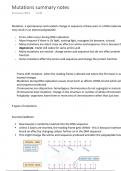
Mutations summary notes
20 January 2023 12:46
Mutation- a spontaneous and random change in sequence of base pairs in a DNA molecule
may result in an altered polypeptide
- Errors often occur during DNA replication
- More frequent if there is UV light, ionising light, mutagens (ie benzene, viruses)
- Many mutations are silent- have no effect on amino acid sequence- this is because D
degenerate- triplet still codes for same amino acid
- Many mutations are neutral- change amino acid sequence but do not affect protein
function
- Some mutations affect the amino acid sequence and change the protein function
Frame shift mutation- when the reading frame is altered and where the first base in ea
located changes
Mutations during DNA replication causes most harm as affects mRNA strand which wil
acid sequence produced
Chromosome non disjunction- homologous chromosomes do not segregate in meiosis
Chromosome level mutation- change in the structure or number of whole chromosome
Polyploidy- organisms have three or more sets of chromosomes rather than just two
6 types of mutations
Insertion/addition
• New base(s) is randomly inserted into the DNA sequence
• Unless 3 bases are inserted, the reading frame gets shifted - this is because insertion
knock on effect by changing codons further on in the DNA sequence
• This might change the amino acid sequence produced and alter the polypeptide func
20 January 2023 12:46
Mutation- a spontaneous and random change in sequence of base pairs in a DNA molecule
may result in an altered polypeptide
- Errors often occur during DNA replication
- More frequent if there is UV light, ionising light, mutagens (ie benzene, viruses)
- Many mutations are silent- have no effect on amino acid sequence- this is because D
degenerate- triplet still codes for same amino acid
- Many mutations are neutral- change amino acid sequence but do not affect protein
function
- Some mutations affect the amino acid sequence and change the protein function
Frame shift mutation- when the reading frame is altered and where the first base in ea
located changes
Mutations during DNA replication causes most harm as affects mRNA strand which wil
acid sequence produced
Chromosome non disjunction- homologous chromosomes do not segregate in meiosis
Chromosome level mutation- change in the structure or number of whole chromosome
Polyploidy- organisms have three or more sets of chromosomes rather than just two
6 types of mutations
Insertion/addition
• New base(s) is randomly inserted into the DNA sequence
• Unless 3 bases are inserted, the reading frame gets shifted - this is because insertion
knock on effect by changing codons further on in the DNA sequence
• This might change the amino acid sequence produced and alter the polypeptide func