,Fluid, Electrolyte, and Acid‐Base Balance
An Introduction to Fluid, Electrolyte, and Acid‐Base Balance
• Most of your body weight is water. Water makes up about 99 %of the volume
of the fluid outside cells, the extracellular fluid (ECF), and it is an essential
ingredient of the cytosol inside cells, the intracellular fluid (ICF).
• All of a cell’s operations rely on water as a diffusion medium for the distribution
of gases, nutrients, and wastes. If the water volume of the body changes,
cellular activities are jeopardized.
• Low water volume results in proteins denature, enzymes stop functioning, and
cells die.
27-1 Fluid balance, electrolyte balance, and acid‐base balance are interrelated
and essential to homeostasiS
• we must maintain a normal volume and composition of ECF and the ICF.
• The ionic concentrations and pH of these fluids are as important as their
absolute quantities.
• If a Ca and K+ ion concentration is too high in ECF => cardiac arrhythmias
develop and maybe death
• Low pH—acidity—is especially dangerous, because H+ ions break chemical
bonds, change the shapes of complex molecules, disrupt plasma membranes,
and impair tissue functions.
• Three interrelated processes stabilize the volumes, solute concentrations, and
pH of the ECF and the ICF: Fluid Balance, Electrolyte Balance, Acid-Base
Balance
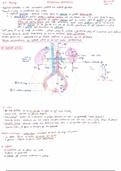
, Fluid Balance. Water balance
• fluid balance; amount of water gained each day = the amount lost to the
environment.
• Maintaining normal fluid balance involves regulating the content and
distribution of body water in the ECF and the ICF.
• The digestive system is the main source of water gains. While The urinary
system is the main route for water loss
• Metabolic activity generates a small amount of additional water.
Electrolyte Balance.
• Electrolytes are ions released when inorganic compounds dissociate.
• body fluids gain electrolytes from the food and drink consumed
• body fluids lose electrolytes in urine, sweat, and feces.
• For each ion, daily gains must balance daily losses. = electrolyte balance
• Electrolyte balance primarily involves balancing the rates of absorption across
Location the digestive tract with rates of loss by the kidneys, although losses at sweat
glands and other sites can play a secondary role.
Acid-Base Balance.
• You are in acid-base balance when the production of H+ ions in your body is
precisely offset by their loss.
• When acid-base balance exists, the pH of body fluids remains within normal
limits.
• Preventing a decrease in pH is the primary problem, because your body
generates a variety of acids during normal metabolic operations.
• The kidneys play a major role by secreting H+ ions into the urine and
generating buffers that enter the bloodstream. Such secretion takes place
primarily in the distal segments of the (DCT) and along the collecting system.
• The lungs also play a key role by eliminating carbon dioxide.
, 27-2 Extracellular fluid (ECF) and intracellular fluid (ICF) are fluid compartments
with differing solute concentrations that are closely regulated
Body Water
ICF> ECF
• In both sexes, the ICF contains a greater proportion of total body water than
does ECF.
• Water makes up about 60 %of the total body weight of an adult male, and 50
%of that of an adult female. This difference is mainly in the ICF. It reflects the
proportionately larger mass of adipose tissue in females, and the greater
average muscle mass in males.
• Adipose tissue is only 10 %water, whereas skeletal muscle is 75 %water.)
• Less striking differences occur in the ECF values, due to variations in the
interstitial fluid volume of various tissues and the larger blood volume in males
An Introduction to Fluid, Electrolyte, and Acid‐Base Balance
• Most of your body weight is water. Water makes up about 99 %of the volume
of the fluid outside cells, the extracellular fluid (ECF), and it is an essential
ingredient of the cytosol inside cells, the intracellular fluid (ICF).
• All of a cell’s operations rely on water as a diffusion medium for the distribution
of gases, nutrients, and wastes. If the water volume of the body changes,
cellular activities are jeopardized.
• Low water volume results in proteins denature, enzymes stop functioning, and
cells die.
27-1 Fluid balance, electrolyte balance, and acid‐base balance are interrelated
and essential to homeostasiS
• we must maintain a normal volume and composition of ECF and the ICF.
• The ionic concentrations and pH of these fluids are as important as their
absolute quantities.
• If a Ca and K+ ion concentration is too high in ECF => cardiac arrhythmias
develop and maybe death
• Low pH—acidity—is especially dangerous, because H+ ions break chemical
bonds, change the shapes of complex molecules, disrupt plasma membranes,
and impair tissue functions.
• Three interrelated processes stabilize the volumes, solute concentrations, and
pH of the ECF and the ICF: Fluid Balance, Electrolyte Balance, Acid-Base
Balance
, Fluid Balance. Water balance
• fluid balance; amount of water gained each day = the amount lost to the
environment.
• Maintaining normal fluid balance involves regulating the content and
distribution of body water in the ECF and the ICF.
• The digestive system is the main source of water gains. While The urinary
system is the main route for water loss
• Metabolic activity generates a small amount of additional water.
Electrolyte Balance.
• Electrolytes are ions released when inorganic compounds dissociate.
• body fluids gain electrolytes from the food and drink consumed
• body fluids lose electrolytes in urine, sweat, and feces.
• For each ion, daily gains must balance daily losses. = electrolyte balance
• Electrolyte balance primarily involves balancing the rates of absorption across
Location the digestive tract with rates of loss by the kidneys, although losses at sweat
glands and other sites can play a secondary role.
Acid-Base Balance.
• You are in acid-base balance when the production of H+ ions in your body is
precisely offset by their loss.
• When acid-base balance exists, the pH of body fluids remains within normal
limits.
• Preventing a decrease in pH is the primary problem, because your body
generates a variety of acids during normal metabolic operations.
• The kidneys play a major role by secreting H+ ions into the urine and
generating buffers that enter the bloodstream. Such secretion takes place
primarily in the distal segments of the (DCT) and along the collecting system.
• The lungs also play a key role by eliminating carbon dioxide.
, 27-2 Extracellular fluid (ECF) and intracellular fluid (ICF) are fluid compartments
with differing solute concentrations that are closely regulated
Body Water
ICF> ECF
• In both sexes, the ICF contains a greater proportion of total body water than
does ECF.
• Water makes up about 60 %of the total body weight of an adult male, and 50
%of that of an adult female. This difference is mainly in the ICF. It reflects the
proportionately larger mass of adipose tissue in females, and the greater
average muscle mass in males.
• Adipose tissue is only 10 %water, whereas skeletal muscle is 75 %water.)
• Less striking differences occur in the ECF values, due to variations in the
interstitial fluid volume of various tissues and the larger blood volume in males