ATI ADVANCED MED SURG PROCTORED EXAM
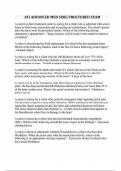
A nurse in a burn treatment center is caring for a client who is admitted with severe burns to both lower extremities and is pending an escharotomy. The client's spouse asks the nurse what the procedure entails. Which of the following nursing statements is appropriate? - "large incisions will be made in the eschar to improve circulation" A nurse is monitoring the fluid replacement of a client who has sustained burns Which of the following fluids is used in the first 24 hours following a burn injury? - lactated ringers A nurse is caring for a client who has full-thickness burns all over 75% of his body. Which of the following methods is appropriate to accurately monitor the cardiovascular svstem. - OotaIn a central venous Dressure A nurse is assessing the depth and extent of a client who has severe burns to the face, neck, and upper extremities. Which of the following factors is the first priority when assessing the severity of the burn? - Cause of the burn A client arrives at the emergency dept following an explosion at the chemical plant. He has deep partial and full-thickness chemical burns over more than 25 % of his body surface area. What is the nurse's priority intervention? - Maintain a patent airway A nurse is caring for a client who came the emergency dept reporting chest pain. The provider suspects a myocardial infarction. While waiting for the laboratory to report the client's troponin levels, the client asks what this blood test will show. The nurse should explain that troponin is - A heart muscle protein that appears in the bloodstream when there is damage to the heart A nurse is assessing a client who has disseminated intravascular coagulation (DIC). Which of the following should the nurse expect in the findings? - Increased clotting factors A nurse is about to administer warfarin (Coumadin) to a client who has atrial fibrillation. When the client asks what his medication will do, which of the tollowing is an appropriate nursing response? - It prevents strokes in clients who have atrial fibrillation A nurse in a cardiac care unit is caring for a client with acute heart failure. Which of the following findings should the nurse expect? - Elevated centra venous bressure rave A client comes into the ED reporting nausea and vomiting that worsens when lying down and without relief from antacids. The provider suspects acute pancreatitis. Which of the following lab test results should the nurse expect to see if the client has acute pancreatitis? - Increased serum amylase A nurse in the ICU is caring for a client who has acute respiratory distress syndrome (ARDS) and is receiving mechanical via an endotracheal tube. The provider plans to extubate her within the next 24 hour. Which of the following is an important criterion for extubating the client? - Adequate tidal volume without manually assisted breaths A nurse is caring for a client following a CT scan with dye who suffered from an anaphylactic reaction. Which of the following conditions requires a priority nursing response? - Strider A nurse is caring for a female client who came in to the ED reporting SOB and pain in the lung area. Her heart rate is 110/min, resp. rate 40/min, and blood pressure 140/80 m8juimHg. Her arterial blood gases are: pH 7.5, PaCO2 29 mmHg, Pa02 60 mm Hg, HCO3 20 mEq/L, and SaO2 86%. Which of the following is the priority intervention? - Administer oxygen via face mask A nurse is monitoring a client who has just had a thoracentesis to remove pleural fluid. Which of the following clinical manifestations indicate a complication that requires notifying the provider immediately? - Increased heart rate A group of college students was attending a weekend football rally when one of the students stumbled and fell into the bonfire. Although several friends quickly intervened, the client sustained partial-thickness burns to both lower legs, chest, and both forearms. Which of the following is priority nursing action when the client is brought to the ED? - inspect mouth for signs of inhalation A triage nurse in an emergency dept is caring for a client who has gunshot wound to the right side of chest. The nurse notices thick dressing on the chest and sucking noise coming from the wound. The client has a blood pressure of 100/60 mm Hg, a weak pulse rate of 118/min, and a respiratory rate of 40/min. Which of the following actions should the nurse take initially? - Administer oxygen via nasal cannula A nurse is suctioning the endotracheal tube of a client who is on a ventilator. The client's heart rate increases from 86/min to 110/min and becomes irregular. The nurse should know that the client requires which of the following? - Preoxygenation prior to suctioning The nurse is caring for a client who is receiving a blood transfusion. The transfusion started 30 minutes ago at a rate of 100 mL /hr. The client begins to complain of low back pain and headache and is increasingly restless. What is the first nursina action? - Stop the transfusion, disconnect the blood tubing, and begin a primary infusion of normal saline solution A client with a diagnosis of disseminated intravascular coagulation (DIC) has the following assessment findings: blood pressure of 76/56, temperature 102.6degrees, resp. 24 breath/min., with complaints of severe neck and back pain. Which nursina action should the nurse imnlement first? - Administer acetaminophen (Tylenol) PO. The nurse administering albuterol (Proventil) via a metered-dose inhaler (MDI) to a client who has a history of coronary artery disease is now in congestive heart failure. What side effects will be particularly important to observe for when the client takes the medication? - Tremors and central nervous system stimulation The nurse is assessing a client who is on a ventilator and has an endotracheal tube in place. What data confirms that the tube has migrated too far into the trachea? - Decreased breath sounds are heard over the left side of the chest What is the desired action of dopamine (Intropin) when administered in the treatment of shock? - a. It increases myocardial contractility The nurse is monitoring an IV infusion of sodium nitroprusside (Nirpride). Fifteen minutes after the infusion is started, the client's BP goes from 190/120 mm Hg to 120/90 mm Hg. What is the priority nursing action? - Decrease the infusion rate and recheck the blood pressure in 5 minutes Norepinephrine (Levophed) has been ordered for a client in hypovolemic shock. Before administering the drug, the nurse should make sure that the client has: - Been receiving adequate IV fluid replacement The client returns to his room after a thoracotomy. What will the nursing assessment reveal if hypovolemia from excessive blood loss is present? - CVP of 3 cm H20 and urine output of 20 mL/hr The nurse is performing an assessment and finds the client has cold, clammy skin, pulse of 130 beats/min and weak, blood pressure of 84/56 mm Hg, and urinary of 20 mL for the past hour. The nurse would interpret these findings as suggestive of which pathophysiology? - Decrease in the cardiac output and inadequate tissue perfusion The nurse applies a Nitro-Dur patch on a client who has undergone cardiac surgery. What nursing observation indicates that a Nitro-Dur patch is achieving the desired effect? - Client performs activities of daily living without chest pain The V/S of a client with Cardiac disease are as follows: BP 102/76 mm/hg, Pulse 52, RR 16. Atropine is administered IV push. What nursing assessment indicates a therapeutic response to the medication? - Pulse rate has increased to 70 beats/min An older adult client comes into ER stating that he has no appetite, is nauseated, his heart feels funny and has noticed a haziness in his vision. The client states that he has been taking an antihypertensive drug and digitalis for more than a year. Based on the presenting symptoms, what would be the priority nursing action? - Obtain an order for an EKG and serum potassium and digitalis levels the nurse is administering alteplase to a client who has been diagnosed with acute coronary syndrome. What are important nursing implications for this medication? - Place the client on bleeding precautions The nurse is caring for a client who underwent cardiac catheterization 1 hour ago. What is an important nursing measure at this time? - Maintain pressure over catheter insertion site and determine distal circulation status. The nurse in a cardiac stepdown unit has received a hand-off shift report for these clients. Which client should be assess first? - a client who has just returned from a coronary artierogram with placement of an intracoronary stent. What ECG changes would reflect myocardial ischemia in a client who has been admitted for observation after experiencing an episode of chest pain? - STSegment elevation or depression A new employee at a facility needs a hepatitis vaccine. Which statement reflects accurate understanding of the immunization? - I will receive 3 injections over a period of months, which should protect me from hep B While talking with a client with a diagnosis of end stage liver disease. The nurse notices the client is unable to stay awake and seems to fall asleep in the middle of a sentence. The nurse recognizes these symptoms to be indicative of what condition? - Increased blood ammonia levels The nurse is caring for a client with chronic hep B. What will the teaching plan for this client include? - use a condom for sexual intercourse A patient with massive trauma and possible spinal cord injury is admitted to the emergency department (ED). Which finding by the nurse will help confirm a diagnosis of neurogenic shock? - apical heart rate of 48 beats/min A patient with septic shock has a urine output of 20 mL/hr for the past 3 hours. The pulse rate is 120 and the central venous and pulmonary artery wedge pressure are 4. Which of these orders by the health care provider will the nurse question? - a. Give furosemide (Lasix 40 mg IV After receiving 1000 mL of normal saline, the central venous pressure for a patient who has septic shock is 10 mm Hg, but the blood pressure is still 82/40 mm Hg. The nurse will anticipate the administration of which of the following? - Norepinephrine (Levophed) Which of these findings is the best indicators that the fluid resuscitation for a natient with hunovolemic shock has heen success†ulf - Urine outbut is 60 m over the last hour Which interventions will the nurse include in the plan of the care for a patient who has cardiogenic shock? - Monitor breath sounds frequently Which assessment is most important for the nurse to make in order to evaluate whether treatment of a patient with anaphylactic shock has been effective? - Oxygen saturation When caring for the patient who has septic shock, which assessment finding is most important for the nurse to report to the health care provider? (TB ch.67 Q.17) - Skin cool and clammy During change-of-shift report, the nurse learns that a patient has been admitted with dehydration and hypotension after having vomiting and diarrhea for 3 days. Which findings is most important for the nurse to report to the HCP? - New onset of confusion and agitation A patient is admitted to the burn unit with burns the upper body and head after a garage fire. Initially, wheezes are heard, but an hour later, the lung sounds are decreased ad no wheezes are audible. What is the best action for the nurse to take? - Notify the HCP and prepare for endotracheal intubation During the emergent phase of burn care, which nursing action will be most useful in determining whether the patient is receiving adequate fluid infusion? - Measures hourly urine output After receiving change-of-shift report, which of these patients should the nurse assess first? - a.A patient with smoke inhalation who has wheezes and altered mental status The RN observes all of the following actions begin taken by a staff nurse who has floated to the unit. Which action requires that the RN intervene? - The nurse uses latex gloves when applying antibacterial cream to a burn wound A client with cervical neck fracture is admitted to the intensive care unit. Which findings would the nurse recognize as indicative of spinal shock? - Flaccidity and lack of sensation below the level of spinal cord lesion. 50) A client with T6 spinal cord injury is being discharged. The PT is concerned about autonomic dysreflexia. S/S include the following: - Diaphoresis above the level of the lesion
Escuela, estudio y materia
- Institución
- Keiser University
- Grado
- HSC 3057
Información del documento
- Subido en
- 30 de octubre de 2024
- Número de páginas
- 13
- Escrito en
- 2024/2025
- Tipo
- Examen
- Contiene
- Preguntas y respuestas
Temas
-
ati med surg
-
ati med surg proctored exam
-
ati advanced med surg proctored exam

Documento también disponible en un lote