Week 2 – International Marketing
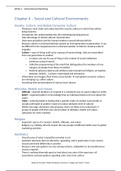
Chapter 4 – Social and Cultural Environments
Society, Culture, and Global Consumer Culture
- Marketers must study and understand the country cultures in which they will be
doing business
- Incorporate this understanding into the marketing planning process
- Take advantage of shared cultural characteristics
- Overcome prejudices and the human tendency toward ethnocentricity
- Because culture is a learned behavior passed on from generation to generation, it can
be difficult for the inexperienced or untrained outsider to fathom; develop cultural
empathy
- Culture = ways of living, built up by a group of human beings, that are transmitted
from one generation to another
o A culture acts out its way of living in the context of social institutions
(reinforce cultural norms)
o Collective programming of the mind that distinguishes the members of one
category of people from those of another
o Material (physical objects and artifacts) and nonmaterial (religion, perception,
attitudes, beliefs,…) culture: interrelated and interactive
- Information and imagery flow freely across border new global consumer cultures
are emerging e.g. coffee culture
- Increasing interconnectedness of various local cultures
Attitudes, Beliefs and Values
- Attitude = learned tendency to respond in a consistent way to a given object or entity
- Belief = organized pattern of knowledge that an individual holds to be true about the
world
- Value = enduring belief or feeling that a specific mode of conduct is personally or
socially preferable to another mode of conduct (deepest level of culture)
- Within any large, dominant cultural group, there are likely to be subcultures (=
groups of people with their own shred subset of attitudes, beliefs and values
(attractive for niche markets)
Religion
- Important source of a society’s beliefs, attitudes, and values
- Religion e.g. holidays directly impact the way people of different faiths react to global
marketing activities
Aesthetics
- Overall sense of what is beautiful and what is not
- Aesthetic elements that are attractive, appealing, and in good taste in one country
may be perceived differently in another
- Because color perceptions can vary among cultures, adaptation to local preferences
may be required
- There is nothing inherently good or bad about any color of the spectrum: all
associations and perceptions regarding color arise from culture
Based on the book ‘Global Marketing’ by Warren J. Keegan and Mark C. Green
Chapter 4 – Social and Cultural Environments
Society, Culture, and Global Consumer Culture
- Marketers must study and understand the country cultures in which they will be
doing business
- Incorporate this understanding into the marketing planning process
- Take advantage of shared cultural characteristics
- Overcome prejudices and the human tendency toward ethnocentricity
- Because culture is a learned behavior passed on from generation to generation, it can
be difficult for the inexperienced or untrained outsider to fathom; develop cultural
empathy
- Culture = ways of living, built up by a group of human beings, that are transmitted
from one generation to another
o A culture acts out its way of living in the context of social institutions
(reinforce cultural norms)
o Collective programming of the mind that distinguishes the members of one
category of people from those of another
o Material (physical objects and artifacts) and nonmaterial (religion, perception,
attitudes, beliefs,…) culture: interrelated and interactive
- Information and imagery flow freely across border new global consumer cultures
are emerging e.g. coffee culture
- Increasing interconnectedness of various local cultures
Attitudes, Beliefs and Values
- Attitude = learned tendency to respond in a consistent way to a given object or entity
- Belief = organized pattern of knowledge that an individual holds to be true about the
world
- Value = enduring belief or feeling that a specific mode of conduct is personally or
socially preferable to another mode of conduct (deepest level of culture)
- Within any large, dominant cultural group, there are likely to be subcultures (=
groups of people with their own shred subset of attitudes, beliefs and values
(attractive for niche markets)
Religion
- Important source of a society’s beliefs, attitudes, and values
- Religion e.g. holidays directly impact the way people of different faiths react to global
marketing activities
Aesthetics
- Overall sense of what is beautiful and what is not
- Aesthetic elements that are attractive, appealing, and in good taste in one country
may be perceived differently in another
- Because color perceptions can vary among cultures, adaptation to local preferences
may be required
- There is nothing inherently good or bad about any color of the spectrum: all
associations and perceptions regarding color arise from culture
Based on the book ‘Global Marketing’ by Warren J. Keegan and Mark C. Green