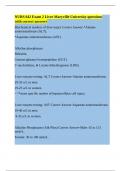
NURS 642 Exam 2 Liver Maryville University questions
with correct answers
Biochemical markers of liver injury Correct Answer-*Alanine
aminotransferase (ALT).
*Aspartate aminotransferase (AST).
Alkaline phosphatase.
Bilirubin.
Gamma-glutamyl transpeptidase (GGT).
5'-nucleotidase, & Lactate dehydrogenase (LDH).
Liver enzyme testing: ALT Correct Answer-Alanine aminotransferase.
29-33 u/L in men.
19-25 u/L in women.
~ **more specific marker of hepatocellular cell injury.
Liver enzyme testing: AST Correct Answer-Aspartate aminotransferase.
10-40 u/L in men.
9-32 u/L in women.
Alkaline Phosphatase (Alk Phos) Correct Answer-Male: 45 to 115
units/L.
Female: 30 to 100 units/L.
,Gamma-glutamyl transpeptidase (GGT) Correct Answer-Male: 8 to 61
units/L
Female: 5 to 36 units/L.
Markers of hepatocellular function Correct Answer-*Albumin
Bilirubin
Prothrombin time
Albumin Correct Answer-3.3 to 5.0 g/dL (33 to 50 g/L).
~Normal albumin suggests a more acute process, such as viral hepatitis.
~Low albumin suggests a chronic process, such as cirrhosis or cancer.
Bilirubin Correct Answer-~Serum bilirubin measures liver's ability to
detox metabolites and transport organic anions into bile.
~Bilirubin A "true" test of liver function.
~Total Bilirubin: 0.0 to 1.0 mg/dL (0 to 17 micromol/L).
~Direct Bilirubin: : 0.0 to 0.4 mg/dL (0 to 7 micromol/L). ~Bilirubin
>2.5-3.0 = Jaundice
Prothrombin time (PT) Correct Answer-11.0 to 13.7 seconds.
The failure of the prothrombin time to correct with parenteral
administration of vitamin K suggests severe hepatocellular injury.
, Hepatitis A (HAV) Correct Answer-~Transmitted (oral-fecal route).
~Labs: normal to low WBC's, markedly elevated Aminotransferases.
~Early S/Sx: asymptomatic. Anorexia, N/V, malaise, dislike to smoking.
~Other S/Sx: Fever, enlarged and tender liver, jaundice.
~Preventive measures include vaccination, proper hand hygiene, and
proper food handling, as well as disinfection of contaminated surfaces.
Hepatitis A serology testing Correct Answer-If IgM (-) but IgG (+) =
immune to HAV.
If IgM (+) but IgG (-) = Acutely infected with HAV.
Hepatitis B (HBV) Correct Answer-~Cause: exposure to infectious
blood, semen, and bodily fluids.
~High risk: IV drug abuse, HIV, unvaccinated, homosexual men,
immunocompromised.
~resolves in most; Acute HBV progresses to chronic infection in about
90% of infants infected at birth.
~Early S/Sx: Anorexia, N/V, malaise, dislike to smoking.
~Other S/Sx: Fever, enlarged and tender liver, jaundice.
~Labs: normal to low WBC's, markedly elevated Aminotransferases.
~Liver biopsy will show hepatocellular necrosis.
~Preventive measures include vaccination, protected sexual contact,
avoid contact w/ infected blood/fluids.
with correct answers
Biochemical markers of liver injury Correct Answer-*Alanine
aminotransferase (ALT).
*Aspartate aminotransferase (AST).
Alkaline phosphatase.
Bilirubin.
Gamma-glutamyl transpeptidase (GGT).
5'-nucleotidase, & Lactate dehydrogenase (LDH).
Liver enzyme testing: ALT Correct Answer-Alanine aminotransferase.
29-33 u/L in men.
19-25 u/L in women.
~ **more specific marker of hepatocellular cell injury.
Liver enzyme testing: AST Correct Answer-Aspartate aminotransferase.
10-40 u/L in men.
9-32 u/L in women.
Alkaline Phosphatase (Alk Phos) Correct Answer-Male: 45 to 115
units/L.
Female: 30 to 100 units/L.
,Gamma-glutamyl transpeptidase (GGT) Correct Answer-Male: 8 to 61
units/L
Female: 5 to 36 units/L.
Markers of hepatocellular function Correct Answer-*Albumin
Bilirubin
Prothrombin time
Albumin Correct Answer-3.3 to 5.0 g/dL (33 to 50 g/L).
~Normal albumin suggests a more acute process, such as viral hepatitis.
~Low albumin suggests a chronic process, such as cirrhosis or cancer.
Bilirubin Correct Answer-~Serum bilirubin measures liver's ability to
detox metabolites and transport organic anions into bile.
~Bilirubin A "true" test of liver function.
~Total Bilirubin: 0.0 to 1.0 mg/dL (0 to 17 micromol/L).
~Direct Bilirubin: : 0.0 to 0.4 mg/dL (0 to 7 micromol/L). ~Bilirubin
>2.5-3.0 = Jaundice
Prothrombin time (PT) Correct Answer-11.0 to 13.7 seconds.
The failure of the prothrombin time to correct with parenteral
administration of vitamin K suggests severe hepatocellular injury.
, Hepatitis A (HAV) Correct Answer-~Transmitted (oral-fecal route).
~Labs: normal to low WBC's, markedly elevated Aminotransferases.
~Early S/Sx: asymptomatic. Anorexia, N/V, malaise, dislike to smoking.
~Other S/Sx: Fever, enlarged and tender liver, jaundice.
~Preventive measures include vaccination, proper hand hygiene, and
proper food handling, as well as disinfection of contaminated surfaces.
Hepatitis A serology testing Correct Answer-If IgM (-) but IgG (+) =
immune to HAV.
If IgM (+) but IgG (-) = Acutely infected with HAV.
Hepatitis B (HBV) Correct Answer-~Cause: exposure to infectious
blood, semen, and bodily fluids.
~High risk: IV drug abuse, HIV, unvaccinated, homosexual men,
immunocompromised.
~resolves in most; Acute HBV progresses to chronic infection in about
90% of infants infected at birth.
~Early S/Sx: Anorexia, N/V, malaise, dislike to smoking.
~Other S/Sx: Fever, enlarged and tender liver, jaundice.
~Labs: normal to low WBC's, markedly elevated Aminotransferases.
~Liver biopsy will show hepatocellular necrosis.
~Preventive measures include vaccination, protected sexual contact,
avoid contact w/ infected blood/fluids.