Julia Jensen
February 12, 2022
Estefania Marin
EO1
Homework Assignment for Lab 3
Lab Notebook Questions:
1. What did you learn about accuracy and precision during the micropipetting part of this
lab exercise?
I learned that accuracy correlates to percent error and precision pertains to standard deviation.
Accuracy and precision depend on how skilled you are with the micropipette and it’s important
to use the tool as accurately as possible so the data will remain consistent, and the percent error
isn’t big.
2. In general, micropipettes are designed to function with accuracies less than 3% of the
intended value. Determine the % error for each of your aliquots with the P200 and the
P1000.
What may have caused you to have a percent error?
Percent error could've been caused by human error or extra water could've been drawn from the
tube, which would jeopardize the data.
3. Refer to your figures. Then, using the equation for the standard curve, estimate the
concentration of glucose in the blood sample from the patient. If you assume that the
patient was fasting when the sample was taken, what would be your diagnosis? If you
assume that the results were from a “random” blood sample, what would be your
diagnosis? Do this for class data.
If the patient was fasting when the sample was taken, then the glucose concentration would be
less. The diagnosis for the patient would be normal and stable. With a “random” blood sample, it
would show the increase of glucose concentration and that would indicate the patient is prone to
diabetes. Therefore, the overall diagnosis for the patient would be that their diabetic.
Discussion:
Percent error is the absolute value of the error subtracted and divided by the intended value and
multiplied by 100. While standard deviation measures the spread of distribution around the
mean. Accuracy and Percent error coincide with each other as precision does with standard
deviation. This can be supported by how accuracy is about measuring what one intends to
measure, while precision is about being able to reproduce the same measurements. According to
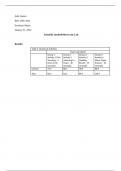
the class data, the P200 had a higher percent error and standard deviation (refer to Table 1 and
February 12, 2022
Estefania Marin
EO1
Homework Assignment for Lab 3
Lab Notebook Questions:
1. What did you learn about accuracy and precision during the micropipetting part of this
lab exercise?
I learned that accuracy correlates to percent error and precision pertains to standard deviation.
Accuracy and precision depend on how skilled you are with the micropipette and it’s important
to use the tool as accurately as possible so the data will remain consistent, and the percent error
isn’t big.
2. In general, micropipettes are designed to function with accuracies less than 3% of the
intended value. Determine the % error for each of your aliquots with the P200 and the
P1000.
What may have caused you to have a percent error?
Percent error could've been caused by human error or extra water could've been drawn from the
tube, which would jeopardize the data.
3. Refer to your figures. Then, using the equation for the standard curve, estimate the
concentration of glucose in the blood sample from the patient. If you assume that the
patient was fasting when the sample was taken, what would be your diagnosis? If you
assume that the results were from a “random” blood sample, what would be your
diagnosis? Do this for class data.
If the patient was fasting when the sample was taken, then the glucose concentration would be
less. The diagnosis for the patient would be normal and stable. With a “random” blood sample, it
would show the increase of glucose concentration and that would indicate the patient is prone to
diabetes. Therefore, the overall diagnosis for the patient would be that their diabetic.
Discussion:
Percent error is the absolute value of the error subtracted and divided by the intended value and
multiplied by 100. While standard deviation measures the spread of distribution around the
mean. Accuracy and Percent error coincide with each other as precision does with standard
deviation. This can be supported by how accuracy is about measuring what one intends to
measure, while precision is about being able to reproduce the same measurements. According to
the class data, the P200 had a higher percent error and standard deviation (refer to Table 1 and