ID&E Lecture 2 Cognitive Load Theory
11-09-19
Content
Historical roots
Properties
Research
Problem, challenges
Introductory remarks
• Studying cognitive load theory means also studying the history of cognitive load theory
You also study the history of every theory, where does it come from?
• This may hold for the study of any theory
• Criticism of a scientific theory is not always welcomed by the field
Additional and interesting background reading (easy reading) (if applicable, see slides)
CLT is everywhere (I am inevitable)
John Sweller (Polish-Australian jewish man) fled to Australia with his aunt.
Sweller: CLT is a theory that explains how the information processing load induced by learning tasks
can affect students’ ability to process new information and to construct knowledge in long-term
memory.
Note: the theory only applies to sufficiently complex material. If learning material is simple, there is
no cognitive load (and the theory does not apply).
What is sufficiently complex depends on what you find?!
When results do not show CLT, maybe the learning task is not complex enough.
Two fundaments
Memory limitations (Miller, the size limit of memory spam)
Problem solving process
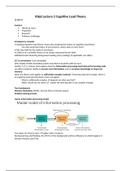
Classic information processing model
Two types of memory store higher order creatures
During learning and thinking, the LTM is in the background and has influence on what happens in
Sensory Memory and STM.
,Chess play remembering experiment
Chess grand master vs. average player (they know the chess pattern)
Max Euwe: perfect recall
Obvious memory limits
Obvious expert-novice difference
Another origin: problem solving (1982)
Goal-free effect starter of CLT
The goal-free effect refers to the finding that practicing by solving problems with a
nonspecific goal imposes a lower cognitive load and leads to better learning than practicing
by solving problems with a specific goal.
Sweller, Mawer, Howe (1982)
Task: transform one number into another
Two operations permitted: multiply by 3 or subtract 69
Finding: students were able to solve problems, but did not learn
the (obvious) underlying rule
There was a pattern in the solutions, but this rule was not learned by the students. Just
solving problems does not create that people learn (the rule).
Sweller and Levine (1982)
Task: maze-trace experiment
Knowledge of the goal made the problem insoluble
Preventing use of means-ends analysis (by not making clear where the goal is)
enhances learning, fewer mistakes
When you know where the goal is, it makes everything much more difficult.
Why? They used means-end-analysis, it prevented to solve the problem.
First presentation of a CL-theory: 1988
Cognitive load during problem solving: effects on learning (John Sweller)
Just problem solving does not lead to learning. This was a small version of the CLT.
Conclusions of the 1988 publication
1. Problem solving through means-ends analysis imposes a heavy cognitive load
a. While you are solving a difficult problem, you are occupied by the solving process
and can not store information in the LTM.
2. Distinct mechanisms for problem solving and schema acquisition
a. Schema acquisition: constructing knowledge in the LTM while using the information
from the STM and combing already stored information.
3. Implication from 1 and 2: conventional problem solving does not lead to schema acquisition
4. Implication from 3: Emphasis on problem solving limits development of expertise
5. Overall implication: assumption that problem solving is effective for learning needs
modification.
Effects of the 1988 publication
- Small. Some hostility (according to Sweller)
- Mostly ignored, except for… The Dutch! Picked up and extended by van Merriënboer and
Paas. The ideas of Sweller where used in this instructional design.
- Work on new model for instructional design (4C/ID). Background in cognitive psychology.
- New effects
- A measure for perceived cognitive load
- 1998, publication of the 4C/ID model.
, 1998: updated version of the theory
Based on research by Sweller and others
Introduces three types of cognitive load:
o Intrinsic, extraneous, germane
Cognitive load as the sum of three types of loadBucket:
Cognitive load as the sum of all three types of load
The experienced CL is the sum of these three CL.
Sweller now considers this to be wrong remove germane load
What determines each type of load?
Intrinsic CL:
- Based on complexity, expressed as ‘element interactivity’
o When is there a lot of element interactivity
o For some persons is a chessboard a new thing first has to be learned
- Combination of nature of information and available knowledge
Extraneous CL:
- Based on way of presenting information and instructional procedure
- Changing this should have a large influence on learning effect
o Used a lot in multimedia technology (a complete scheme or animation)
o Using other colors when presenting something
Germane CL:
- All resources available to deal with intrinsic load (i.e. understanding learning material)
o Trying to understand learning materials (is what you want)
o Actual learning, thinking on the material.
- Concept has conceptual and empirical problems
o The optimal load has never been specified
1988: seven effects of cognitive load
1. Goal-free effect
a. Opposite of means-end analysis: no problem based goal has to be achieved.
b. No goal state is provided, so they just solve what they can to know more.
c. Reduces cognitive load and provides precisely the combination of low load and focus
on solutions that is required for knowledge construction.
d. Replace conventional tasks with goal-free tasks that provide learners with a non-
specific goal.
2. Worked example effect
a. Reducing CL and facilitate knowledge construction.
b. Full problem solution. From solution steps to inducing generalized solutions
c. 3 types: product-oriented worked-out examples, process-oriented examples and
modelling examples (human model who is generating the solution).
d. Less effective for high-expertise learners
e. Should not require the learner to mentally integrate different sources of
information.
f. Replace conventional tasks with worked examples that provide learners with a
solution they must carefully study.
3. Completion problem effect (completion strategy)
a. Complement of the worked example
b. Replace conventional tasks with worked examples, goal state and a partial solution
that must be completed.
11-09-19
Content
Historical roots
Properties
Research
Problem, challenges
Introductory remarks
• Studying cognitive load theory means also studying the history of cognitive load theory
You also study the history of every theory, where does it come from?
• This may hold for the study of any theory
• Criticism of a scientific theory is not always welcomed by the field
Additional and interesting background reading (easy reading) (if applicable, see slides)
CLT is everywhere (I am inevitable)
John Sweller (Polish-Australian jewish man) fled to Australia with his aunt.
Sweller: CLT is a theory that explains how the information processing load induced by learning tasks
can affect students’ ability to process new information and to construct knowledge in long-term
memory.
Note: the theory only applies to sufficiently complex material. If learning material is simple, there is
no cognitive load (and the theory does not apply).
What is sufficiently complex depends on what you find?!
When results do not show CLT, maybe the learning task is not complex enough.
Two fundaments
Memory limitations (Miller, the size limit of memory spam)
Problem solving process
Classic information processing model
Two types of memory store higher order creatures
During learning and thinking, the LTM is in the background and has influence on what happens in
Sensory Memory and STM.
,Chess play remembering experiment
Chess grand master vs. average player (they know the chess pattern)
Max Euwe: perfect recall
Obvious memory limits
Obvious expert-novice difference
Another origin: problem solving (1982)
Goal-free effect starter of CLT
The goal-free effect refers to the finding that practicing by solving problems with a
nonspecific goal imposes a lower cognitive load and leads to better learning than practicing
by solving problems with a specific goal.
Sweller, Mawer, Howe (1982)
Task: transform one number into another
Two operations permitted: multiply by 3 or subtract 69
Finding: students were able to solve problems, but did not learn
the (obvious) underlying rule
There was a pattern in the solutions, but this rule was not learned by the students. Just
solving problems does not create that people learn (the rule).
Sweller and Levine (1982)
Task: maze-trace experiment
Knowledge of the goal made the problem insoluble
Preventing use of means-ends analysis (by not making clear where the goal is)
enhances learning, fewer mistakes
When you know where the goal is, it makes everything much more difficult.
Why? They used means-end-analysis, it prevented to solve the problem.
First presentation of a CL-theory: 1988
Cognitive load during problem solving: effects on learning (John Sweller)
Just problem solving does not lead to learning. This was a small version of the CLT.
Conclusions of the 1988 publication
1. Problem solving through means-ends analysis imposes a heavy cognitive load
a. While you are solving a difficult problem, you are occupied by the solving process
and can not store information in the LTM.
2. Distinct mechanisms for problem solving and schema acquisition
a. Schema acquisition: constructing knowledge in the LTM while using the information
from the STM and combing already stored information.
3. Implication from 1 and 2: conventional problem solving does not lead to schema acquisition
4. Implication from 3: Emphasis on problem solving limits development of expertise
5. Overall implication: assumption that problem solving is effective for learning needs
modification.
Effects of the 1988 publication
- Small. Some hostility (according to Sweller)
- Mostly ignored, except for… The Dutch! Picked up and extended by van Merriënboer and
Paas. The ideas of Sweller where used in this instructional design.
- Work on new model for instructional design (4C/ID). Background in cognitive psychology.
- New effects
- A measure for perceived cognitive load
- 1998, publication of the 4C/ID model.
, 1998: updated version of the theory
Based on research by Sweller and others
Introduces three types of cognitive load:
o Intrinsic, extraneous, germane
Cognitive load as the sum of three types of loadBucket:
Cognitive load as the sum of all three types of load
The experienced CL is the sum of these three CL.
Sweller now considers this to be wrong remove germane load
What determines each type of load?
Intrinsic CL:
- Based on complexity, expressed as ‘element interactivity’
o When is there a lot of element interactivity
o For some persons is a chessboard a new thing first has to be learned
- Combination of nature of information and available knowledge
Extraneous CL:
- Based on way of presenting information and instructional procedure
- Changing this should have a large influence on learning effect
o Used a lot in multimedia technology (a complete scheme or animation)
o Using other colors when presenting something
Germane CL:
- All resources available to deal with intrinsic load (i.e. understanding learning material)
o Trying to understand learning materials (is what you want)
o Actual learning, thinking on the material.
- Concept has conceptual and empirical problems
o The optimal load has never been specified
1988: seven effects of cognitive load
1. Goal-free effect
a. Opposite of means-end analysis: no problem based goal has to be achieved.
b. No goal state is provided, so they just solve what they can to know more.
c. Reduces cognitive load and provides precisely the combination of low load and focus
on solutions that is required for knowledge construction.
d. Replace conventional tasks with goal-free tasks that provide learners with a non-
specific goal.
2. Worked example effect
a. Reducing CL and facilitate knowledge construction.
b. Full problem solution. From solution steps to inducing generalized solutions
c. 3 types: product-oriented worked-out examples, process-oriented examples and
modelling examples (human model who is generating the solution).
d. Less effective for high-expertise learners
e. Should not require the learner to mentally integrate different sources of
information.
f. Replace conventional tasks with worked examples that provide learners with a
solution they must carefully study.
3. Completion problem effect (completion strategy)
a. Complement of the worked example
b. Replace conventional tasks with worked examples, goal state and a partial solution
that must be completed.