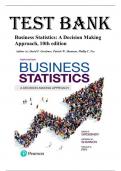
BUSINESS STATISTICS
A D ECISION -MAKING
R
A PPROACH
U
TENTH EDITION
E S
S
David F. Groebner
I
O
Boise State University
N
Patrick W. Shannon
N
Boise State University
O
Phillip C. Fry
C
Boise State University
E D
M
,Business Statistics, 10th (Groebner/Shannon/Fry) ALL CHAPTERS
Chapter 1: The Where, Why, and How of Data Collection
1) Statistics is a discipline that involves tools and techniques used to describe data and draw conclusions.
Answer: TRUE
Diff: 1
Keywords: descriptive statistics
Section: 1-1 What Is Business Statistics?
R
Outcome: none
U
2) In this course, the term business statistics refers to the set of tools and techniques that are used to
convert information into meaningful data.
E
Answer: FALSE
Diff: 1
S
Keywords: descriptive statistics and/or inferential statistics
Section: 1-1 What Is Business Statistics?
S
Outcome: none
I
3) Descriptive statistics allow a decision maker to reach a conclusion about a population based on a
O
subset from the population.
Answer: FALSE
Diff: 2
N
Keywords: descriptive statistics and/or inferential statistics
Section: 1-1 What Is Business Statistics?
N
Outcome: none
O
4) An accountant has recently prepared a report for a client that contains a variety of graphs and charts.
In doing so, she has used descriptive statistical methods.
Answer: TRUE
C
Diff: 1
Keywords: descriptive statistics
D
Section: 1-1 What Is Business Statistics?
Outcome: none
E
5) Descriptive statistical tools include graphs, charts, and numerical measures.
M
Answer: TRUE
Diff: 1
Keywords: descriptive statistics
Section: 1-1 What Is Business Statistics?
Outcome: none
6) A histogram is an example of a numerical measure.
Answer: FALSE
Diff: 1
Keywords: descriptive statistics
Section: 1-1 What Is Business Statistics?
Outcome: none
1-1
Copyright © 2018 Pearson Education, Inc.
,7) Companies frequently use charts and graphs in their regular communications with stockholders and
investors; this shows the use of descriptive statistics.
Answer: TRUE
Diff: 1
Keywords: descriptive statistics
Section: 1-1 What Is Business Statistics?
Outcome: none
R
8) A manufacturing manager has developed a table that shows the average production volume each day
for the past three weeks. The average production level is an example of a numerical measure.
U
Answer: TRUE
Diff: 1
E
Keywords: descriptive statistics
Section: 1-1 What Is Business Statistics?
Outcome: none
S
9) An accountant who recently examined 200 accounts from a company's total of 4,000 accounts in an
S
effort to estimate the percentage of all accounts that have incorrect journal entries is using descriptive
statistical analysis to reach the conclusion.
I
Answer: FALSE
O
Diff: 2
Keywords: descriptive statistics
N
Section: 1-1 What Is Business Statistics?
Outcome: none
N
10) The editor of a local newspaper is interested in determining the percentage of subscribers who read
the paper's editorials. The statistical technique that he would use is called estimation.
O
Answer: TRUE
Diff: 2
C
Keywords: descriptive statistics
Section: 1-1 What Is Business Statistics?
D
Outcome: none
11) Hypothesis testing and estimation are two statistical tools that are used to draw inferences about a
E
large data set based on a subset of the data.
Answer: TRUE
M
Diff: 1
Keywords: inferential statistics
Section: 1-1 What Is Business Statistics?
Outcome: none
12) Another term for the arithmetic average is the mean.
Answer: TRUE
Diff: 1
Keywords: descriptive statistics, mean
Section: 1-1 What Is Business Statistics?
Outcome: none
1-2
Copyright © 2018 Pearson Education, Inc.
, 13) Statistical inference would be used as the primary statistical tool by a quality control manager who
wishes to estimate the average weight of her company's products.
Answer: TRUE
Diff: 2
Keywords: inferential statistics
Section: 1-1 What Is Business Statistics?
Outcome: none
R
14) A light bulb manufacturer wants to advertise the average life of its light bulbs so it tests a subset of
light bulbs. This is an example of inferential statistics.
U
Answer: TRUE
Diff: 2
E
Keywords: inferential statistics
Section: 1-1 What Is Business Statistics?
Outcome: none
S
15) A sales manager has five salespeople. The following are the number of units sold by the five
S
salespeople during the past week: {5, 13, 6, 2, 4}. Based on the data, the mean number of units sold was 6
units.
I
Answer: TRUE
O
Diff: 2
Keywords: descriptive statistics, mean
N
Section: 1-1 What Is Business Statistics?
Outcome: none
N
16) Some of the most common methods of collecting data include experiments, telephone surveys, mail
questionnaires, direct observations, and personal interviews.
O
Answer: TRUE
Diff: 1
C
Keywords: data collection
Section: 1-2 Procedures for Collecting Data
D
Outcome: 1
17) An experiment is a process that generates data as its outcome.
E
Answer: TRUE
Diff: 1
M
Keywords: data collection
Section: 1-2 Procedures for Collecting Data
Outcome: 1
18) Experimental design is a plan for performing an experiment where the effects of one or more factors
on the variable of interest are measured.
Answer: TRUE
Diff: 2
Keywords: data collection, experiments
Section: 1-2 Procedures for Collecting Data
Outcome: 1
1-3
Copyright © 2018 Pearson Education, Inc.
A D ECISION -MAKING
R
A PPROACH
U
TENTH EDITION
E S
S
David F. Groebner
I
O
Boise State University
N
Patrick W. Shannon
N
Boise State University
O
Phillip C. Fry
C
Boise State University
E D
M
,Business Statistics, 10th (Groebner/Shannon/Fry) ALL CHAPTERS
Chapter 1: The Where, Why, and How of Data Collection
1) Statistics is a discipline that involves tools and techniques used to describe data and draw conclusions.
Answer: TRUE
Diff: 1
Keywords: descriptive statistics
Section: 1-1 What Is Business Statistics?
R
Outcome: none
U
2) In this course, the term business statistics refers to the set of tools and techniques that are used to
convert information into meaningful data.
E
Answer: FALSE
Diff: 1
S
Keywords: descriptive statistics and/or inferential statistics
Section: 1-1 What Is Business Statistics?
S
Outcome: none
I
3) Descriptive statistics allow a decision maker to reach a conclusion about a population based on a
O
subset from the population.
Answer: FALSE
Diff: 2
N
Keywords: descriptive statistics and/or inferential statistics
Section: 1-1 What Is Business Statistics?
N
Outcome: none
O
4) An accountant has recently prepared a report for a client that contains a variety of graphs and charts.
In doing so, she has used descriptive statistical methods.
Answer: TRUE
C
Diff: 1
Keywords: descriptive statistics
D
Section: 1-1 What Is Business Statistics?
Outcome: none
E
5) Descriptive statistical tools include graphs, charts, and numerical measures.
M
Answer: TRUE
Diff: 1
Keywords: descriptive statistics
Section: 1-1 What Is Business Statistics?
Outcome: none
6) A histogram is an example of a numerical measure.
Answer: FALSE
Diff: 1
Keywords: descriptive statistics
Section: 1-1 What Is Business Statistics?
Outcome: none
1-1
Copyright © 2018 Pearson Education, Inc.
,7) Companies frequently use charts and graphs in their regular communications with stockholders and
investors; this shows the use of descriptive statistics.
Answer: TRUE
Diff: 1
Keywords: descriptive statistics
Section: 1-1 What Is Business Statistics?
Outcome: none
R
8) A manufacturing manager has developed a table that shows the average production volume each day
for the past three weeks. The average production level is an example of a numerical measure.
U
Answer: TRUE
Diff: 1
E
Keywords: descriptive statistics
Section: 1-1 What Is Business Statistics?
Outcome: none
S
9) An accountant who recently examined 200 accounts from a company's total of 4,000 accounts in an
S
effort to estimate the percentage of all accounts that have incorrect journal entries is using descriptive
statistical analysis to reach the conclusion.
I
Answer: FALSE
O
Diff: 2
Keywords: descriptive statistics
N
Section: 1-1 What Is Business Statistics?
Outcome: none
N
10) The editor of a local newspaper is interested in determining the percentage of subscribers who read
the paper's editorials. The statistical technique that he would use is called estimation.
O
Answer: TRUE
Diff: 2
C
Keywords: descriptive statistics
Section: 1-1 What Is Business Statistics?
D
Outcome: none
11) Hypothesis testing and estimation are two statistical tools that are used to draw inferences about a
E
large data set based on a subset of the data.
Answer: TRUE
M
Diff: 1
Keywords: inferential statistics
Section: 1-1 What Is Business Statistics?
Outcome: none
12) Another term for the arithmetic average is the mean.
Answer: TRUE
Diff: 1
Keywords: descriptive statistics, mean
Section: 1-1 What Is Business Statistics?
Outcome: none
1-2
Copyright © 2018 Pearson Education, Inc.
, 13) Statistical inference would be used as the primary statistical tool by a quality control manager who
wishes to estimate the average weight of her company's products.
Answer: TRUE
Diff: 2
Keywords: inferential statistics
Section: 1-1 What Is Business Statistics?
Outcome: none
R
14) A light bulb manufacturer wants to advertise the average life of its light bulbs so it tests a subset of
light bulbs. This is an example of inferential statistics.
U
Answer: TRUE
Diff: 2
E
Keywords: inferential statistics
Section: 1-1 What Is Business Statistics?
Outcome: none
S
15) A sales manager has five salespeople. The following are the number of units sold by the five
S
salespeople during the past week: {5, 13, 6, 2, 4}. Based on the data, the mean number of units sold was 6
units.
I
Answer: TRUE
O
Diff: 2
Keywords: descriptive statistics, mean
N
Section: 1-1 What Is Business Statistics?
Outcome: none
N
16) Some of the most common methods of collecting data include experiments, telephone surveys, mail
questionnaires, direct observations, and personal interviews.
O
Answer: TRUE
Diff: 1
C
Keywords: data collection
Section: 1-2 Procedures for Collecting Data
D
Outcome: 1
17) An experiment is a process that generates data as its outcome.
E
Answer: TRUE
Diff: 1
M
Keywords: data collection
Section: 1-2 Procedures for Collecting Data
Outcome: 1
18) Experimental design is a plan for performing an experiment where the effects of one or more factors
on the variable of interest are measured.
Answer: TRUE
Diff: 2
Keywords: data collection, experiments
Section: 1-2 Procedures for Collecting Data
Outcome: 1
1-3
Copyright © 2018 Pearson Education, Inc.