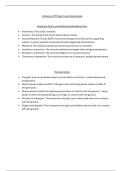
PSY101 Unit 1 Study Guide (Matthews)
Topic: Positive Psychology
Reading: The science of subjective well-being (Diener). Screencasts: Modules 1.2, 1.3, 1.4.
• Flow - being in the moment and doing what you are doing.
• Hedonic treadmill - the fact that we have boost on our happiness level but we have a
tendency to go back where we were. Example - you won a lottery, your happy and
have a billionaire feeling but after a while your newly minted happiness decreases
in the amount of happiness it brings to you..
• Adaptation - when good an dbad events occur, people often react strongly at first,
buy then their reactions adapt over time and they return to their former levels of
happiness. EXAMPLE - in marriage people are very excited at first but after year
they return to their original level of happiness. Marriage becomes a common place
and they return to their former level of happiness.
• Subjective well-being - The name the scientists give to happiness — thinking and
feeling that our lives are going very well.
• Life satisfaction - a person reflects on their life and judges to what degree it is going
well, by whatever standards that person thinks are most important for a good life.
Two type of feeling positive and negative. Positive = desirable and pleasant feeling,
moods and emotions such as enjoyment and love are examples. Negative =
undesirable and unpleasant feelings that people tend to avoid if they can. Mood and
emotions such as depression, anger, and worry are examples.
• Top-down (internal) causes of happiness - Inborn temperament , personality and
temperament, outlook, resilience - the process of recovering from stress and
recovering from trauma and adversity
• Bottom-up (external) causes of happiness - situational factors outside the person
that influences his or her subjective well being (happiness)sufficient material
resources people have enough money to fulfill their life, sufficient social resources
people have a significant other or family or friend to fulfill their happiness, desirable
society - society also fulfills happiness, high level of trust and war free, hunger less
society etc.
• What are some intentional activities that have been shown through research to
increase happiness?
• Based on the reading and in-class video clips, what is the relationship between
money and happiness?
, Topic: Research methods Readings: Why Science? (Diener) and
Research designs (Scollon). Screencasts: Modules 1.2, 1.3, 1.4, 1.5.
• Skepticism- doubting and not taking something true just because someone told you
its true
• Objectivity - Removing as much bias as possible even tho you can not fully remove it
100%. You ca at least beware if the biases you can remove.
• Empirical methods - actual research based support or approaches to inquiry that
are tied to actual measurement and observation
• Data - sets of numbers or pieces of information obtained during research studies
• Replication - Replication is the word for repeating a research study to see if the
main conclusions of the original study can be applied to various participants and
settings, usually with different situations and different subjects
• Why are the scientific attitude and scientific method important?
= They are important because they reduce the biases in an experiments.
• Theory - groups of closely related phenomena or a broad idea, explains
observations, predicts observations (use the theory to form a hypothesis)
• Hypothesis - specific prediction, empirically testable, derived from theory
( educated guess or a prediction which leads you to design a study to test) or a
logical idea that can be tested
• Variable - any quality or condition that can have different categories, level, values
(any thing that has )
• Operational definition - very specific/ how a variable is measured in a particular
study (clarify/quantify)
• Population - everyone in the group of interest for the research
• Sample - group of people who the experimenter studies or the group that takes part
in the experiments or investigation
• W.E.I.R.D. sample - western, educated, industrialize, rich, democratic nations
• Which is more specific: Theory or hypothesis? Variable or operational
definition? Population or sample?
• Can one variable (such as “level of sadness”) be operationally defined in more
than one way? Explain.
• When hearing about a scientific study, why do you need to know its operational
definitions?
Topic: Positive Psychology
Reading: The science of subjective well-being (Diener). Screencasts: Modules 1.2, 1.3, 1.4.
• Flow - being in the moment and doing what you are doing.
• Hedonic treadmill - the fact that we have boost on our happiness level but we have a
tendency to go back where we were. Example - you won a lottery, your happy and
have a billionaire feeling but after a while your newly minted happiness decreases
in the amount of happiness it brings to you..
• Adaptation - when good an dbad events occur, people often react strongly at first,
buy then their reactions adapt over time and they return to their former levels of
happiness. EXAMPLE - in marriage people are very excited at first but after year
they return to their original level of happiness. Marriage becomes a common place
and they return to their former level of happiness.
• Subjective well-being - The name the scientists give to happiness — thinking and
feeling that our lives are going very well.
• Life satisfaction - a person reflects on their life and judges to what degree it is going
well, by whatever standards that person thinks are most important for a good life.
Two type of feeling positive and negative. Positive = desirable and pleasant feeling,
moods and emotions such as enjoyment and love are examples. Negative =
undesirable and unpleasant feelings that people tend to avoid if they can. Mood and
emotions such as depression, anger, and worry are examples.
• Top-down (internal) causes of happiness - Inborn temperament , personality and
temperament, outlook, resilience - the process of recovering from stress and
recovering from trauma and adversity
• Bottom-up (external) causes of happiness - situational factors outside the person
that influences his or her subjective well being (happiness)sufficient material
resources people have enough money to fulfill their life, sufficient social resources
people have a significant other or family or friend to fulfill their happiness, desirable
society - society also fulfills happiness, high level of trust and war free, hunger less
society etc.
• What are some intentional activities that have been shown through research to
increase happiness?
• Based on the reading and in-class video clips, what is the relationship between
money and happiness?
, Topic: Research methods Readings: Why Science? (Diener) and
Research designs (Scollon). Screencasts: Modules 1.2, 1.3, 1.4, 1.5.
• Skepticism- doubting and not taking something true just because someone told you
its true
• Objectivity - Removing as much bias as possible even tho you can not fully remove it
100%. You ca at least beware if the biases you can remove.
• Empirical methods - actual research based support or approaches to inquiry that
are tied to actual measurement and observation
• Data - sets of numbers or pieces of information obtained during research studies
• Replication - Replication is the word for repeating a research study to see if the
main conclusions of the original study can be applied to various participants and
settings, usually with different situations and different subjects
• Why are the scientific attitude and scientific method important?
= They are important because they reduce the biases in an experiments.
• Theory - groups of closely related phenomena or a broad idea, explains
observations, predicts observations (use the theory to form a hypothesis)
• Hypothesis - specific prediction, empirically testable, derived from theory
( educated guess or a prediction which leads you to design a study to test) or a
logical idea that can be tested
• Variable - any quality or condition that can have different categories, level, values
(any thing that has )
• Operational definition - very specific/ how a variable is measured in a particular
study (clarify/quantify)
• Population - everyone in the group of interest for the research
• Sample - group of people who the experimenter studies or the group that takes part
in the experiments or investigation
• W.E.I.R.D. sample - western, educated, industrialize, rich, democratic nations
• Which is more specific: Theory or hypothesis? Variable or operational
definition? Population or sample?
• Can one variable (such as “level of sadness”) be operationally defined in more
than one way? Explain.
• When hearing about a scientific study, why do you need to know its operational
definitions?