APCSP DATA AND INFORMATION
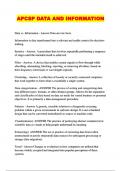
Data vs. Information - Answer Data are raw facts.
Information is data transformed into a relevant and usable context for decision-
making.
Iterative - Answer. A procedure that involves repeatedly performing a sequence
of stages until the intended result is achieved.
Filter - Answer. A device that enables certain signals to flow through while
absorbing, attenuating, blocking, rejecting, or removing all others, based on
their frequency (electrical) or wavelength (optical).
Clustering - Answer A collection of loosely or securely connected computers
that work together to form what is essentially a single system.
Data categorization - ANSWER The process of sorting and categorizing data
into different types, formats, or other distinct groups. Allows for the separation
and classification of data based on data set needs for varied business or personal
objectives. It is primarily a data-management procedure.
Patterns - Answer A generic, reusable solution to a frequently occurring
problem within a given environment in software design. It is not a finished
design that can be converted immediately to source or machine code.
Visualization(s): ANSWER The practice of portraying abstract commercial or
scientific data as visuals to help people understand its meaning.
Extract(ing): ANSWER The act or practice of extracting data from (often
unstructured or poorly structured) data sources for subsequent processing or
storage (data migration).
Trend - Answer Changes or evolutions in how computers are utilized that
become widely accepted and integrated into popular perceptions of these
systems.
Data vs. Information - Answer Data are raw facts.
Information is data transformed into a relevant and usable context for decision-
making.
Iterative - Answer. A procedure that involves repeatedly performing a sequence
of stages until the intended result is achieved.
Filter - Answer. A device that enables certain signals to flow through while
absorbing, attenuating, blocking, rejecting, or removing all others, based on
their frequency (electrical) or wavelength (optical).
Clustering - Answer A collection of loosely or securely connected computers
that work together to form what is essentially a single system.
Data categorization - ANSWER The process of sorting and categorizing data
into different types, formats, or other distinct groups. Allows for the separation
and classification of data based on data set needs for varied business or personal
objectives. It is primarily a data-management procedure.
Patterns - Answer A generic, reusable solution to a frequently occurring
problem within a given environment in software design. It is not a finished
design that can be converted immediately to source or machine code.
Visualization(s): ANSWER The practice of portraying abstract commercial or
scientific data as visuals to help people understand its meaning.
Extract(ing): ANSWER The act or practice of extracting data from (often
unstructured or poorly structured) data sources for subsequent processing or
storage (data migration).
Trend - Answer Changes or evolutions in how computers are utilized that
become widely accepted and integrated into popular perceptions of these
systems.