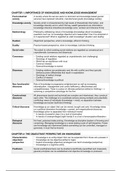
CHAPTER 1: IMPORTANCE OF KNOWLEDGE AND KNOWLEDGE MANAGEMENT
Post-industrial A society where the service sector is dominant and knowledge-based goods/
society services have replaced industrial, manufactured goods (knowledge society)
Knowledge society Society which is characterized by high levels of (theoretical) information- and
knowledge intensity and in which the key wealth generators are information/
knowledge intensive industries (knowledge work, workers and intensive firms)
Epistemology Philosophy addressing nature of knowledge (knowledge about knowledge),
questions such as: Is knowledge objective and measurable? Can it be acquired or
is it experienced? What is regarded as valid knowledge? (dualism and duality)
Dualism Objectivist perspective, what is knowledge, either/or thinking
Duality Practice-based perspective, when is knowledge, both/and thinking
Social order The extent to which existing social relations are regarded as consensual and
unproblematic (consensus and dissensus)
Consensus - Existing social relations regarded as unproblematic (not challenging)
- Sociology of regulation
- World has an equilibrium with trust
- Common interest
- Science/knowledge is neutral
Dissensus - Existing relations are problematic and rife with conflict and they typically
reinforce power differentials that result in exploitation
- Sociology of radical change
- Conflict of interest
- Science/knowledge is political
Neo-functionalist Role of knowledge is progressive enlightenment as well as increasing
discourse rationalization, management and control (efficiency, effectiveness and
competitiveness). There is a place of ultimate perfection (either/or thinking) —>
achieving a competitive advantage for the firm
Constructivist All phenomena (social and technical) are complex and intertwined, they construct
discourse each other. The challenge is to coordinate actions among multiple and potentially
conflicting views of individuals (knowledge = mind), no separation between
knowledge and action (both/and thinking)
Critical discourse Knowledge as an object that can be owned, bought and sold. Knowledge takes
on a political dimension (knowledge = power), anti-organizational discourse.
Knowledge action is separated from individual knower
- In hands of powerful class it is a tool of domination
- In hands of underprivileged (right hands) it is a tool of emancipation/liberation
Dialogical No fixed, polarized sides picking. Knowledge as discipline (system of knowing and
discourse correcting). Managing knowledge is a never-ending cycle of self-discipline. Power
and knowledge are intertwined (before something can be controlled, managed or
governed, it must first be known)
CHAPTER 2: THE OBJECTIVIST PERSPECTIVE ON KNOWLEDGE
Characteristics - Knowledge is an entity/object that can be separated from those who possess it
objectivist - Knowledge can be objective (either/or logic)
perspective - Explicit knowledge (objective) privileged over tacit knowledge (subjective)
- Knowledge is a cognitive entity
Positivism Social world/phenomena can be studied scientifically (quantified and measured),
general principles can be established and objective knowledge is produced
, Tacit knowledge Inexpressible in a codifiable form, subjective, personal, informal, context-specific
and difficult to share (embedded within cultural values and assumptions)
Explicit knowledge Codifiable, objective, impersonal, context-independent and easy to share
Knowledge-based 1. Knowledge that is difficult to replicate and copy is a source of competitive
theory of the firm advantage (firm-specific knowledge)
2. Organizations provide more effective mechanism for sharing and integration of
knowledge between people than markets do
Discourses and Neo-functionalist discourse: ‘organizational knowledge is important source of
knowledge-based competitive advantage and should be protected’
theory Objectivist discourse: ‘entitative view of knowledge, separate and distinctive types
of knowledge, objective character of knowledge (positivistic methods)’
Shared knowledge Knowledge held by individuals in a group
Complementary Knowledge regarding the division of expertise within a group
knowledge
Artefactual Knowledge embedded in collective, group artifacts
knowledge
Conduit model of Knowledge is shared by being transferred from an independent sender to a
knowledge sharing separate receiver via a specific transmission channel/mechanism (sender —>
knowledge —> receiver)
Knowledge - Convert tacit to explicit knowledge (codification)
management - Collect knowledge in centralized repository
process - Structure/systematize knowledge (into discrete categories)
- ICT plays a key role (repository in which codified knowledge can be stored)
CHAPTER 3: THE PRACTICE-BASED PERSPECTIVE ON KNOWLEDGE
Characteristics - Knowledge is embedded in practice/human activity (holistic: whole body)
practice-based - Knowledge is multidimensional and non-dichotomous (both/and logic)
perspective - Knowledge is embodied in people (personal and implicit)
- Knowledge is socially constructed (open to interpretation, not neutral)
- Knowledge is culturally embedded (language game)
- Knowledge is contestable (what is good knowledge? power is important)
Practice Refers to purposeful human activity. Activity includes both physical and cognitive
elements, and these elements are inseparable. Knowledge use and development
is therefore regarded as a fundamental aspect of (consequential) activities
Managing - Less normative (how it should be done), more ‘performative’ (how it is done)
knowledge - Knowledge can hardly be managed
(practice-based) - ‘Synoptic delusion’ (not managers, but the ones in the doing know best)
- Find more ways to get connected (interrelating knowledge)
Sensible knowledge Knowing that involves workers using the human senses in what is perceived,
judged and (re)produced
Both/and logic No such thing as pure tacit/explicit knowledge, knowledge is knowing and doing,
knowledge is both individual and collective
Indeterminacy of The essential distinctiveness of all situations that people act in requires them to
practice continually make personal judgements (knowledge embodied in people), practice
is never something on its own (related to other things)
Perspective making The process through which an individual develops, strengthens, and sustain their
knowledge, beliefs and values (production and interpretation of knowledge)
Post-industrial A society where the service sector is dominant and knowledge-based goods/
society services have replaced industrial, manufactured goods (knowledge society)
Knowledge society Society which is characterized by high levels of (theoretical) information- and
knowledge intensity and in which the key wealth generators are information/
knowledge intensive industries (knowledge work, workers and intensive firms)
Epistemology Philosophy addressing nature of knowledge (knowledge about knowledge),
questions such as: Is knowledge objective and measurable? Can it be acquired or
is it experienced? What is regarded as valid knowledge? (dualism and duality)
Dualism Objectivist perspective, what is knowledge, either/or thinking
Duality Practice-based perspective, when is knowledge, both/and thinking
Social order The extent to which existing social relations are regarded as consensual and
unproblematic (consensus and dissensus)
Consensus - Existing social relations regarded as unproblematic (not challenging)
- Sociology of regulation
- World has an equilibrium with trust
- Common interest
- Science/knowledge is neutral
Dissensus - Existing relations are problematic and rife with conflict and they typically
reinforce power differentials that result in exploitation
- Sociology of radical change
- Conflict of interest
- Science/knowledge is political
Neo-functionalist Role of knowledge is progressive enlightenment as well as increasing
discourse rationalization, management and control (efficiency, effectiveness and
competitiveness). There is a place of ultimate perfection (either/or thinking) —>
achieving a competitive advantage for the firm
Constructivist All phenomena (social and technical) are complex and intertwined, they construct
discourse each other. The challenge is to coordinate actions among multiple and potentially
conflicting views of individuals (knowledge = mind), no separation between
knowledge and action (both/and thinking)
Critical discourse Knowledge as an object that can be owned, bought and sold. Knowledge takes
on a political dimension (knowledge = power), anti-organizational discourse.
Knowledge action is separated from individual knower
- In hands of powerful class it is a tool of domination
- In hands of underprivileged (right hands) it is a tool of emancipation/liberation
Dialogical No fixed, polarized sides picking. Knowledge as discipline (system of knowing and
discourse correcting). Managing knowledge is a never-ending cycle of self-discipline. Power
and knowledge are intertwined (before something can be controlled, managed or
governed, it must first be known)
CHAPTER 2: THE OBJECTIVIST PERSPECTIVE ON KNOWLEDGE
Characteristics - Knowledge is an entity/object that can be separated from those who possess it
objectivist - Knowledge can be objective (either/or logic)
perspective - Explicit knowledge (objective) privileged over tacit knowledge (subjective)
- Knowledge is a cognitive entity
Positivism Social world/phenomena can be studied scientifically (quantified and measured),
general principles can be established and objective knowledge is produced
, Tacit knowledge Inexpressible in a codifiable form, subjective, personal, informal, context-specific
and difficult to share (embedded within cultural values and assumptions)
Explicit knowledge Codifiable, objective, impersonal, context-independent and easy to share
Knowledge-based 1. Knowledge that is difficult to replicate and copy is a source of competitive
theory of the firm advantage (firm-specific knowledge)
2. Organizations provide more effective mechanism for sharing and integration of
knowledge between people than markets do
Discourses and Neo-functionalist discourse: ‘organizational knowledge is important source of
knowledge-based competitive advantage and should be protected’
theory Objectivist discourse: ‘entitative view of knowledge, separate and distinctive types
of knowledge, objective character of knowledge (positivistic methods)’
Shared knowledge Knowledge held by individuals in a group
Complementary Knowledge regarding the division of expertise within a group
knowledge
Artefactual Knowledge embedded in collective, group artifacts
knowledge
Conduit model of Knowledge is shared by being transferred from an independent sender to a
knowledge sharing separate receiver via a specific transmission channel/mechanism (sender —>
knowledge —> receiver)
Knowledge - Convert tacit to explicit knowledge (codification)
management - Collect knowledge in centralized repository
process - Structure/systematize knowledge (into discrete categories)
- ICT plays a key role (repository in which codified knowledge can be stored)
CHAPTER 3: THE PRACTICE-BASED PERSPECTIVE ON KNOWLEDGE
Characteristics - Knowledge is embedded in practice/human activity (holistic: whole body)
practice-based - Knowledge is multidimensional and non-dichotomous (both/and logic)
perspective - Knowledge is embodied in people (personal and implicit)
- Knowledge is socially constructed (open to interpretation, not neutral)
- Knowledge is culturally embedded (language game)
- Knowledge is contestable (what is good knowledge? power is important)
Practice Refers to purposeful human activity. Activity includes both physical and cognitive
elements, and these elements are inseparable. Knowledge use and development
is therefore regarded as a fundamental aspect of (consequential) activities
Managing - Less normative (how it should be done), more ‘performative’ (how it is done)
knowledge - Knowledge can hardly be managed
(practice-based) - ‘Synoptic delusion’ (not managers, but the ones in the doing know best)
- Find more ways to get connected (interrelating knowledge)
Sensible knowledge Knowing that involves workers using the human senses in what is perceived,
judged and (re)produced
Both/and logic No such thing as pure tacit/explicit knowledge, knowledge is knowing and doing,
knowledge is both individual and collective
Indeterminacy of The essential distinctiveness of all situations that people act in requires them to
practice continually make personal judgements (knowledge embodied in people), practice
is never something on its own (related to other things)
Perspective making The process through which an individual develops, strengthens, and sustain their
knowledge, beliefs and values (production and interpretation of knowledge)