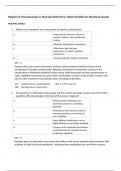
Chapter 54: Neuromuscular or Muscular Dysfu Perry: Maternal Child Care Nursing in Canada
MULTIPLE CHOICE
1. Which set of symptoms are characteristic of spastic cerebral palsy?
a. Hypertonicity and poor control of
posture, balance, and coordinated
motion
b. Athetosis and dystonic movements
c. Wide-based gait and poor
performance of rapid, repetitive
movements
d. Tremors and lack of active movement
ANS: A
Hypertonicity, poor control of posture, balance, and coordinated motion are part of the
classification of spastic cerebral palsy. Athetosis and dystonic movements are part of the
classification of dyskinetic/athetoid cerebral palsy. Wide-based gait and poor performance of
rapid, repetitive movements are part of the classification of ataxic cerebral palsy. Tremors and
lack of active movement may indicate other neurological disorders.
DIF: Cognitive Level: Comprehension REF: p. 1755 | Box 54-1
OBJ: Nursing Process: Assessment
2. The parents of a child with cerebral palsy ask the nurse if any drugs can decrease their child’s
spasticity. What knowledge is the basis of the nurses’ response?
a. Anticonvulsant medications are
sometimes useful for controlling
spasticity.
b. Medications that would be useful in
reducing spasticity are too toxic for
use in children.
c. Many different medications can be
highly effective in controlling spasticity.
d. A pump can be implanted that delivers
medication into the intrathecal space
to decrease spasticity.
ANS: D
Baclofen given intrathecally is best suited for children with severe spasticity that interferes with
activities of daily living and ambulation. Anticonvulsant medications are used when seizures
, occur in children with cerebral palsy. The intrathecal route decreases the adverse effects of the
drugs that reduce spasticity. Few medications are presently available for the control of
spasticity.
DIF: Cognitive Level: Analysis REF: p. 1758
OBJ: Nursing Process: Implementation
3. What term is used for a hernial protrusion of a saclike cyst of meninges, spinal fluid, and a
portion of the spinal cord with its nerves through a defect in the vertebral column?
a. Rachischisis
b. Encephalocele
c. Meningocele
d. Myelomeningocele
ANS: D
A myelomeningocele is a visible defect with an external, saclike protrusion containing
meninges, spinal fluid, and nerves. Rachischisis is a fissure in the spinal column that leaves the
meninges and spinal cord exposed. Encephalocele is a herniation of the brain and meninges
through a defect in the skull, producing a fluid-filled sac.
Meningocele is a hernial protrusion of a saclike cyst of meninges with spinal fluid but no neural
elements.
DIF: Cognitive Level: ComprehensionREF: p. 1761 | Box 54-4 OBJ:
Nursing Process: Assessment
4. Which problem is most often associated with a myelomeningocele?
a. Hydrocephalus
b. Craniosynostosis
c. Biliary atresia
d. Esophageal atresia
ANS: A
Hydrocephalus is a frequently associated anomaly in 80 to 90% of children with
myelomeningocele. Craniosynostosis is the premature closing of the cranial sutures and is not
associated with myelomeningocele. Biliary and esophageal atresias are not associated with
myelomeningocele.
DIF: Cognitive Level: Comprehension REF: p. 1763 OBJ: Nursing
Process: Assessment
MULTIPLE CHOICE
1. Which set of symptoms are characteristic of spastic cerebral palsy?
a. Hypertonicity and poor control of
posture, balance, and coordinated
motion
b. Athetosis and dystonic movements
c. Wide-based gait and poor
performance of rapid, repetitive
movements
d. Tremors and lack of active movement
ANS: A
Hypertonicity, poor control of posture, balance, and coordinated motion are part of the
classification of spastic cerebral palsy. Athetosis and dystonic movements are part of the
classification of dyskinetic/athetoid cerebral palsy. Wide-based gait and poor performance of
rapid, repetitive movements are part of the classification of ataxic cerebral palsy. Tremors and
lack of active movement may indicate other neurological disorders.
DIF: Cognitive Level: Comprehension REF: p. 1755 | Box 54-1
OBJ: Nursing Process: Assessment
2. The parents of a child with cerebral palsy ask the nurse if any drugs can decrease their child’s
spasticity. What knowledge is the basis of the nurses’ response?
a. Anticonvulsant medications are
sometimes useful for controlling
spasticity.
b. Medications that would be useful in
reducing spasticity are too toxic for
use in children.
c. Many different medications can be
highly effective in controlling spasticity.
d. A pump can be implanted that delivers
medication into the intrathecal space
to decrease spasticity.
ANS: D
Baclofen given intrathecally is best suited for children with severe spasticity that interferes with
activities of daily living and ambulation. Anticonvulsant medications are used when seizures
, occur in children with cerebral palsy. The intrathecal route decreases the adverse effects of the
drugs that reduce spasticity. Few medications are presently available for the control of
spasticity.
DIF: Cognitive Level: Analysis REF: p. 1758
OBJ: Nursing Process: Implementation
3. What term is used for a hernial protrusion of a saclike cyst of meninges, spinal fluid, and a
portion of the spinal cord with its nerves through a defect in the vertebral column?
a. Rachischisis
b. Encephalocele
c. Meningocele
d. Myelomeningocele
ANS: D
A myelomeningocele is a visible defect with an external, saclike protrusion containing
meninges, spinal fluid, and nerves. Rachischisis is a fissure in the spinal column that leaves the
meninges and spinal cord exposed. Encephalocele is a herniation of the brain and meninges
through a defect in the skull, producing a fluid-filled sac.
Meningocele is a hernial protrusion of a saclike cyst of meninges with spinal fluid but no neural
elements.
DIF: Cognitive Level: ComprehensionREF: p. 1761 | Box 54-4 OBJ:
Nursing Process: Assessment
4. Which problem is most often associated with a myelomeningocele?
a. Hydrocephalus
b. Craniosynostosis
c. Biliary atresia
d. Esophageal atresia
ANS: A
Hydrocephalus is a frequently associated anomaly in 80 to 90% of children with
myelomeningocele. Craniosynostosis is the premature closing of the cranial sutures and is not
associated with myelomeningocele. Biliary and esophageal atresias are not associated with
myelomeningocele.
DIF: Cognitive Level: Comprehension REF: p. 1763 OBJ: Nursing
Process: Assessment