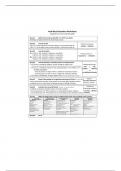
Acid-Base Disorders Worksheet
Adapted from Joshua Steinberg MD
Step #1: Gather the necessary data (Na+, Cl-, HCO3-, pH, pCO2)
Preferably, all obtained from the same blood sample.
Step #2: Look at the pH. Patient has primary:
If pH >7.4 the patient has a primary alkalosis proceed to Step 3a acidosis | alkalosis
If pH < 7.4 the patient has a primary acidosis proceed to Step 3b
Step #3: Look at the pCO2.
3a: If pCO2 is >40 patient’s alkalosis is metabolic; Primary process is:
If pCO2 is <40 patient’s alkalosis is respiratory respiratory | metabolic
3b: If pCO2 is >40 patient’s acidosis is respiratory;
If pCO2 is <40 patient’s acidosis is metabolic
Step #4: Look for disorders revealed by failure of compensation.
- If 1o process is metabolic alkalosis pCO2 should be >40 but <55* Additional disorder:
* There are several metabolic alkalosis PCO2 prediction formulas, but fraught with clinical inaccuracy/unreliability
resp. resp.
o
- If 1 process is metabolic acidosis calc. predicted pCO2 = (1.5 x HCO3) + 8 +/- 2 acidosis alkalosis
In either case above: -or-
- If actual pCO2 is too high there is additional respiratory acidosis no additional disorder
- If actual pCO2 is too low there is additional respiratory alkalosis
- If 1o process is respiratory skip to steps 5 & 6 (where further metabolic disorders revealed)
Step #5: Check if the patient has a significant anion gap (>12-18). (AG = Na-Cl-HCO3) Patient
If AG is significantly elevated the patient has an anion gap metabolic acidosis has|does not have:
in addition to (or in confirmation of) whatever Steps 2 through 4 yielded AG met. acidosis
Step #6: Calculate the corrected bicarb. (Pt’s gap – 12 + pt’s serum bicarb) Patient has
In addition to whatever disorders Steps 1 through 5 yielded, underlying metabolic:
- If corrected bicarb >30 the patient has an underlying metabolic alkalosis; non-AG alkalosis
- If corrected bicarb <23 the patient has an underlying non-AG metabolic acidosis acidosis
Step #7: Make the diagnosis(es) using the differentials below and knowledge of the patient
Anion Gap Non-Anion Gap Acute Respiratory Metabolic Respiratory
Metabolic Acidosis Metabolic Acidosis Acidosis Alkalosis Alkalosis
"MUDPILERS" "HARDUPS" anything that causes "CLEVER PD" anything that causes
Methanol Hyperalimentation hypoventilation, i.e.: Contraction hyperventilation, i.e.:
Uremia Acetazolamide CNS depression (drugs/CVA) Licorice* CNS disease
DKA/Alcoholic KA Renal tubular acidosis Airway obstruction Endo: Conn's/Cushing's/ Hypoxia
Paradehyde Diarrhea Pneumonia Bartter's)* Anxiety
Isoniazid Uretero-Pelvic shunt Pulmonary edema Vomiting, NG suction Mechanical ventilators
Lactic acidosis Post-hypocapnia Hemo/Pneumothorax Excess alkali* Progesterone
EtOH/Ethylene glycol Spironolactone Myopathy Refeeding alkalosis* Salicylates/Sepsis
Rhabdo/Renal failure Post-hypercapnia
Salicylates ( Chronic respiratory acidosis Diuretics*
is caused by COPD and
restrictive lung disease) *assoc w/high urine Cl levels
Step #8: Fix it!
Adapted from Joshua Steinberg MD
Step #1: Gather the necessary data (Na+, Cl-, HCO3-, pH, pCO2)
Preferably, all obtained from the same blood sample.
Step #2: Look at the pH. Patient has primary:
If pH >7.4 the patient has a primary alkalosis proceed to Step 3a acidosis | alkalosis
If pH < 7.4 the patient has a primary acidosis proceed to Step 3b
Step #3: Look at the pCO2.
3a: If pCO2 is >40 patient’s alkalosis is metabolic; Primary process is:
If pCO2 is <40 patient’s alkalosis is respiratory respiratory | metabolic
3b: If pCO2 is >40 patient’s acidosis is respiratory;
If pCO2 is <40 patient’s acidosis is metabolic
Step #4: Look for disorders revealed by failure of compensation.
- If 1o process is metabolic alkalosis pCO2 should be >40 but <55* Additional disorder:
* There are several metabolic alkalosis PCO2 prediction formulas, but fraught with clinical inaccuracy/unreliability
resp. resp.
o
- If 1 process is metabolic acidosis calc. predicted pCO2 = (1.5 x HCO3) + 8 +/- 2 acidosis alkalosis
In either case above: -or-
- If actual pCO2 is too high there is additional respiratory acidosis no additional disorder
- If actual pCO2 is too low there is additional respiratory alkalosis
- If 1o process is respiratory skip to steps 5 & 6 (where further metabolic disorders revealed)
Step #5: Check if the patient has a significant anion gap (>12-18). (AG = Na-Cl-HCO3) Patient
If AG is significantly elevated the patient has an anion gap metabolic acidosis has|does not have:
in addition to (or in confirmation of) whatever Steps 2 through 4 yielded AG met. acidosis
Step #6: Calculate the corrected bicarb. (Pt’s gap – 12 + pt’s serum bicarb) Patient has
In addition to whatever disorders Steps 1 through 5 yielded, underlying metabolic:
- If corrected bicarb >30 the patient has an underlying metabolic alkalosis; non-AG alkalosis
- If corrected bicarb <23 the patient has an underlying non-AG metabolic acidosis acidosis
Step #7: Make the diagnosis(es) using the differentials below and knowledge of the patient
Anion Gap Non-Anion Gap Acute Respiratory Metabolic Respiratory
Metabolic Acidosis Metabolic Acidosis Acidosis Alkalosis Alkalosis
"MUDPILERS" "HARDUPS" anything that causes "CLEVER PD" anything that causes
Methanol Hyperalimentation hypoventilation, i.e.: Contraction hyperventilation, i.e.:
Uremia Acetazolamide CNS depression (drugs/CVA) Licorice* CNS disease
DKA/Alcoholic KA Renal tubular acidosis Airway obstruction Endo: Conn's/Cushing's/ Hypoxia
Paradehyde Diarrhea Pneumonia Bartter's)* Anxiety
Isoniazid Uretero-Pelvic shunt Pulmonary edema Vomiting, NG suction Mechanical ventilators
Lactic acidosis Post-hypocapnia Hemo/Pneumothorax Excess alkali* Progesterone
EtOH/Ethylene glycol Spironolactone Myopathy Refeeding alkalosis* Salicylates/Sepsis
Rhabdo/Renal failure Post-hypercapnia
Salicylates ( Chronic respiratory acidosis Diuretics*
is caused by COPD and
restrictive lung disease) *assoc w/high urine Cl levels
Step #8: Fix it!