BISC1404 Introductory Biology 2
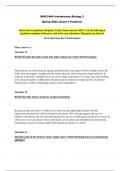
Spring 2024, Exam 4 Predictor
Short answer questions (30 points Total): Please answer ONLY 3 of the following 6
questions (complete both part a and b for your selections). Diagrams are allowed.
Each Questions has 5 marks/points
Short Answer 1:
Question 1a
Briefly describe the main reason why polar regions are cooler than the equator.
Polar regions are cooler than the equator primarily due to the angle at which sunlight strikes the
Earth. Near the equator, sunlight hits the surface directly, delivering more energy and heat. In
contrast, at the poles, sunlight arrives at a lower angle, spreading over a larger area and resulting
in less heat absorption. Additionally, the polar regions experience longer periods of darkness
during winter, further contributing to their cooler temperatures.
Question 1b
Briefly describe what is meant by reciprocal altruism
Reciprocal altruism refers to a behavior in which an individual helps another with the
expectation that the favor will be returned in the future. This concept suggests that acts of
kindness can enhance the survival and reproductive success of both parties involved over time. It
often occurs in social species where individuals can recognize and remember past interactions,
facilitating a system of mutual support that benefits the group as a whole.
Question 2a
Describe some of the features of the waggle dance. What information does it communicate
and how?
, The waggle dance is a behavior performed by honeybees to communicate the location of food
sources. Here are some key features:
1. Figure-Eight Pattern: The dance consists of a series of straight runs followed by
circular or semicircular turns, forming a figure-eight shape.
2. Waggle Phase: During the straight runs, the bee waggles its abdomen while moving in a
specific direction. The duration of the waggle indicates the distance to the food source—
longer waggles mean the food is farther away.
3. Angle of Dance: The angle of the waggle run in relation to the vertical (gravity)
communicates the direction of the food relative to the position of the sun. For example, if
the waggle run is angled 30 degrees to the right of vertical, the food source is 30 degrees
to the right of the sun's position.
4. Duration and Intensity: The overall intensity and duration of the dance can indicate the
quality and abundance of the food source, with more vigorous dances suggesting a richer
source.
Through these features, the waggle dance effectively conveys both distance and direction,
helping other bees locate the food.
Question 2b
What is meant by altruistic behavior? What is the evolutionary benefit of altruism?
Altruistic behavior refers to actions that benefit another individual at a cost to oneself, often
without any immediate personal gain. Examples include helping others, sharing resources, or
protecting group members.
The evolutionary benefit of altruism lies in concepts like kin selection and reciprocal altruism:
1. Kin Selection: Altruism can promote the survival of shared genes. By helping relatives,
individuals increase the likelihood that their genetic material will be passed on to future
generations.
2. Reciprocal Altruism: In social species, helping others can lead to mutual benefits over
time. By assisting others, individuals may receive help in return when they need it,
enhancing their survival and reproductive success.
Both mechanisms support the idea that altruism can ultimately enhance an individual's fitness,
despite the initial cost of the altruistic act.
Spring 2024, Exam 4 Predictor
Short answer questions (30 points Total): Please answer ONLY 3 of the following 6
questions (complete both part a and b for your selections). Diagrams are allowed.
Each Questions has 5 marks/points
Short Answer 1:
Question 1a
Briefly describe the main reason why polar regions are cooler than the equator.
Polar regions are cooler than the equator primarily due to the angle at which sunlight strikes the
Earth. Near the equator, sunlight hits the surface directly, delivering more energy and heat. In
contrast, at the poles, sunlight arrives at a lower angle, spreading over a larger area and resulting
in less heat absorption. Additionally, the polar regions experience longer periods of darkness
during winter, further contributing to their cooler temperatures.
Question 1b
Briefly describe what is meant by reciprocal altruism
Reciprocal altruism refers to a behavior in which an individual helps another with the
expectation that the favor will be returned in the future. This concept suggests that acts of
kindness can enhance the survival and reproductive success of both parties involved over time. It
often occurs in social species where individuals can recognize and remember past interactions,
facilitating a system of mutual support that benefits the group as a whole.
Question 2a
Describe some of the features of the waggle dance. What information does it communicate
and how?
, The waggle dance is a behavior performed by honeybees to communicate the location of food
sources. Here are some key features:
1. Figure-Eight Pattern: The dance consists of a series of straight runs followed by
circular or semicircular turns, forming a figure-eight shape.
2. Waggle Phase: During the straight runs, the bee waggles its abdomen while moving in a
specific direction. The duration of the waggle indicates the distance to the food source—
longer waggles mean the food is farther away.
3. Angle of Dance: The angle of the waggle run in relation to the vertical (gravity)
communicates the direction of the food relative to the position of the sun. For example, if
the waggle run is angled 30 degrees to the right of vertical, the food source is 30 degrees
to the right of the sun's position.
4. Duration and Intensity: The overall intensity and duration of the dance can indicate the
quality and abundance of the food source, with more vigorous dances suggesting a richer
source.
Through these features, the waggle dance effectively conveys both distance and direction,
helping other bees locate the food.
Question 2b
What is meant by altruistic behavior? What is the evolutionary benefit of altruism?
Altruistic behavior refers to actions that benefit another individual at a cost to oneself, often
without any immediate personal gain. Examples include helping others, sharing resources, or
protecting group members.
The evolutionary benefit of altruism lies in concepts like kin selection and reciprocal altruism:
1. Kin Selection: Altruism can promote the survival of shared genes. By helping relatives,
individuals increase the likelihood that their genetic material will be passed on to future
generations.
2. Reciprocal Altruism: In social species, helping others can lead to mutual benefits over
time. By assisting others, individuals may receive help in return when they need it,
enhancing their survival and reproductive success.
Both mechanisms support the idea that altruism can ultimately enhance an individual's fitness,
despite the initial cost of the altruistic act.