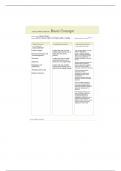
ACTIVE LEARNING TEMPLATE: Basic Concept
Raven Trickett
STUDENT NAME _____________________________________
Acute v Chronic urgent v nonurgent stable v unstable
CONCEPT ______________________________________________________________________________
Managing care
REVIEW MODULE CHAPTER ___________
Related Content Underlying Principles Nursing Interventions
(E.G., DELEGATION, WHO? WHEN? WHY? HOW?
LEVELS OF PREVENTION,
ADVANCE DIRECTIVES)
Evidence Based A client who has an acute First: Airway:-Identify an airway
problem takes priority over a concern (obstruction,
stridor) -Establish a patent
Practice Prioritization and client who has chronic airway if indicated-Recognize
Time Management problem that 3 to 5 min without oxygen
causes irreversible brain
Teamwork A client who has an urgent damage secondary to cerebral
need takes priority over a anoxia
Assigning, client has a nonurgent deep Second: Breathing -Assess the
effectiveness of breathing
Delegating, and A client who has unstable (apnea, depressed respiratory
Supervising findings takes priority over a rate)-Intervene as needed
client who has stable findings (reposition, administer naloxene)
Managing Client Care Third: Circulation-Identify
circulation concern
Maslow's hierarchy (hypotension, dysrhythmia,
inadequate cardiac output,
compartment
syndrome)-Institute actions to
reverse or minimize circulatory
alteration
Fourth: Disability-Assess for
current or evolving disability
(neurological deficits, stroke in
evolution)-Implement actions to
slow down development of
disability
Fifth: Exposure-Remove the
client's clothing to allow for a
complete assessment or
resuscitation-Implement
measures to reduce the risk for
hypothermia (provide warm
blankets and IV solutions or use
cooling measures for clients
exposed to extreme heat
ACTIVE LEARNING TEMPLATES
Raven Trickett
STUDENT NAME _____________________________________
Acute v Chronic urgent v nonurgent stable v unstable
CONCEPT ______________________________________________________________________________
Managing care
REVIEW MODULE CHAPTER ___________
Related Content Underlying Principles Nursing Interventions
(E.G., DELEGATION, WHO? WHEN? WHY? HOW?
LEVELS OF PREVENTION,
ADVANCE DIRECTIVES)
Evidence Based A client who has an acute First: Airway:-Identify an airway
problem takes priority over a concern (obstruction,
stridor) -Establish a patent
Practice Prioritization and client who has chronic airway if indicated-Recognize
Time Management problem that 3 to 5 min without oxygen
causes irreversible brain
Teamwork A client who has an urgent damage secondary to cerebral
need takes priority over a anoxia
Assigning, client has a nonurgent deep Second: Breathing -Assess the
effectiveness of breathing
Delegating, and A client who has unstable (apnea, depressed respiratory
Supervising findings takes priority over a rate)-Intervene as needed
client who has stable findings (reposition, administer naloxene)
Managing Client Care Third: Circulation-Identify
circulation concern
Maslow's hierarchy (hypotension, dysrhythmia,
inadequate cardiac output,
compartment
syndrome)-Institute actions to
reverse or minimize circulatory
alteration
Fourth: Disability-Assess for
current or evolving disability
(neurological deficits, stroke in
evolution)-Implement actions to
slow down development of
disability
Fifth: Exposure-Remove the
client's clothing to allow for a
complete assessment or
resuscitation-Implement
measures to reduce the risk for
hypothermia (provide warm
blankets and IV solutions or use
cooling measures for clients
exposed to extreme heat
ACTIVE LEARNING TEMPLATES