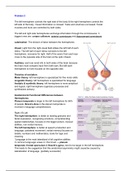
Problem 2
The left hemisphere controls the right side of the body & the right hemisphere controls the
left side of the body. Visual information is crossed. Taste and smell are uncrossed. Facial
muscles and trunk are controlled by both sides.
The left and right side hemispheres exchange information through the commissures. 3
biggest ones are: corpus callosum, anterior commissure and hippocampal commissure
Laterization: The division of labor between the hemispheres
Visual: Light from the right visual field strikes the left half of each
retina. The left half of each retina connects to the left
hemisphere, viceversa for right. Half of the axons from each eye
cross to the opposite side of the brain at the optic chiasm.
Auditory: each ear send info to both sides of the brain because
the brain must compare input from both ears. But still each
hemisphere is more focused on the opposite side.
Theories of evolution:
Motor theory: left hemisphere is specialized for fine motor skills
Linguistic theory: left hemisphere is specialized for language
Analytic & synthetic theory: left hemisphere is more analytical
and logical, right hemisphere organizes processes and
synthesizes sensory
Anatomical & Functional Differences between
Hemispheres
Planum temporale is larger in the left hemisphere for 65%
of people. Broca's Area in the planum temporale is
involved in language comprehension.
Right VS Left
The right hemisphere: is better at reading gestures and
facial expression, recognizing emotions, comprehending
spatial relationships, focuses on the bigger picture, musical
abilities, non-verbal memory
The left hemisphere: is better at speech production and
language, ipsilateral movement, verbal memory,focuses on
details, numbers and mathematics, looks for logic and
meaning
*Language is the most lateralized of all cognitive abilities
3 cortical language areas in the brain → planum
temporale, frontal operculum & Heschl’s gyrus, tend to be larger in the left hemisphere.
This leads to the suggestion that this anatomical asymmetry might cause/be caused by
lateralization of language. (partially successful)
The left hemisphere controls the right side of the body & the right hemisphere controls the
left side of the body. Visual information is crossed. Taste and smell are uncrossed. Facial
muscles and trunk are controlled by both sides.
The left and right side hemispheres exchange information through the commissures. 3
biggest ones are: corpus callosum, anterior commissure and hippocampal commissure
Laterization: The division of labor between the hemispheres
Visual: Light from the right visual field strikes the left half of each
retina. The left half of each retina connects to the left
hemisphere, viceversa for right. Half of the axons from each eye
cross to the opposite side of the brain at the optic chiasm.
Auditory: each ear send info to both sides of the brain because
the brain must compare input from both ears. But still each
hemisphere is more focused on the opposite side.
Theories of evolution:
Motor theory: left hemisphere is specialized for fine motor skills
Linguistic theory: left hemisphere is specialized for language
Analytic & synthetic theory: left hemisphere is more analytical
and logical, right hemisphere organizes processes and
synthesizes sensory
Anatomical & Functional Differences between
Hemispheres
Planum temporale is larger in the left hemisphere for 65%
of people. Broca's Area in the planum temporale is
involved in language comprehension.
Right VS Left
The right hemisphere: is better at reading gestures and
facial expression, recognizing emotions, comprehending
spatial relationships, focuses on the bigger picture, musical
abilities, non-verbal memory
The left hemisphere: is better at speech production and
language, ipsilateral movement, verbal memory,focuses on
details, numbers and mathematics, looks for logic and
meaning
*Language is the most lateralized of all cognitive abilities
3 cortical language areas in the brain → planum
temporale, frontal operculum & Heschl’s gyrus, tend to be larger in the left hemisphere.
This leads to the suggestion that this anatomical asymmetry might cause/be caused by
lateralization of language. (partially successful)