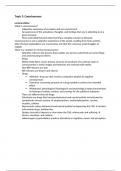
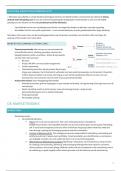
Topic 3: Consciousness
Lecture/slides:
What is consciousness?
- Subjective awareness of ourselves and our environment
- An awareness of the sensations, thoughts, and feelings that one is attending to at a
given moment.
- More controlled/focused when learning a complex concept or behavior.
Consciousness is one’s subjective experience of the world, resulting from brain activity.
After-the-fact-explanations are unconscious acts that the conscious mind struggles to
explain.
There is a variation in normal consciousness:
- Attention refers to the process that enables you to focus selectively on some things
and avoid focusing on others
- Sleep:
Within sleep there comes dreams. Dreams are products of an altered state of
consciousness in which images and fantasies are confused with reality.
Non-REM dreams are dull.
REM dreams are bizarre and intense
- Drugs:
Addiction: drug use that remains compulsive despite its negative
consequences
Tolerance: increasing amounts of a drug needed to achieve the intended
effect
Withdrawal: physiological (fysiologisch) and psychological state characterized
by feelings of anxiety, tension, and cravings for the addictive substance
There are different kind of drugs:
Stimulants are drugs that increase behavioral and mental activity and activate the
sympathetic nervous system amphetamines, methamphetamine, cocaine,
nicotine, caffeine
Depressants reduce behavioral and mental activity by depressing the CNS alcohol,
anti-anxiety drugs, barbiturates
Opiates (narcotics) depress or slow down the CNS; relieve pain and suffering
heroin, morphine, and codeine
Hallucinogens (psychedelics) produce alterations in cognition, mood, and perception
, Book:
Attention involves being able to focus selectively on some things and not others.
Attentions and consciousness are not the same thing.
Attention selects what enters your limited consciousness. by selecting your friends voice
to focus on and ignoring other voices and sounds, you become consciously aware of the
selected information, which allows you to fully perceive and process it.
Endogenous attention is intentionally directing your focus to something.
Exogenous attention is when your attention on something was driven by a stimulus of event.
You see an accident on the side of the road and cannot help but slow down to look at the
traumatic scene. Why?
Exogenous attention occurs when attention is unintentionally shifted to an emotional
stimulus.
Endogenous attention = attention that is directed voluntarily
Exogenous attention = attention that is directed involuntarily by a stimulus
Why should you avoid using a laptop during lectures?
Laptop use in the classroom may shift attention away from the lecture, leading you to
miss or superficially process information.
Priming occurs when the response to a stimulus is influenced or facilitated by recent
experience with that stimulus or a related stimulus. Priming can influence how you perceive
an object, the speed or ease with which you respond, and the choices you make.
- for example, name a word with cha… chat chase charm.
Read sentence ‘The family was having dinner at the table’
Now say a word that starts with cha… chair.
Chair and table are related, so priming occurs.
Subliminal perception occurs when stimuli are processed by sensory systems but, because
of their short duration or subtlety, do not reach consciousness.
Which type of subliminal messages are most likely to affect behavior?
Messages that invoke emotion or motivation may subtly shift behavior, but such messages
do not affect complex behaviors like buying or self-confidence.
Priming = a facilitation in the response to a stimulus due to recent experience with that
stimulus or a related stimulus
Subliminal perception = the processing of information by sensory systems without conscious
awareness.
Automatic processing occurs when a task is so well learned that we can do it without much
attention.
When Tara was learning to knit, she had to pay attention to every stitch.
Lecture/slides:
What is consciousness?
- Subjective awareness of ourselves and our environment
- An awareness of the sensations, thoughts, and feelings that one is attending to at a
given moment.
- More controlled/focused when learning a complex concept or behavior.
Consciousness is one’s subjective experience of the world, resulting from brain activity.
After-the-fact-explanations are unconscious acts that the conscious mind struggles to
explain.
There is a variation in normal consciousness:
- Attention refers to the process that enables you to focus selectively on some things
and avoid focusing on others
- Sleep:
Within sleep there comes dreams. Dreams are products of an altered state of
consciousness in which images and fantasies are confused with reality.
Non-REM dreams are dull.
REM dreams are bizarre and intense
- Drugs:
Addiction: drug use that remains compulsive despite its negative
consequences
Tolerance: increasing amounts of a drug needed to achieve the intended
effect
Withdrawal: physiological (fysiologisch) and psychological state characterized
by feelings of anxiety, tension, and cravings for the addictive substance
There are different kind of drugs:
Stimulants are drugs that increase behavioral and mental activity and activate the
sympathetic nervous system amphetamines, methamphetamine, cocaine,
nicotine, caffeine
Depressants reduce behavioral and mental activity by depressing the CNS alcohol,
anti-anxiety drugs, barbiturates
Opiates (narcotics) depress or slow down the CNS; relieve pain and suffering
heroin, morphine, and codeine
Hallucinogens (psychedelics) produce alterations in cognition, mood, and perception
, Book:
Attention involves being able to focus selectively on some things and not others.
Attentions and consciousness are not the same thing.
Attention selects what enters your limited consciousness. by selecting your friends voice
to focus on and ignoring other voices and sounds, you become consciously aware of the
selected information, which allows you to fully perceive and process it.
Endogenous attention is intentionally directing your focus to something.
Exogenous attention is when your attention on something was driven by a stimulus of event.
You see an accident on the side of the road and cannot help but slow down to look at the
traumatic scene. Why?
Exogenous attention occurs when attention is unintentionally shifted to an emotional
stimulus.
Endogenous attention = attention that is directed voluntarily
Exogenous attention = attention that is directed involuntarily by a stimulus
Why should you avoid using a laptop during lectures?
Laptop use in the classroom may shift attention away from the lecture, leading you to
miss or superficially process information.
Priming occurs when the response to a stimulus is influenced or facilitated by recent
experience with that stimulus or a related stimulus. Priming can influence how you perceive
an object, the speed or ease with which you respond, and the choices you make.
- for example, name a word with cha… chat chase charm.
Read sentence ‘The family was having dinner at the table’
Now say a word that starts with cha… chair.
Chair and table are related, so priming occurs.
Subliminal perception occurs when stimuli are processed by sensory systems but, because
of their short duration or subtlety, do not reach consciousness.
Which type of subliminal messages are most likely to affect behavior?
Messages that invoke emotion or motivation may subtly shift behavior, but such messages
do not affect complex behaviors like buying or self-confidence.
Priming = a facilitation in the response to a stimulus due to recent experience with that
stimulus or a related stimulus
Subliminal perception = the processing of information by sensory systems without conscious
awareness.
Automatic processing occurs when a task is so well learned that we can do it without much
attention.
When Tara was learning to knit, she had to pay attention to every stitch.