FINRA Series 24 Questions with Correct Answers
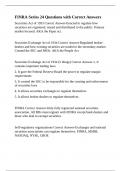
Securities Act of 1933 Correct Answer-Enacted to regulate how
securities are registered, issued and distributed to the public. Primary
market focused. AKA the Paper act.
Securities Exchange Act of 1934 Correct Answer-Regulated broker-
dealers and how existing securities are traded in the secondary market.
Created the SEC and SROs. AKA the People Act
Securities Exchange Act of 1934 (5 things) Correct Answer-1. It
contains important trading laws
2. It gave the Federal Reserve Board the power to regulate margin
requirements
3. It created the SEC to be responsible for the creating and enforcement
of securities laws
4. It allows securities exchanges to regulate themselves
5. It allows broker-dealers to regulate themselves
FINRA Correct Answer-Only fully registered national securities
association. All BDs must register with FINRA except bank dealers and
those who deal in exempt securities.
Self-regulatory organizations Correct Answer-Exchanges and national
securities associations can regulate themselves. FINRA, MSRB,
NASDAQ, NYSE, CBOE
, Form BD Correct Answer-An application for registration which
identifies the type and nature of the applicants business. Also must
identify all owners and officers of the firm.
Fingerprint card Correct Answer-Every officer or employee of a member
firm who sells, handles, or processes securities, or who supervises those
who do, must be fingerprinted
Investment adviser Correct Answer-The Investment Advisors Act of
1940 defines an investment adviser as any person or firm that is in the
business of providing advice or reports about securities for
compensation
Exempt from Advisers Act Correct Answer-Advice is incidental to its
business:
Lawyers, accountants, teachers, engineers (LATE)
Banks, broker-dealers, publishers
Only U.S. government securities or GSEs
RIA registration Correct Answer->$100mm in AUM
Pension consultants of plans >$200mm
principal office in Wyoming
Advisers to registered investment companies
Securities Act of 1933 Correct Answer-Enacted to regulate how
securities are registered, issued and distributed to the public. Primary
market focused. AKA the Paper act.
Securities Exchange Act of 1934 Correct Answer-Regulated broker-
dealers and how existing securities are traded in the secondary market.
Created the SEC and SROs. AKA the People Act
Securities Exchange Act of 1934 (5 things) Correct Answer-1. It
contains important trading laws
2. It gave the Federal Reserve Board the power to regulate margin
requirements
3. It created the SEC to be responsible for the creating and enforcement
of securities laws
4. It allows securities exchanges to regulate themselves
5. It allows broker-dealers to regulate themselves
FINRA Correct Answer-Only fully registered national securities
association. All BDs must register with FINRA except bank dealers and
those who deal in exempt securities.
Self-regulatory organizations Correct Answer-Exchanges and national
securities associations can regulate themselves. FINRA, MSRB,
NASDAQ, NYSE, CBOE
, Form BD Correct Answer-An application for registration which
identifies the type and nature of the applicants business. Also must
identify all owners and officers of the firm.
Fingerprint card Correct Answer-Every officer or employee of a member
firm who sells, handles, or processes securities, or who supervises those
who do, must be fingerprinted
Investment adviser Correct Answer-The Investment Advisors Act of
1940 defines an investment adviser as any person or firm that is in the
business of providing advice or reports about securities for
compensation
Exempt from Advisers Act Correct Answer-Advice is incidental to its
business:
Lawyers, accountants, teachers, engineers (LATE)
Banks, broker-dealers, publishers
Only U.S. government securities or GSEs
RIA registration Correct Answer->$100mm in AUM
Pension consultants of plans >$200mm
principal office in Wyoming
Advisers to registered investment companies