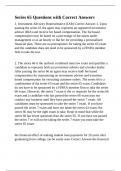
Series 65 Questions with Correct Answers
1. Investment Advisory Representative (IAR) Correct Answer-1. Upon
passing the series 65 the agent may represent an registered investment
adviser (RIA) and receive fee based compensation. The fee based
compensation may be based on a percentage of the assets under
management or as an hourly or flat fee for providing a personalized
financial plan. There are no prerequisites for taking the series 65 exam
and the candidate does not need to be sponsored by a FINRA member
firm to take the test.
2. The series 66 is the uniform combined state law exam and qualifies a
candidate to represent both an investment adviser and a broker dealer.
After passing the series 66 an agent may receive both fee based
compensation for representing an investment adviser and transition
based compensation for executing customer orders. The series 66 is a
combination of the series 63 exam and the series 65 exam. Candidates
do not have to be sponsored by a FINRA member firm to take the series
66 exam. However, the series 7 exam is the co requisite for the series 66
exam and a candidate who has passed the series 66 exam may not
conduct any business until they have passed the series 7 exam. All
candidates must be sponsored to take the series 7 exam. If you have
passed the series 7 exam and have not taken the series 63 exam, the
series 66 may be the right exam to take. Keep in mind that while the
series 66 has fewer questions than the series 65. If you have not passed
the series 7 or will not be taking the series 7 exam you must take the
series 65 exam.
the financial effect of making student loan payments for 20 years after
graduating from college can be easily seen Correct Answer-the financial
,effect of making student loan payments for 20 years after graduating
from college can be easily seen.
For example, a college graduate who owes $60,000 in student loans at
3% interest will have to pay $332.76 per month for 20 years to get that
paid off. If that amount was instead diverted into a Roth IRA that grows
at 6% for that same time period (with no further contributions after 20
years), then the student would have almost $600,000 of tax-free money
by age 65. No poll or study is necessary to see the enormous impact that
student loan debt can have on a borrower's retirement preparedness. (For
more, see: Student Loans: What to Do When You Can't Repay Them.)
Certificate of Deposit (CD) Correct Answer-1. a time deposit at a
commercial bank and insured by the FDIC that restricts holders from
withdrawing funds on demand.
2. bears a maturity date ranging from one month to five years at a fixed
interest rate and can be issued in any denomination.
Negotiable Certificates of Deposit (NCD)
(Jumbo CD) Correct Answer-1. a large certificate of deposit that is
typically purchased by institutional/company investors.
2. Unlike a regular CD, NCDs pay periodic interest, usually twice a year
and cannot be cashed in before reaching maturity, but can be easily sold
in the open market before that time.
3. minimum face value of $100,000, but typically are $1 million or
more.
,Treasury Bills (T-bills) Correct Answer-1. short-term securities that
mature in 3-months, 6-months or 1-year.
2. exempt from state and local taxes.
3. purchased at less than par.
4. issued in denominations at $1,000, $5,000, $10,000, $25,000,
$50,000, $100,000 and $1 million.
5. all Treasuries are considered to be risk-free (safest investments in the
world).
Treasury Notes (T-notes) Correct Answer-1. a maturity between 1 and
10 years.
2. exempt from state and local taxes.
3. purchased at face value and pay out interest payments semi-annually.
4. bought through a bank or directly from US gov't.
5. can be sold in a large secondary market (liquidity).
Treasury Bond (T-Bond) Correct Answer-1. a maturity of more than 10
years.
2. exempt from state and local taxes.
3. purchased at face value and pay out interest payments semi-annually.
4. issued with a minimum denomination of $1,000 and maximum of $5
million.
5. After auction, bonds can be sold in the secondary market.
, 6. bonds can be bought directly from the government through
TreasuryDirect at http://www.treasurydirect.gov, thereby bypassing a
broker.
U.S. Savings Bonds Correct Answer-1. offer a fixed rate of interest over
a fixed period of time.
2. not subject to state or local income taxes.
3. cannot be cashed until at least six months after purchase but maturity
varies somewhere between 15 to 30 years.
4. come in 8 values: $50, $75, $100, $200, $500, $1,000, $5,000, and
$10,000.
5. purchased directly from the Dept of the Treasury but can be cashed
out at most banks.
6. must be an American citizen.
Municipal Bonds Correct Answer-1. are exempt from federal taxes and
from most state and local taxes.
2. issued by a state, municipality or county to finance its capital
expenditures (such as the construction of highways, bridges or schools).
Zero-Coupon Bonds Correct Answer-a type of bond that makes no
coupon payments but instead is issued at a considerable discount to par
value.
Brady Bonds Correct Answer-1. are U.S. dollar denominated bonds that
were issued by mainly Latin American countries, with U.S. Government
30 year zero coupon bonds serving
1. Investment Advisory Representative (IAR) Correct Answer-1. Upon
passing the series 65 the agent may represent an registered investment
adviser (RIA) and receive fee based compensation. The fee based
compensation may be based on a percentage of the assets under
management or as an hourly or flat fee for providing a personalized
financial plan. There are no prerequisites for taking the series 65 exam
and the candidate does not need to be sponsored by a FINRA member
firm to take the test.
2. The series 66 is the uniform combined state law exam and qualifies a
candidate to represent both an investment adviser and a broker dealer.
After passing the series 66 an agent may receive both fee based
compensation for representing an investment adviser and transition
based compensation for executing customer orders. The series 66 is a
combination of the series 63 exam and the series 65 exam. Candidates
do not have to be sponsored by a FINRA member firm to take the series
66 exam. However, the series 7 exam is the co requisite for the series 66
exam and a candidate who has passed the series 66 exam may not
conduct any business until they have passed the series 7 exam. All
candidates must be sponsored to take the series 7 exam. If you have
passed the series 7 exam and have not taken the series 63 exam, the
series 66 may be the right exam to take. Keep in mind that while the
series 66 has fewer questions than the series 65. If you have not passed
the series 7 or will not be taking the series 7 exam you must take the
series 65 exam.
the financial effect of making student loan payments for 20 years after
graduating from college can be easily seen Correct Answer-the financial
,effect of making student loan payments for 20 years after graduating
from college can be easily seen.
For example, a college graduate who owes $60,000 in student loans at
3% interest will have to pay $332.76 per month for 20 years to get that
paid off. If that amount was instead diverted into a Roth IRA that grows
at 6% for that same time period (with no further contributions after 20
years), then the student would have almost $600,000 of tax-free money
by age 65. No poll or study is necessary to see the enormous impact that
student loan debt can have on a borrower's retirement preparedness. (For
more, see: Student Loans: What to Do When You Can't Repay Them.)
Certificate of Deposit (CD) Correct Answer-1. a time deposit at a
commercial bank and insured by the FDIC that restricts holders from
withdrawing funds on demand.
2. bears a maturity date ranging from one month to five years at a fixed
interest rate and can be issued in any denomination.
Negotiable Certificates of Deposit (NCD)
(Jumbo CD) Correct Answer-1. a large certificate of deposit that is
typically purchased by institutional/company investors.
2. Unlike a regular CD, NCDs pay periodic interest, usually twice a year
and cannot be cashed in before reaching maturity, but can be easily sold
in the open market before that time.
3. minimum face value of $100,000, but typically are $1 million or
more.
,Treasury Bills (T-bills) Correct Answer-1. short-term securities that
mature in 3-months, 6-months or 1-year.
2. exempt from state and local taxes.
3. purchased at less than par.
4. issued in denominations at $1,000, $5,000, $10,000, $25,000,
$50,000, $100,000 and $1 million.
5. all Treasuries are considered to be risk-free (safest investments in the
world).
Treasury Notes (T-notes) Correct Answer-1. a maturity between 1 and
10 years.
2. exempt from state and local taxes.
3. purchased at face value and pay out interest payments semi-annually.
4. bought through a bank or directly from US gov't.
5. can be sold in a large secondary market (liquidity).
Treasury Bond (T-Bond) Correct Answer-1. a maturity of more than 10
years.
2. exempt from state and local taxes.
3. purchased at face value and pay out interest payments semi-annually.
4. issued with a minimum denomination of $1,000 and maximum of $5
million.
5. After auction, bonds can be sold in the secondary market.
, 6. bonds can be bought directly from the government through
TreasuryDirect at http://www.treasurydirect.gov, thereby bypassing a
broker.
U.S. Savings Bonds Correct Answer-1. offer a fixed rate of interest over
a fixed period of time.
2. not subject to state or local income taxes.
3. cannot be cashed until at least six months after purchase but maturity
varies somewhere between 15 to 30 years.
4. come in 8 values: $50, $75, $100, $200, $500, $1,000, $5,000, and
$10,000.
5. purchased directly from the Dept of the Treasury but can be cashed
out at most banks.
6. must be an American citizen.
Municipal Bonds Correct Answer-1. are exempt from federal taxes and
from most state and local taxes.
2. issued by a state, municipality or county to finance its capital
expenditures (such as the construction of highways, bridges or schools).
Zero-Coupon Bonds Correct Answer-a type of bond that makes no
coupon payments but instead is issued at a considerable discount to par
value.
Brady Bonds Correct Answer-1. are U.S. dollar denominated bonds that
were issued by mainly Latin American countries, with U.S. Government
30 year zero coupon bonds serving