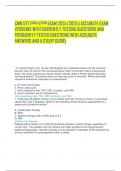
CMN 577 FINAL EXAM EXAM 2024/2025 | ACCURATE EXAM
VERSIONS WITH CURRENTLY TESTING QUESTIONS AND
FREQUENTLY TESTED QUESTIONS WITH ACCURATE
ANSWERS AND A STUDY GUIDE|
. A mother brings in her 16-year-old daughter for a wellness check and has concerns
that she has not had her first menstrual period. After a thorough history and physical
exam, the nurse practitioner notices sexual maturity rating 4 of both breast and pubic
hair development. The patient does not have any acne or hirsutism. What initial tests
should be ordered for evaluation of amenorrhea?
a. CT scan of the head
b. Pelvic ultrasound
c. Urine pregnancy test, TSH, CBC, prolactin, and FSH
d. Serum estradiol, serum Testosterone
Urine pregnancy test, TSH, CBC, prolactin, and FSH
1. A 56-year-old patient comes in for a routine well visit. He has a history of a previous
stroke and Type 2 Diabetes. Which of the following orders would be appropriate for a
patient with a previous stroke?
A. Initiate statin therapy
B. EEG
C. Warfarin therapy with an INR goal of 2-3
D. MRI
Initiate statin therapy
Patients with a history of an ASCVD should be started on statin therapy regardless of
current LDL. The question did not mention any other symptoms that would warrant
additional diagnostics. Warfarin therapy is only indicated if indicated. AFIB would be the
primary indication for anticoagulation after a stroke.
0:12
/
0:15
Brainpower
, Read More
1. A 36-year-old female is being seen in your clinic for left sided facial weakness. In
your review of systems, the patient reports that "certain sounds really bother her and
taste buds seem off". She also reports temporal pain which had subsided. Your physical
exam revealed no other neurological deficits. Which of the following intervention would
be most appropriate?
A. Call 911 to activate emergency stroke protocols
B. Refer the patient to neurology
C. Order an MRI
D. Prescribe a course of oral corticosteroids
Prescribe a course of oral corticosteroids
Bell's Palsy commonly causes alterations in taste and hyperacusis. This contrasts with
stroke. Corticosteroids increase the chances of recovery complete by 12-15% at nine to
twelve months and are routinely prescribed. The complaint of pain also suggests a
possible viral infection such as herpes simplex or varicella which has been implicated, in
some cases, as a trigger for facial palsy.
Hffte57te57te57te57te57te57te57te57te57te57te57te57te57te57te57te57te57te57te57t
e57te57te57te57te57te57te57te57te57te57te575 141. A mother brings in her 16-year-
old daughter for a wellness check and has concerns that she has not had her first
menstrual period. After a thorough history and physical exam, the nurse practitioner
notices sexual maturity rating 4 of both breast and pubic hair development. The patient
does not have any acne or hirsutism. What initial tests should be ordered for evaluation
of amenorrhea?
a. CT scan of the head
b. Pelvic ultrasound
c. Urine pregnancy test, TSH, CBC, prolactin, and FSH
d. Serum estradiol, serum Testosterone
Urine pregnancy test, TSH, CBC, prolactin, and FSH
1. A 56-year-old patient comes in for a routine well visit. He has a history of a previous
stroke and Type 2 Diabetes. Which of the following orders would be appropriate for a
patient with a previous stroke?
A. Initiate statin therapy
B. EEG
C. Warfarin therapy with an INR goal of 2-3
D. MRI
Initiate statin therapy
Patients with a history of an ASCVD should be started on statin therapy regardless of
current LDL. The question did not mention any other symptoms that would warrant
additional diagnostics. Warfarin therapy is only indicated if indicated. AFIB would be the
primary indication for anticoagulation after a stroke.
0:12
/
0:15
,Brainpower
Read More
1. A 36-year-old female is being seen in your clinic for left sided facial weakness. In
your review of systems, the patient reports that "certain sounds really bother her and
taste buds seem off". She also reports temporal pain which had subsided. Your physical
exam revealed no other neurological deficits. Which of the following intervention would
be most appropriate?
A. Call 911 to activate emergency stroke protocols
B. Refer the patient to neurology
C. Order an MRI
D. Prescribe a course of oral corticosteroids
Prescribe a course of oral corticosteroids
Bell's Palsy commonly causes alterations in taste and hyperacusis. This contrasts with
stroke. Corticosteroids increase the chances of recovery complete by 12-15% at nine to
twelve months and are routinely prescribed. The complaint of pain also suggests a
possible viral infection such as herpes simplex or varicella which has been implicated, in
some cases, as a trigger for facial palsy.
1. A 9-year-old female patient presents to your clinic with complaints of a headache.
The patients mother states that the headache started two days ago and has been giving
her children's Tylenol. The child states that the pain is bilateral and worsens when
running or standing. The nurse practitioner should:
A. Treat her for migraine prevention and start topiramate
B. Order a CT of her head
C. Educate the parent that children need at least 9 hours of sleep
D. Refer to a psychologist for cognitive behavioral therapy
Order a CT of her head*
Table 25-8 lists red flags for pediatric headaches. Headaches that worsen with postural
changes may indicate additional intracranial pathology and should be further
investigated. Depending on the urgency an MRI vs. CT should be considered. A, C, & D
are preventative measures for established migraines or TTH.
1. You are educating the parents of a 16-year-old boy who has been newly diagnosed
with epileptic syndrome. Which statement is false?
A. Most states will grant a driver's license if the patient has been deemed seizure free
for 6-12 months by his physician.
B. Clinical seizures that last 15 minutes are considered medical emergencies
C. Physical training such as weight training should be restricted due to safety concerns.
D. Depression is a common comorbidity of epilepsy.
Physical training such as weight training should be restricted due to safety concerns.
Physical activity that promote age appropriate socialization and normalcy are highly
recommended. The only activities that come with restrictions are scuba diving, contact
sports (may or may not be allowed depending on the physician), and free climbing.
Swimming is allowed, but preferably under supervision.
1. A 25-year-old male presents to clinic complaining of a severe, throbbing headache for
the past 2 days. The pain increases when exposed to bright lights and is accompanied
by nausea. He states the headache started after working a 16-hour shift without resting.
, What type of headache is the patient suffering from and what medication is appropriate
for immediate relief?
A. Migraine headache - Zolmitriptan 5mg PO one dose now, repeat after 2 hours if no
relief
B. Migraine headache - Topiramate 50mg BID
C. Tension - Type Headache - Zolmitriptan 5mg PO one dose now, repeat after 2 hours
if no relief
D. Cluster headache - Sumatriptan 6mg SQ single dose
Migraine headache - Zolmitriptan 5mg PO one dose now, repeat after 2 hours if no relief
Migraine headaches can be unilateral and are often accompanied by nausea, vomiting,
and photophobia. These headaches can be triggered by lack of sleep and stress.
Zolmitriptan is often effective for immediate relief of migraines. Topiramate is used as a
prophylaxis for migraines. The patient's symptoms are not characteristic of a tension
type or cluster headache. Triptans are not recommended for tension type headaches.
1. A 63-year old male presents to clinic with complaints of tremors and muscle spasms.
The patient has a history of Parkinson's disease and has been taking Levodopa 50mg
TID. What is an appropriate treatment plan for this patient?
A. Decrease the amount of levodopa the patient is taking per day.
B. Inform the patient that these side effects are common as Parkinson's disease
progresses and start the patient on amantadine.
C. Refer the patient to a neurologist for further evaluation.
D. Continue to monitor the patient for increase in tremors.
Inform the patient that these side effects are common as Parkinson's disease
progresses and start the patient on amantadine.
Levodopa-induced dyskinesias are common in later Parkinson's disease. Dyskinesias
can occur in the form of chorea, tremors, tics, and dystonia. According to Papadakis
and McPhee (2018), although levodopa-induced dyskinesias are dose related,
decreasing the dose can alter the therapeutic benefit of the medication. The patient can
begin taking amantadine or levetiracetam to help decrease the dyskinesias.
1. An 11-year old presents to clinic with her mother complaining of severe headaches
and nausea when she wakes up in the morning. Headaches have worsened over the
past week. The patient states the headaches are worse when she changes position and
is mostly towards the back of her head. As the nurse practitioner, what is best treatment
option for this patient?
A. Tell the mother to buy ibuprofen over the counter and follow-up if no relief.
B. Prescribe topiramate 50mg BID.
C. Refer the patient for a stat CT scan of her head.
Prescribe acetaminophen 15mg/kg.
Refer the patient for a stat CT scan of her head.
Although ibuprofen 10mg/kg and acetaminophen 15mg/kg are first line treatment for
acute headaches in children, this patient's symptoms are red flags and require further
evaluation and workup. Topiramate is prescribed as a preventative medication for
headaches in children.
VERSIONS WITH CURRENTLY TESTING QUESTIONS AND
FREQUENTLY TESTED QUESTIONS WITH ACCURATE
ANSWERS AND A STUDY GUIDE|
. A mother brings in her 16-year-old daughter for a wellness check and has concerns
that she has not had her first menstrual period. After a thorough history and physical
exam, the nurse practitioner notices sexual maturity rating 4 of both breast and pubic
hair development. The patient does not have any acne or hirsutism. What initial tests
should be ordered for evaluation of amenorrhea?
a. CT scan of the head
b. Pelvic ultrasound
c. Urine pregnancy test, TSH, CBC, prolactin, and FSH
d. Serum estradiol, serum Testosterone
Urine pregnancy test, TSH, CBC, prolactin, and FSH
1. A 56-year-old patient comes in for a routine well visit. He has a history of a previous
stroke and Type 2 Diabetes. Which of the following orders would be appropriate for a
patient with a previous stroke?
A. Initiate statin therapy
B. EEG
C. Warfarin therapy with an INR goal of 2-3
D. MRI
Initiate statin therapy
Patients with a history of an ASCVD should be started on statin therapy regardless of
current LDL. The question did not mention any other symptoms that would warrant
additional diagnostics. Warfarin therapy is only indicated if indicated. AFIB would be the
primary indication for anticoagulation after a stroke.
0:12
/
0:15
Brainpower
, Read More
1. A 36-year-old female is being seen in your clinic for left sided facial weakness. In
your review of systems, the patient reports that "certain sounds really bother her and
taste buds seem off". She also reports temporal pain which had subsided. Your physical
exam revealed no other neurological deficits. Which of the following intervention would
be most appropriate?
A. Call 911 to activate emergency stroke protocols
B. Refer the patient to neurology
C. Order an MRI
D. Prescribe a course of oral corticosteroids
Prescribe a course of oral corticosteroids
Bell's Palsy commonly causes alterations in taste and hyperacusis. This contrasts with
stroke. Corticosteroids increase the chances of recovery complete by 12-15% at nine to
twelve months and are routinely prescribed. The complaint of pain also suggests a
possible viral infection such as herpes simplex or varicella which has been implicated, in
some cases, as a trigger for facial palsy.
Hffte57te57te57te57te57te57te57te57te57te57te57te57te57te57te57te57te57te57te57t
e57te57te57te57te57te57te57te57te57te57te575 141. A mother brings in her 16-year-
old daughter for a wellness check and has concerns that she has not had her first
menstrual period. After a thorough history and physical exam, the nurse practitioner
notices sexual maturity rating 4 of both breast and pubic hair development. The patient
does not have any acne or hirsutism. What initial tests should be ordered for evaluation
of amenorrhea?
a. CT scan of the head
b. Pelvic ultrasound
c. Urine pregnancy test, TSH, CBC, prolactin, and FSH
d. Serum estradiol, serum Testosterone
Urine pregnancy test, TSH, CBC, prolactin, and FSH
1. A 56-year-old patient comes in for a routine well visit. He has a history of a previous
stroke and Type 2 Diabetes. Which of the following orders would be appropriate for a
patient with a previous stroke?
A. Initiate statin therapy
B. EEG
C. Warfarin therapy with an INR goal of 2-3
D. MRI
Initiate statin therapy
Patients with a history of an ASCVD should be started on statin therapy regardless of
current LDL. The question did not mention any other symptoms that would warrant
additional diagnostics. Warfarin therapy is only indicated if indicated. AFIB would be the
primary indication for anticoagulation after a stroke.
0:12
/
0:15
,Brainpower
Read More
1. A 36-year-old female is being seen in your clinic for left sided facial weakness. In
your review of systems, the patient reports that "certain sounds really bother her and
taste buds seem off". She also reports temporal pain which had subsided. Your physical
exam revealed no other neurological deficits. Which of the following intervention would
be most appropriate?
A. Call 911 to activate emergency stroke protocols
B. Refer the patient to neurology
C. Order an MRI
D. Prescribe a course of oral corticosteroids
Prescribe a course of oral corticosteroids
Bell's Palsy commonly causes alterations in taste and hyperacusis. This contrasts with
stroke. Corticosteroids increase the chances of recovery complete by 12-15% at nine to
twelve months and are routinely prescribed. The complaint of pain also suggests a
possible viral infection such as herpes simplex or varicella which has been implicated, in
some cases, as a trigger for facial palsy.
1. A 9-year-old female patient presents to your clinic with complaints of a headache.
The patients mother states that the headache started two days ago and has been giving
her children's Tylenol. The child states that the pain is bilateral and worsens when
running or standing. The nurse practitioner should:
A. Treat her for migraine prevention and start topiramate
B. Order a CT of her head
C. Educate the parent that children need at least 9 hours of sleep
D. Refer to a psychologist for cognitive behavioral therapy
Order a CT of her head*
Table 25-8 lists red flags for pediatric headaches. Headaches that worsen with postural
changes may indicate additional intracranial pathology and should be further
investigated. Depending on the urgency an MRI vs. CT should be considered. A, C, & D
are preventative measures for established migraines or TTH.
1. You are educating the parents of a 16-year-old boy who has been newly diagnosed
with epileptic syndrome. Which statement is false?
A. Most states will grant a driver's license if the patient has been deemed seizure free
for 6-12 months by his physician.
B. Clinical seizures that last 15 minutes are considered medical emergencies
C. Physical training such as weight training should be restricted due to safety concerns.
D. Depression is a common comorbidity of epilepsy.
Physical training such as weight training should be restricted due to safety concerns.
Physical activity that promote age appropriate socialization and normalcy are highly
recommended. The only activities that come with restrictions are scuba diving, contact
sports (may or may not be allowed depending on the physician), and free climbing.
Swimming is allowed, but preferably under supervision.
1. A 25-year-old male presents to clinic complaining of a severe, throbbing headache for
the past 2 days. The pain increases when exposed to bright lights and is accompanied
by nausea. He states the headache started after working a 16-hour shift without resting.
, What type of headache is the patient suffering from and what medication is appropriate
for immediate relief?
A. Migraine headache - Zolmitriptan 5mg PO one dose now, repeat after 2 hours if no
relief
B. Migraine headache - Topiramate 50mg BID
C. Tension - Type Headache - Zolmitriptan 5mg PO one dose now, repeat after 2 hours
if no relief
D. Cluster headache - Sumatriptan 6mg SQ single dose
Migraine headache - Zolmitriptan 5mg PO one dose now, repeat after 2 hours if no relief
Migraine headaches can be unilateral and are often accompanied by nausea, vomiting,
and photophobia. These headaches can be triggered by lack of sleep and stress.
Zolmitriptan is often effective for immediate relief of migraines. Topiramate is used as a
prophylaxis for migraines. The patient's symptoms are not characteristic of a tension
type or cluster headache. Triptans are not recommended for tension type headaches.
1. A 63-year old male presents to clinic with complaints of tremors and muscle spasms.
The patient has a history of Parkinson's disease and has been taking Levodopa 50mg
TID. What is an appropriate treatment plan for this patient?
A. Decrease the amount of levodopa the patient is taking per day.
B. Inform the patient that these side effects are common as Parkinson's disease
progresses and start the patient on amantadine.
C. Refer the patient to a neurologist for further evaluation.
D. Continue to monitor the patient for increase in tremors.
Inform the patient that these side effects are common as Parkinson's disease
progresses and start the patient on amantadine.
Levodopa-induced dyskinesias are common in later Parkinson's disease. Dyskinesias
can occur in the form of chorea, tremors, tics, and dystonia. According to Papadakis
and McPhee (2018), although levodopa-induced dyskinesias are dose related,
decreasing the dose can alter the therapeutic benefit of the medication. The patient can
begin taking amantadine or levetiracetam to help decrease the dyskinesias.
1. An 11-year old presents to clinic with her mother complaining of severe headaches
and nausea when she wakes up in the morning. Headaches have worsened over the
past week. The patient states the headaches are worse when she changes position and
is mostly towards the back of her head. As the nurse practitioner, what is best treatment
option for this patient?
A. Tell the mother to buy ibuprofen over the counter and follow-up if no relief.
B. Prescribe topiramate 50mg BID.
C. Refer the patient for a stat CT scan of her head.
Prescribe acetaminophen 15mg/kg.
Refer the patient for a stat CT scan of her head.
Although ibuprofen 10mg/kg and acetaminophen 15mg/kg are first line treatment for
acute headaches in children, this patient's symptoms are red flags and require further
evaluation and workup. Topiramate is prescribed as a preventative medication for
headaches in children.