

Escrito por estudiantes que aprobaron Inmediatamente disponible después del pago Leer en línea o como PDF ¿Documento equivocado? Cámbialo gratis 4,6 TrustPilot
logo-home
Document preview thumbnail
Vista previa 1 fuera de 4 páginas
Examen

Test Bank Solution Manual for Installation of the Sprinkler System 100% Pass

Document preview thumbnail
Vista previa 1 fuera de 4 páginas

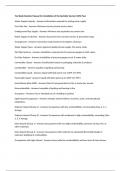
Test Bank Solution Manual for Installation of the Sprinkler System 100% Pass Water Supply Capacity - Answers Information required for testing water supply Fire Main Size - Answers Minimum size for private service mains Underground Pipe Supply - Answers Minimum size equivalent to system riser Water Supply Treatment - Answers Assessment for corrosive factors & prevention steps Arrangement - Answers Connection requirements & foundation clearance Water Supply Types - Answers Approved public/private supply, fire pump, tanks Wet Pipe Systems - Answers Installation requirements for pressure gauges & relief valves Dry Pipe Systems - Answers Installation of pressure gauges on air & water sides Commodity Classes - Answers Classification based on packaging materials & products Combustible - Answers Capable of igniting and burning Combustible Liquid - Answers Liquid with flash point over 100°F (37.78°C) Flammable Liquid - Answers Liquid with flash point up to 100°F (37.78°C) Heat Release Rate (HRR) - Answers Rate of heat generation by fire in Joules per second Noncombustible - Answers Incapable of igniting and burning in fire Occupancy - Answers Use or intended use of a building or portion Light Hazard Occupancies - Answers Includes animal shelters, churches, clubs, and educational institutions. Ordinary Hazard (Group 1) - Answers Occupancies with low combustibility, not exceeding Class 2, 3, 4 storage. Ordinary Hazard (Group 2) - Answers Occupancies with moderate to high combustibility, exceeding Class 2, 3, 4 storage. Extra Hazard (Group 1) - Answers Occupancies with very high combustibility, presence of dust, lint, or other materials. Extra Hazard (Group 2) - Answers Occupancies with moderate to substantial flammable liquids or extensive shielding of combustibles. Occupancies with Light Hazard - Answers Areas with low combustibility and low rates of heat release. Occupancies with Ordinary Hazard (Group 1) - Answers Areas with low combustibility not exceeding Class 2, 3, 4 storage. Occupancies with Ordinary Hazard (Group 2) - Answers Areas with moderate to high combustibility exceeding Class 2, 3, 4 storage. Occupancies with Extra Hazard (Group 1) - Answers Areas with very high combustibility and presence of dust, lint, or other materials. Occupancies with Extra Hazard (Group 2) - Answers Areas with moderate to substantial flammable liquids or extensive shielding of combustibles. NFPA 13 Property - Answers NFPA 13 is the property of the National Fire Protection Association. BRAZED AND SOLDERED JOINTS - Answers Solder joints must comply with ASTM B828 for copper and copper alloy tube and fittings. Copper tube joints must be brazed, except for specific wet pipe scenarios. SPRINKLER HEAD TYPES - Answers Various types include Upright, Pendent, Sidewall, Sidewall-Type EC, Dry Pendent, Intermediate Level, Corrosion-Resistant, Recessed, and Residential Sprinklers, each with specific usage and installation requirements. ANTIFREEZE SYSTEMS - Answers Antifreeze solutions in systems must adhere to state & local health regulations. Not permitted in ESFR systems unless explicitly listed for such use. PREACTION & DELUGE SYSTEMS - Answers Components must be compatible, and the water control valve's operation must be independent of detection devices & sprinklers. Specific requirements exist for single, non-interlock, and double interlock systems. OUTSIDE SPRINKLERS FOR PROTECTION - Answers Allowed regardless of interior sprinklers. Must protect doors, windows, walls, or any combination. Specific guidelines for water supply, control, and sprinkler placement. Sprinklers - Answers Devices installed to suppress or control fires by discharging water. Protected area per sprinkler - Answers The maximum area a single sprinkler is designed to protect without exceeding its capacity. Sprinkler location - Answers The specific placement of sprinklers to ensure suitable distribution and initiation time performance. Allowed Omission Locations - Answers Areas where fire sprinklers are not required, such as bathrooms, closets, and noncombustible stairways. Clearance from structural members - Answers The distance between sprinklers and structural elements, which if tested and proven not to impact performance negatively, allows for alternative placement. Exposure Protection - Answers Measures to protect against fire exposure, such as wall and window sprinklers in specific locations. K-Factor - Answers A coefficient representing the discharge characteristics of a sprinkler, with different values for various types. Minimum Average Application Rate - Answers The minimum water flow rate per square foot required for effective fire suppression. Installation Requirements - Answers Guidelines specifying the types and locations of sprinklers allowed in different occupancy and hazard classifications. Seismic Protection - Answers Measures to secure sprinkler systems against damage from seismic activity, including bracing and flexible couplings. Seismic Separation Assembly - Answers An approved system to allow movement at structural joints while maintaining the integrity of the sprinkler piping. Clearance for pipes - Answers The space required around pipes passing through floors, walls, and other structures to ensure proper installation and maintenance. Sway Bracing - Answers Bracing installed to prevent excessive movement of piping during seismic events. Hangers and Fasteners Subject to Earthquakes - Answers Requirements for securing hangers and fasteners to withstand horizontal motion during earthquakes. Piping Hanging & Support - Answers Guidelines for supporting sprinkler piping, including hanger features, spacing, and weight-bearing capacity. Non-System Component Support - Answers Prohibition of using sprinkler piping or hangers to support non-system components. Ultimate Allowable Stress - Answers Maximum stress a material can sustain under tension before failure Shared Support Structure - Answers Structure supporting pipe with water & additional weight as per NFPA 13 Incompatible Systems - Answers Systems not suitable to share support with fire sprinkler system due to various factors Seismic Requirements - Answers Standards for hangers to withstand earthquake damage Listing Requirements - Answers Specifications for hanger components attachment to structures Ferrous Metal - Answers Metal containing iron, suitable for hangers & components

Vista previa del contenido

Test Bank Solution Manual for Installation of the Sprinkler System 100% Pass

Water Supply Capacity - Answers Information required for testing water supply

Fire Main Size - Answers Minimum size for private service mains

Underground Pipe Supply - Answers Minimum size equivalent to system riser

Water Supply Treatment - Answers Assessment for corrosive factors & prevention steps

Arrangement - Answers Connection requirements & foundation clearance

Water Supply Types - Answers Approved public/private supply, fire pump, tanks

Wet Pipe Systems - Answers Installation requirements for pressure gauges & relief valves

Dry Pipe Systems - Answers Installation of pressure gauges on air & water sides

Commodity Classes - Answers Classification based on packaging materials & products

Combustible - Answers Capable of igniting and burning

Combustible Liquid - Answers Liquid with flash point over 100°F (37.78°C)

Flammable Liquid - Answers Liquid with flash point up to 100°F (37.78°C)

Heat Release Rate (HRR) - Answers Rate of heat generation by fire in Joules per second

Noncombustible - Answers Incapable of igniting and burning in fire

Occupancy - Answers Use or intended use of a building or portion

Light Hazard Occupancies - Answers Includes animal shelters, churches, clubs, and educational
institutions.

Ordinary Hazard (Group 1) - Answers Occupancies with low combustibility, not exceeding Class 2, 3, 4
storage.

Ordinary Hazard (Group 2) - Answers Occupancies with moderate to high combustibility, exceeding Class
2, 3, 4 storage.

Extra Hazard (Group 1) - Answers Occupancies with very high combustibility, presence of dust, lint, or
other materials.

Extra Hazard (Group 2) - Answers Occupancies with moderate to substantial flammable liquids or
extensive shielding of combustibles.

Occupancies with Light Hazard - Answers Areas with low combustibility and low rates of heat release.


Información del documento

Subido en
5 de octubre de 2024
Número de páginas
4
Escrito en
2024/2025
Tipo
Examen
Contiene
Preguntas y respuestas
$8.49

¿Documento equivocado? Cámbialo gratis Dentro de los 14 días posteriores a la compra y antes de descargarlo, puedes elegir otro documento. Puedes gastar el importe de nuevo.
Escrito por estudiantes que aprobaron
Inmediatamente disponible después del pago
Leer en línea o como PDF

Seller avatar
Los indicadores de reputación están sujetos a la cantidad de artículos vendidos por una tarifa y las reseñas que ha recibido por esos documentos. Hay tres niveles: Bronce, Plata y Oro. Cuanto mayor reputación, más podrás confiar en la calidad del trabajo del vendedor.
TutorJosh
3.4
(74)
Vendido
470
Seguidores
16
Artículos
32483
Última venta
22 horas hace


Por qué los estudiantes eligen Stuvia

Creado por compañeros estudiantes, verificado por reseñas

Calidad en la que puedes confiar: escrito por estudiantes que aprobaron y evaluado por otros que han usado estos resúmenes.

¿No estás satisfecho? Elige otro documento

¡No te preocupes! Puedes elegir directamente otro documento que se ajuste mejor a lo que buscas.

Paga como quieras, empieza a estudiar al instante

Sin suscripción, sin compromisos. Paga como estés acostumbrado con tarjeta de crédito y descarga tu documento PDF inmediatamente.

Student with book image

“Comprado, descargado y aprobado. Así de fácil puede ser.”

Alisha Student

Preguntas frecuentes