Social Psychology 10E
Chapter 8 group processes
Fundamentals of Groups
What is a group? Why join a group?
What is a group?
-A set of individuals who have direct interactions with each other over a period of
time and share a common fate, identity or set of goals
-Or people who have joined membership in a social category based on sex, race or
other attributes
-Groups vary in the extinct to which they are seen as distinct entities
-Collectives: people engaging in a common activity but having little direct interaction
with each other
-Western: more likely to identify with groups based on activity
-Eastern: more likely to identify with groups based on relation
-Modern groups: shifting boundaries and membership, more self-managed, shared
leadership
Why join a group?
-Evolutionary pressure -> higher chances of survival if in group
-Social brain hypothesis: large size of human brain due to complex social worlds
-Social identity theory: Important part of people's feelings of self-worth comes from
identification with particular groups
-Give meaning and purpose, symbolic sense of immortality
Key Features of Groups: Roles, Norms and cohesiveness
-Socialization process:
formal and explicit (initiation, orientation program…)
Implicit (observing)
-Things to learn as a new member: group focused language, expected roles, norms,
cohesiveness
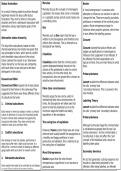
Roles
-Formal and informal (instrumental and expressive)
-Problems when members are assigned a role they are not suited for
-Uncertain about role, role conflicts with other roles
- Uncertainty, instability and conflict-> poor job performance, workplace bullying,
interpersonal conflicts, emotional exhaustion…
-People might get absorbed in role (Stanford prison experiment)
Norms
=Rules of conduct for members
-Either formal or informal
-Strong conformity pressure on individuals who deviate from the norm
, -Low status members my punished deviation especially harsh to heighten their status
-Members might deviate from group norm if they think norm is likely to harm the
group
-Tolerance towards deviation from norm can be seen as norm by itself
Culture and Norms
Tight:
strong norms and little tolerance for behavior deviating from norms
encouraged by ecological and historical threats, higher population density,
restrictive governments, religious institutions
Loose:
weaker norms, greater tolerance
Environment with fewer constraints
Cohesiveness
-Forces exerted on a group that push its members closer together
-Members feel committed to the group task, feel positive towards other group
members, feel group pride, engage in interactions in the group
-Cohesiveness may improve group performance
Culture and Cohesiveness
-Collectivistic:
Obedience and respect towards the leader
Intragroup conflict associated with reduced satisfaction and job performance
-Individualistic:
The opposite of collectivistic
Individuals in Groups: The Presence of Others
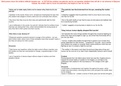
Social Facilitation: When Others Arouse Us
The Zajonc Solution
Three step process
1. Presence of others creates general physiological arousal
2. Arousal enhances individual’s tendency to perform the dominant response
3. Quality of individuals performance varies according to type of task (dominant
response correct for easy task and incorrect for complex task)
-Also found in animals
Alternative Explanations for Social Facilitation
-Mere presence: Presence of others enough to produce arousal
-Evaluation-Apprehension Theory: Arousal only if others in position to evaluate
performance
Distraction-Conflict Theory: Torn between focusing on task and glancing at
distraction-> attention conflict leads to arousal
-All 3 theories influence social facilitation
Social Loafing: When Others Relax Us
-Individuals exert less effort when they act collectively
Chapter 8 group processes
Fundamentals of Groups
What is a group? Why join a group?
What is a group?
-A set of individuals who have direct interactions with each other over a period of
time and share a common fate, identity or set of goals
-Or people who have joined membership in a social category based on sex, race or
other attributes
-Groups vary in the extinct to which they are seen as distinct entities
-Collectives: people engaging in a common activity but having little direct interaction
with each other
-Western: more likely to identify with groups based on activity
-Eastern: more likely to identify with groups based on relation
-Modern groups: shifting boundaries and membership, more self-managed, shared
leadership
Why join a group?
-Evolutionary pressure -> higher chances of survival if in group
-Social brain hypothesis: large size of human brain due to complex social worlds
-Social identity theory: Important part of people's feelings of self-worth comes from
identification with particular groups
-Give meaning and purpose, symbolic sense of immortality
Key Features of Groups: Roles, Norms and cohesiveness
-Socialization process:
formal and explicit (initiation, orientation program…)
Implicit (observing)
-Things to learn as a new member: group focused language, expected roles, norms,
cohesiveness
Roles
-Formal and informal (instrumental and expressive)
-Problems when members are assigned a role they are not suited for
-Uncertain about role, role conflicts with other roles
- Uncertainty, instability and conflict-> poor job performance, workplace bullying,
interpersonal conflicts, emotional exhaustion…
-People might get absorbed in role (Stanford prison experiment)
Norms
=Rules of conduct for members
-Either formal or informal
-Strong conformity pressure on individuals who deviate from the norm
, -Low status members my punished deviation especially harsh to heighten their status
-Members might deviate from group norm if they think norm is likely to harm the
group
-Tolerance towards deviation from norm can be seen as norm by itself
Culture and Norms
Tight:
strong norms and little tolerance for behavior deviating from norms
encouraged by ecological and historical threats, higher population density,
restrictive governments, religious institutions
Loose:
weaker norms, greater tolerance
Environment with fewer constraints
Cohesiveness
-Forces exerted on a group that push its members closer together
-Members feel committed to the group task, feel positive towards other group
members, feel group pride, engage in interactions in the group
-Cohesiveness may improve group performance
Culture and Cohesiveness
-Collectivistic:
Obedience and respect towards the leader
Intragroup conflict associated with reduced satisfaction and job performance
-Individualistic:
The opposite of collectivistic
Individuals in Groups: The Presence of Others
Social Facilitation: When Others Arouse Us
The Zajonc Solution
Three step process
1. Presence of others creates general physiological arousal
2. Arousal enhances individual’s tendency to perform the dominant response
3. Quality of individuals performance varies according to type of task (dominant
response correct for easy task and incorrect for complex task)
-Also found in animals
Alternative Explanations for Social Facilitation
-Mere presence: Presence of others enough to produce arousal
-Evaluation-Apprehension Theory: Arousal only if others in position to evaluate
performance
Distraction-Conflict Theory: Torn between focusing on task and glancing at
distraction-> attention conflict leads to arousal
-All 3 theories influence social facilitation
Social Loafing: When Others Relax Us
-Individuals exert less effort when they act collectively