Emergency Cardiovascular Life Support
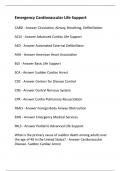
CABD - Answer Circulation, Airway, Breathing, Defibrillation
ACLS - Answer Advanced Cardiac Life Support
AED - Answer Automated External Defibrillator
AHA - Answer American Heart Association
BLS - Answer Basic Life Support
SCA - Answer Sudden Cardiac Arrest
CDC - Answer Centers for Disease Control
CNS - Answer Central Nervous System
CPR - Answer Cardio Pulmonary Resuscitation
FBAO - Answer Foreign Body Airway Obstruction
EMS - Answer Emergency Medical Services
PALS - Answer Pediatric Advanced Life Support
What is the primary cause of sudden death among adults over
the age of 40 in the United States? - Answer Cardiovascular
Disease- Sudden Cardiac Arrest
,What is the most common rhythm immediately after cardiac
arrest?
Describe the 2 basic treatments: - Answer Ventricular
Fibrillation (V-Fib)
CPR is a start, but early defibrillation is the key. A rapid response
is essential.
Compare adult, child, infant resuscitation for the following
categories for two rescuers:
Category:
Compression:
1) Hand Placement-
2) Depth-
3) Rate-
4) Check Pulse- - Answer Adult-
1) Mid-Sternum
2) 2 inches
3) 100 to 120
4) 5 Cycles
Child-
1) Lower Half of Sternum
,2) Heel- One Hand 1/3 to 1/2 Chest
3) 100
4) 5 Cycles
Infant-
1) Sternum with 2 Fingers Placed Just Below Nipple Line in
Center of Chest
2) 2 Fingers 1/2 inches
3) 120
4) 5 Cycles
Obstructed:
1) Mild-
2) Unresponsive- - Answer Adult-
1)Abdominal Thrusts; Chest Thrusts, Call for Help,
2)Check Mouth for FBAO, then Commence CPR.
Child-
1)Chest Thrusts
2)Same, CPR
Infant-
1)Back Blows then 5 Chest Blows. Repeat.
2)CPR
, Ventilation:
1) Rate-
2) Ratio- - Answer Adult-
1) 10
2) 2:30
Child-
1) 12 to 20
2) 2:30
Infant-
1) 20
2) 2:30
You wouldn't want to do CPR on someone who is just sedated.
Once you carefully assess unresponsiveness, you need help!
What should you do in each of these situations?
1) Collapsed outside hospital:
2) Collapsed inside the hospital:
3) How do you quickly check for "signs of life": - Answer Call 9-
11 activate EMS, check for head/neck injury.
CABD - Answer Circulation, Airway, Breathing, Defibrillation
ACLS - Answer Advanced Cardiac Life Support
AED - Answer Automated External Defibrillator
AHA - Answer American Heart Association
BLS - Answer Basic Life Support
SCA - Answer Sudden Cardiac Arrest
CDC - Answer Centers for Disease Control
CNS - Answer Central Nervous System
CPR - Answer Cardio Pulmonary Resuscitation
FBAO - Answer Foreign Body Airway Obstruction
EMS - Answer Emergency Medical Services
PALS - Answer Pediatric Advanced Life Support
What is the primary cause of sudden death among adults over
the age of 40 in the United States? - Answer Cardiovascular
Disease- Sudden Cardiac Arrest
,What is the most common rhythm immediately after cardiac
arrest?
Describe the 2 basic treatments: - Answer Ventricular
Fibrillation (V-Fib)
CPR is a start, but early defibrillation is the key. A rapid response
is essential.
Compare adult, child, infant resuscitation for the following
categories for two rescuers:
Category:
Compression:
1) Hand Placement-
2) Depth-
3) Rate-
4) Check Pulse- - Answer Adult-
1) Mid-Sternum
2) 2 inches
3) 100 to 120
4) 5 Cycles
Child-
1) Lower Half of Sternum
,2) Heel- One Hand 1/3 to 1/2 Chest
3) 100
4) 5 Cycles
Infant-
1) Sternum with 2 Fingers Placed Just Below Nipple Line in
Center of Chest
2) 2 Fingers 1/2 inches
3) 120
4) 5 Cycles
Obstructed:
1) Mild-
2) Unresponsive- - Answer Adult-
1)Abdominal Thrusts; Chest Thrusts, Call for Help,
2)Check Mouth for FBAO, then Commence CPR.
Child-
1)Chest Thrusts
2)Same, CPR
Infant-
1)Back Blows then 5 Chest Blows. Repeat.
2)CPR
, Ventilation:
1) Rate-
2) Ratio- - Answer Adult-
1) 10
2) 2:30
Child-
1) 12 to 20
2) 2:30
Infant-
1) 20
2) 2:30
You wouldn't want to do CPR on someone who is just sedated.
Once you carefully assess unresponsiveness, you need help!
What should you do in each of these situations?
1) Collapsed outside hospital:
2) Collapsed inside the hospital:
3) How do you quickly check for "signs of life": - Answer Call 9-
11 activate EMS, check for head/neck injury.