Solution
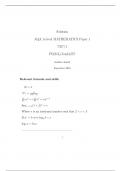
AQA A-level MATHEMATICS Paper 1
7357/1
PB/KL/Jun23/E7
shahbaz ahmed
September 2024
Relevant formula and skills
0! = 1
n n!
Cr = r!(n−r)!
d n d n
dx cx = c dx x = nxn−1
limn−→∞ (1 + n1 )n = e
Where e is an irrational number such that 2 < e < 3
If ax = b ⇐⇒ loga b = x
loge x = ln x
................................................................
1
, To expand cos(θ) using Taylor’s theorem up to three terms around
x = 0, we can use the formula:
f ′′ (0) 2 f ′′′ (0) 3
f (x) = f (0) + f ′ (0)x + x + x + R3 (x)
2! 3!
where R3 (x) is the remainder term. For cos(θ):
1. **Function and its derivatives**: - f (θ) = cos(θ) - f ′ (x) =
− sin(x) - f ′′ (x) = − cos(x) - f ′′′ (x) = sin(x) - f (4) (x) = cos(x) (and it
repeats)
2. **Evaluating at x = 0**: - f (0) = cos(0) = 1 - f ′ (0) = − sin(0) =
0 - f ′′ (0) = − cos(0) = −1 - f ′′′ (0) = sin(0) = 0
3. **Constructing the expansion**: Using the derivatives:
−1 2 θ3
cos(θ) ≈ 1 + 0 · θ + θ +0·
2! 3!
Simplifying this gives:
θ2
cos(θ) ≈ 1 −
2
Thus, the Taylor series expansion of cos(θ) up to three terms is:
2
, θ2
cos(θ) ≈ 1 − + 0 · θ3
2
For practical purposes, we can stop at the quadratic term, resulting
in:
θ2
cos(θ) ≈ 1 −
2
............................................................................
cos(α + β) = cos α cos β − sin α sin β
Put α = β = x
cos 2x = cos2 x − sin2 x
From equation
cos2 x + sin2 x = 1 ⇐⇒ cos2 x = 1 − sin2 x
=⇒ cos 2x = cos2 x − sin2 x = 1 − sin2 x − sin2 x = 1 − 2 sin2 x
Similarly
From equation
cos2 x + sin2 x = 1 ⇐⇒ sin2 x = 1 − cos2 x
=⇒
cos 2x = cos2 x − sin2 x = cos2 x − (1 − cos2 x) = 2 cos2 x − 1
3
, .....................................................................
log m + log n = log mn
log m
n = log m − log n
log mn = n log m
...........................................................................
Integration by parts
Z Z
u dv = uv − v du
..........................................................................
Q1. Find the coefficient of x7 in the expansion of
(2x − 3)7
Circle your answer.
128
−2187 − 128 2
Solution
Using the formula
4
AQA A-level MATHEMATICS Paper 1
7357/1
PB/KL/Jun23/E7
shahbaz ahmed
September 2024
Relevant formula and skills
0! = 1
n n!
Cr = r!(n−r)!
d n d n
dx cx = c dx x = nxn−1
limn−→∞ (1 + n1 )n = e
Where e is an irrational number such that 2 < e < 3
If ax = b ⇐⇒ loga b = x
loge x = ln x
................................................................
1
, To expand cos(θ) using Taylor’s theorem up to three terms around
x = 0, we can use the formula:
f ′′ (0) 2 f ′′′ (0) 3
f (x) = f (0) + f ′ (0)x + x + x + R3 (x)
2! 3!
where R3 (x) is the remainder term. For cos(θ):
1. **Function and its derivatives**: - f (θ) = cos(θ) - f ′ (x) =
− sin(x) - f ′′ (x) = − cos(x) - f ′′′ (x) = sin(x) - f (4) (x) = cos(x) (and it
repeats)
2. **Evaluating at x = 0**: - f (0) = cos(0) = 1 - f ′ (0) = − sin(0) =
0 - f ′′ (0) = − cos(0) = −1 - f ′′′ (0) = sin(0) = 0
3. **Constructing the expansion**: Using the derivatives:
−1 2 θ3
cos(θ) ≈ 1 + 0 · θ + θ +0·
2! 3!
Simplifying this gives:
θ2
cos(θ) ≈ 1 −
2
Thus, the Taylor series expansion of cos(θ) up to three terms is:
2
, θ2
cos(θ) ≈ 1 − + 0 · θ3
2
For practical purposes, we can stop at the quadratic term, resulting
in:
θ2
cos(θ) ≈ 1 −
2
............................................................................
cos(α + β) = cos α cos β − sin α sin β
Put α = β = x
cos 2x = cos2 x − sin2 x
From equation
cos2 x + sin2 x = 1 ⇐⇒ cos2 x = 1 − sin2 x
=⇒ cos 2x = cos2 x − sin2 x = 1 − sin2 x − sin2 x = 1 − 2 sin2 x
Similarly
From equation
cos2 x + sin2 x = 1 ⇐⇒ sin2 x = 1 − cos2 x
=⇒
cos 2x = cos2 x − sin2 x = cos2 x − (1 − cos2 x) = 2 cos2 x − 1
3
, .....................................................................
log m + log n = log mn
log m
n = log m − log n
log mn = n log m
...........................................................................
Integration by parts
Z Z
u dv = uv − v du
..........................................................................
Q1. Find the coefficient of x7 in the expansion of
(2x − 3)7
Circle your answer.
128
−2187 − 128 2
Solution
Using the formula
4