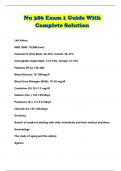
NU 386 Exam 3 Guide With
Complete Solution
Laboratory tests
CBC:
-Hgb: Male 14-18 g/dL, Female 12-16 g/dL
-Hct: Male 42-52% Female 37-47%
-Total RBC: Male 4.5-6.0 Female 4.5-5.0
-MCV: 78-100
-MCH: 27.0-32.0
-WBC: 5,000-10,000
-WBC differential: 150,000-300,000
-PLT: 150,000-400,000
Coagulation:
-Hep Xa (IV heparin): 0.3 to 0.79 IU/mL
-PT/INR (warfarin): 2.0-3.0
-PLT: Help to form clots to stop bleeding
-d-dimer: 0.50 mg/L
Miscellaneous:
,-Ferritin: measures a protein inside the blood that stores iron
-Erythrocyte Sedimentation Rate (ESR): a blood test that that can show if you
have inflammation in your body
-C-Reactive Protein: produced by the liver, test is used to check for
inflammation in the body
-Bilirubin: is used to find out how well your liver is working
-Schilling Test: vitamin b12 absorption test
-BNP: detects heart failure by measuring the amount of BNP or its
prohormone NT-proBNP in the bloodstream
Before starting a blood transfusion
-Verify that there is an order for the transfusion
-Conduct thorough physical assessment of the patient (VS) to help identify
later changes
-Document findings, confirm that the patient has given informed consent
-Teach the patient about the procedures associated risks and benefits, s/s of
a reaction and how to call for assistance
-Check for appropriate venous access, 22g or larger is needed
-Be aware of blood type, blood product , and infusion rate
-Thoroughly double check the pts identification & verify the product
-Infuse the blood product w/normal saline only using filtered y-tubing
How do you ensure safety before a blood transfusion?
,-Ensure that patient has given consent and is aware of the risks/benefits
-Double check the patients information using two patient identifiers
-Check the unit to be transferred against patient identifiers and verify the
actual product
-Infuse with NORMAL SALINE ONLY
Administration of blood: procedure
-Administer w/ a 22g IV needle, canula, or catheter (18g or 16g may be
preferred if rapid transfusion is given)
-Smaller needles can be used for platelets, albumin, and clotting factor
replacement
-Verify venous patency before requesting the blood component from the
blood bank
-To administer, use a "y" type microaggregate filter with one arm of the
tubing for saline and the other for the blood product
Blood transfusions: notes
-DO NOT give dextrose solutions (D5w) or Lactated ringers, they will cause
RBC hemolysis
-DO NOT give any additives via the same tubing as the blood
, -Administer the blood as soon as it is brought to the patient, DO NOT
refrigerate on unit, use w/in 30 min
-Remain by bedside during the first 15min or 50mL of infusion, rate of admin
should not exceed 2L/min at this time
-Reassess vital signs after first 15 min, observe patient periodically through
infusion
-Most pts not in danger of fluid overload can tolerate 1 unit of PRBCs over
2hrs
-Never store blood components in unmonitored refrigerators on unit
Steps for blood transfusion reaction
1) Stop the transfusion
2) Maintain a patient IV line w/ saline solution
3) Notify the blood bank & provider immediately
4) Recheck identifying tags and numbers
5) Monitor vital signs and urine output
6) Treat symptoms per provider
7) Save the blood bag & tubing and send them to the blood bank for
Complete Solution
Laboratory tests
CBC:
-Hgb: Male 14-18 g/dL, Female 12-16 g/dL
-Hct: Male 42-52% Female 37-47%
-Total RBC: Male 4.5-6.0 Female 4.5-5.0
-MCV: 78-100
-MCH: 27.0-32.0
-WBC: 5,000-10,000
-WBC differential: 150,000-300,000
-PLT: 150,000-400,000
Coagulation:
-Hep Xa (IV heparin): 0.3 to 0.79 IU/mL
-PT/INR (warfarin): 2.0-3.0
-PLT: Help to form clots to stop bleeding
-d-dimer: 0.50 mg/L
Miscellaneous:
,-Ferritin: measures a protein inside the blood that stores iron
-Erythrocyte Sedimentation Rate (ESR): a blood test that that can show if you
have inflammation in your body
-C-Reactive Protein: produced by the liver, test is used to check for
inflammation in the body
-Bilirubin: is used to find out how well your liver is working
-Schilling Test: vitamin b12 absorption test
-BNP: detects heart failure by measuring the amount of BNP or its
prohormone NT-proBNP in the bloodstream
Before starting a blood transfusion
-Verify that there is an order for the transfusion
-Conduct thorough physical assessment of the patient (VS) to help identify
later changes
-Document findings, confirm that the patient has given informed consent
-Teach the patient about the procedures associated risks and benefits, s/s of
a reaction and how to call for assistance
-Check for appropriate venous access, 22g or larger is needed
-Be aware of blood type, blood product , and infusion rate
-Thoroughly double check the pts identification & verify the product
-Infuse the blood product w/normal saline only using filtered y-tubing
How do you ensure safety before a blood transfusion?
,-Ensure that patient has given consent and is aware of the risks/benefits
-Double check the patients information using two patient identifiers
-Check the unit to be transferred against patient identifiers and verify the
actual product
-Infuse with NORMAL SALINE ONLY
Administration of blood: procedure
-Administer w/ a 22g IV needle, canula, or catheter (18g or 16g may be
preferred if rapid transfusion is given)
-Smaller needles can be used for platelets, albumin, and clotting factor
replacement
-Verify venous patency before requesting the blood component from the
blood bank
-To administer, use a "y" type microaggregate filter with one arm of the
tubing for saline and the other for the blood product
Blood transfusions: notes
-DO NOT give dextrose solutions (D5w) or Lactated ringers, they will cause
RBC hemolysis
-DO NOT give any additives via the same tubing as the blood
, -Administer the blood as soon as it is brought to the patient, DO NOT
refrigerate on unit, use w/in 30 min
-Remain by bedside during the first 15min or 50mL of infusion, rate of admin
should not exceed 2L/min at this time
-Reassess vital signs after first 15 min, observe patient periodically through
infusion
-Most pts not in danger of fluid overload can tolerate 1 unit of PRBCs over
2hrs
-Never store blood components in unmonitored refrigerators on unit
Steps for blood transfusion reaction
1) Stop the transfusion
2) Maintain a patient IV line w/ saline solution
3) Notify the blood bank & provider immediately
4) Recheck identifying tags and numbers
5) Monitor vital signs and urine output
6) Treat symptoms per provider
7) Save the blood bag & tubing and send them to the blood bank for