Project management
Def.
= A project can be defined as a group of people, usually from various fields of expertise,
collaborating temporarily with the aim of reaching a predetermined project result within a
predetermined budget within a predetermined time frame.
(never learn definitions by heart. Try to understand. Remember bit by bit)
Types of activities
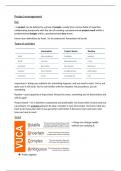
Improvised = things you suddenly do, something happens, and you need to react. You’re not
quite sure it will work. You’re not familiar with the situation. No procedures, just do
something.
Routine = exact opposite of improvised. Always the same, something you’ve done before and
will do again.
Project-based = it’s in between unexpected and predictable. You know when it starts and you
can prepare. It’s probably going to be okay. A project is new and unique. You know what you
have to do if you plan well. If you go further and further it becomes more and more clear
how you have to react.
VUCA
= things can change rapidly
without you realizing it.
Pretty negative
,Positive version in project management
= try to react in a flexible way
when things change.
What’s a project?
- Building a new shopping centre, bridge, housing estate, nursing home….
- Relocating a large company to a new location, moving
- Organizing a major event (exhibition, sports event or music festival)
- Implementing software at a company
- Introducing a new electronic learning environment
- Developing and launching a new product (developing and launch are 2 different
projects)
- Setting up a website
- Doing a theater production or film
- …
Project features
- Temporary
o Clear starting point (start-up or kick-off)
o Finishing date
Moving because it ends when you’ve settled
- Unique and clearly defined goal
- Sponsor who has commissioned the project
o Is not always a commercial sponsor, here it is a project sponsor.
Commercial sponsor gives money to do the project. For example a bar
who gives you money for organizing a KSA party.
o He is the one who askes you to do the project. In some cases the commercial
and project sponsor are the same person, like when moving.
o In most cases a project manager works for a project sponsor.
, - A project has a budget
- Project members with different expertise
- Own organizational set-up
o You have to set-up a project
- A project must be initiated
From improvisation to routine
Project has a start and
finish, when finished it
can become a routine
For example you
design a new car with
fifth wheel, this car
gets in production and
becomes a routine.
Types of projects
- Technical projects
o Effect change in technology or come up with a new product
o E.g. construction of a bridge, railway line or computer network
For example, you develop a new Iphone
- Social projects
o Change the corporate culture or organizational structure of a company
o E.g. adapting working procedures, reorganization of a company
o Also known as ‘soft’ projects most difficult projects
About people, this makes it a soft project. The most difficult one, you
have to let some go. For example you don’t need 100 people so you
have to let 25 go.
- Commercial projects
o Ultimate goal is to earn money
o E.g. conducting market research or introducing a new product on the market
Just focus on selling. For example launching a new Iphone, bring it into
the market and selling as much as u can.
- Mixed projects
o Combine some of the aspects of both technical and social projects
o E.g. the design, programming and installation of an extensive computer
program
o “They do not speak each other’s language”
Mix of technical and social. For example you develop a new way of
working which possibly results in letting some people go. The 2 teams
don’t speak each others language, IT’s thing more about the technical
stuff and not the usability, they don’t think about the user.
, - Events
o The end result only appears at a certain point in time
o E.g. computer fair, pop festival, quiz, car show
Only know at the end if it’s a good project. The project starts when you
have an idea and ends before the execution of the event. The party is
the finally of the project.
Phasing and products
Each phase leads to a product / paper
Why phasing?
- Phasing minimizes the risks associated with the project.
o You have complete control
- A number of opportunities for decision making are built into the project. At the end
of each phase the sponsor has an opportunity to alter the project:
o Continue as planned
o Continue with some alterations to the project
o Termination of the project
At the end of each phase, you have a moment to reflect. Here you can
consult your project sponsor.
- Termination? Requires a great deal of courage. After all, a lot of time and effort has
already been invested in it.
- In general: benefits <-> the costs, during each phase of the project.
o Stop when the costs are higher than the benefits.
Def.
= A project can be defined as a group of people, usually from various fields of expertise,
collaborating temporarily with the aim of reaching a predetermined project result within a
predetermined budget within a predetermined time frame.
(never learn definitions by heart. Try to understand. Remember bit by bit)
Types of activities
Improvised = things you suddenly do, something happens, and you need to react. You’re not
quite sure it will work. You’re not familiar with the situation. No procedures, just do
something.
Routine = exact opposite of improvised. Always the same, something you’ve done before and
will do again.
Project-based = it’s in between unexpected and predictable. You know when it starts and you
can prepare. It’s probably going to be okay. A project is new and unique. You know what you
have to do if you plan well. If you go further and further it becomes more and more clear
how you have to react.
VUCA
= things can change rapidly
without you realizing it.
Pretty negative
,Positive version in project management
= try to react in a flexible way
when things change.
What’s a project?
- Building a new shopping centre, bridge, housing estate, nursing home….
- Relocating a large company to a new location, moving
- Organizing a major event (exhibition, sports event or music festival)
- Implementing software at a company
- Introducing a new electronic learning environment
- Developing and launching a new product (developing and launch are 2 different
projects)
- Setting up a website
- Doing a theater production or film
- …
Project features
- Temporary
o Clear starting point (start-up or kick-off)
o Finishing date
Moving because it ends when you’ve settled
- Unique and clearly defined goal
- Sponsor who has commissioned the project
o Is not always a commercial sponsor, here it is a project sponsor.
Commercial sponsor gives money to do the project. For example a bar
who gives you money for organizing a KSA party.
o He is the one who askes you to do the project. In some cases the commercial
and project sponsor are the same person, like when moving.
o In most cases a project manager works for a project sponsor.
, - A project has a budget
- Project members with different expertise
- Own organizational set-up
o You have to set-up a project
- A project must be initiated
From improvisation to routine
Project has a start and
finish, when finished it
can become a routine
For example you
design a new car with
fifth wheel, this car
gets in production and
becomes a routine.
Types of projects
- Technical projects
o Effect change in technology or come up with a new product
o E.g. construction of a bridge, railway line or computer network
For example, you develop a new Iphone
- Social projects
o Change the corporate culture or organizational structure of a company
o E.g. adapting working procedures, reorganization of a company
o Also known as ‘soft’ projects most difficult projects
About people, this makes it a soft project. The most difficult one, you
have to let some go. For example you don’t need 100 people so you
have to let 25 go.
- Commercial projects
o Ultimate goal is to earn money
o E.g. conducting market research or introducing a new product on the market
Just focus on selling. For example launching a new Iphone, bring it into
the market and selling as much as u can.
- Mixed projects
o Combine some of the aspects of both technical and social projects
o E.g. the design, programming and installation of an extensive computer
program
o “They do not speak each other’s language”
Mix of technical and social. For example you develop a new way of
working which possibly results in letting some people go. The 2 teams
don’t speak each others language, IT’s thing more about the technical
stuff and not the usability, they don’t think about the user.
, - Events
o The end result only appears at a certain point in time
o E.g. computer fair, pop festival, quiz, car show
Only know at the end if it’s a good project. The project starts when you
have an idea and ends before the execution of the event. The party is
the finally of the project.
Phasing and products
Each phase leads to a product / paper
Why phasing?
- Phasing minimizes the risks associated with the project.
o You have complete control
- A number of opportunities for decision making are built into the project. At the end
of each phase the sponsor has an opportunity to alter the project:
o Continue as planned
o Continue with some alterations to the project
o Termination of the project
At the end of each phase, you have a moment to reflect. Here you can
consult your project sponsor.
- Termination? Requires a great deal of courage. After all, a lot of time and effort has
already been invested in it.
- In general: benefits <-> the costs, during each phase of the project.
o Stop when the costs are higher than the benefits.