A-level Psychology
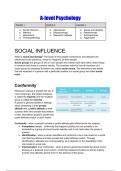
PAPER 1 PAPER 2 PAPER 3
a. Social influence a. Approaches a. Issues and debates
b. Memory b. Biopsychology b. Relationships
c. Attachment c. Research methods c. Schizophrenia
d. Psychopathology d. Aggression
SOCIAL INFLUENCE
What is social psychology? The study of how people’s behaviours and attitudes are
influenced by the presence, actual or imagined, of other people.
Social groups are groups of two or more people who interact with each other, share things
in common and share a common identity. The unwritten rules for how all members of a
social group are expected to behave are called social norms. The behaviours and beliefs
that are expected of a person with a particular position in a social group are called social
roles.
Conformity
Whenever a group is divided into two or
more subgroups, the largest subgroup
is called the majority and the smallest
group is called the minority.
A person’s genuine beliefs or feelings
about something is their private
attitude and a public attitude is what
a person tells other people they believe
or feel. Sometimes people’s private and
public attitudes match or don’t match.
Conformity - when a person’s private or public attitude gets influenced by the majority.
➢ Compliance (weak) - conformity that happens publicly but not privately to be
accepted by a group and avoid social rejection and it only lasts when the group is
present.
➢ Identification - when a person identifies and conforms to be a role model or a social
role that they admire and their private and public attitudes match. Through
identification, attitudes are not long-lasting, as it depends on the desirability of the
role model or social role.
➢ Internalisation (true conformity) - when a person genuinely accepts the group norms
because it is believed to be correct, conformity happens privately as well as publicly
and the new attitudes persist even in the absence of the group.
, EXPLANATIONS OF CONFORMITY
1. Normative social influence - explains conformity by compliance, people conform
because they want to be liked and accepted by the group, people change their public
attitudes to avoid rejection, even though their private attitude is different and it is
likely to occur when social pressure is high. However, it can’t explain why people
conform when social pressure is low.
2. Informational social influence - explains conformity by internalisation, individuals
conform when they are uncertain in ambiguous situations, thinking that the majority is
likely to be correct, it occurs when the task difficulty is high even with low social
pressure.
If social pressure and uncertainty are both high, conformity can be explained by both
normative and informational social influence.
VARIABLES THAT AFFECT CONFORMITY
Situational:
1. Group size (bigger) - conformity increases with group size; the bigger the majority
already is, the smaller are effects of increasing group size.
2. Unanimity (higher) - the extent to which all members of a group agree. The higher
the unanimity more people are likely to conform.
3. Tax difficulty (more) - when a task is more difficult people are more likely to
conform.
Individual/dispositional variables - personal characteristics that affect conformity, such as
personality, mode, gender, and culture.
ZIMBARDO’S STANFORD PRISON EXPERIMENT 1971
Philip Zimbardo's, aim was to investigate if prison brutality happens because of the
personality of guards and prisoners or because they are conforming to social roles.
He turned the basement of his university into a mock prison. 75 male university students
responded to Zimbardo’s newspaper advert; 21 were recruited to participate in the study
and they were randomly divided to play the role of prisoners or guards. Zimbardo tried to
simulate a real prison, prisoners were arrested, fingerprinted stripped off of their clothes
and made to dress like prisoners; the guards dressed with uniforms and sunglasses and
were given handcuffs and bats. Zimbardo put the participants in a controlled environment
and observed their behaviour (controlled overt observation). The prisoners tried to rebel
and barricaded themselves in their cells by putting their beds against the doors; the guards
got mad and crushed the rebellion forcing the prisoners away from the door and using fire
extinguishers, they broke into the cells and stripped the prisoners of their clothes, after that
the guards become more brutal they taunted the prisoners and gave them meaningless task
to do. Prisoners who protested were punished and were placed in solitary confinement,
prevented from peeing and made to sleep on the floor. Whereas prisoners who sided with
the guards were given special privileges. The prisoners became more and more submissive
and eventually started to go crazy, one prisoner was released after a fit of hysterical crying
another one went on a hunger strike. After 6 days Zimbardo’s girlfriend stepped in and
begged him to stop the experiment.
PAPER 1 PAPER 2 PAPER 3
a. Social influence a. Approaches a. Issues and debates
b. Memory b. Biopsychology b. Relationships
c. Attachment c. Research methods c. Schizophrenia
d. Psychopathology d. Aggression
SOCIAL INFLUENCE
What is social psychology? The study of how people’s behaviours and attitudes are
influenced by the presence, actual or imagined, of other people.
Social groups are groups of two or more people who interact with each other, share things
in common and share a common identity. The unwritten rules for how all members of a
social group are expected to behave are called social norms. The behaviours and beliefs
that are expected of a person with a particular position in a social group are called social
roles.
Conformity
Whenever a group is divided into two or
more subgroups, the largest subgroup
is called the majority and the smallest
group is called the minority.
A person’s genuine beliefs or feelings
about something is their private
attitude and a public attitude is what
a person tells other people they believe
or feel. Sometimes people’s private and
public attitudes match or don’t match.
Conformity - when a person’s private or public attitude gets influenced by the majority.
➢ Compliance (weak) - conformity that happens publicly but not privately to be
accepted by a group and avoid social rejection and it only lasts when the group is
present.
➢ Identification - when a person identifies and conforms to be a role model or a social
role that they admire and their private and public attitudes match. Through
identification, attitudes are not long-lasting, as it depends on the desirability of the
role model or social role.
➢ Internalisation (true conformity) - when a person genuinely accepts the group norms
because it is believed to be correct, conformity happens privately as well as publicly
and the new attitudes persist even in the absence of the group.
, EXPLANATIONS OF CONFORMITY
1. Normative social influence - explains conformity by compliance, people conform
because they want to be liked and accepted by the group, people change their public
attitudes to avoid rejection, even though their private attitude is different and it is
likely to occur when social pressure is high. However, it can’t explain why people
conform when social pressure is low.
2. Informational social influence - explains conformity by internalisation, individuals
conform when they are uncertain in ambiguous situations, thinking that the majority is
likely to be correct, it occurs when the task difficulty is high even with low social
pressure.
If social pressure and uncertainty are both high, conformity can be explained by both
normative and informational social influence.
VARIABLES THAT AFFECT CONFORMITY
Situational:
1. Group size (bigger) - conformity increases with group size; the bigger the majority
already is, the smaller are effects of increasing group size.
2. Unanimity (higher) - the extent to which all members of a group agree. The higher
the unanimity more people are likely to conform.
3. Tax difficulty (more) - when a task is more difficult people are more likely to
conform.
Individual/dispositional variables - personal characteristics that affect conformity, such as
personality, mode, gender, and culture.
ZIMBARDO’S STANFORD PRISON EXPERIMENT 1971
Philip Zimbardo's, aim was to investigate if prison brutality happens because of the
personality of guards and prisoners or because they are conforming to social roles.
He turned the basement of his university into a mock prison. 75 male university students
responded to Zimbardo’s newspaper advert; 21 were recruited to participate in the study
and they were randomly divided to play the role of prisoners or guards. Zimbardo tried to
simulate a real prison, prisoners were arrested, fingerprinted stripped off of their clothes
and made to dress like prisoners; the guards dressed with uniforms and sunglasses and
were given handcuffs and bats. Zimbardo put the participants in a controlled environment
and observed their behaviour (controlled overt observation). The prisoners tried to rebel
and barricaded themselves in their cells by putting their beds against the doors; the guards
got mad and crushed the rebellion forcing the prisoners away from the door and using fire
extinguishers, they broke into the cells and stripped the prisoners of their clothes, after that
the guards become more brutal they taunted the prisoners and gave them meaningless task
to do. Prisoners who protested were punished and were placed in solitary confinement,
prevented from peeing and made to sleep on the floor. Whereas prisoners who sided with
the guards were given special privileges. The prisoners became more and more submissive
and eventually started to go crazy, one prisoner was released after a fit of hysterical crying
another one went on a hunger strike. After 6 days Zimbardo’s girlfriend stepped in and
begged him to stop the experiment.