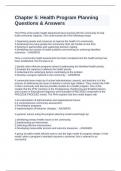
Chapter 5: Health Program Planning
Questions & Answers
The PHNs at the public health department have teamed with the community to help
build community capacity. This could include all of the following except:
1.Organizing assets and resources to improve the health of a community.
2.Assessing how many people the community clinic will contain at one time.
3.Working in partnerships and supporting decision making.
4.Identifying root causes of health problems and working on achieving identified
outcomes. - ANSWER2
Once a community health assessment has been completed and the health priority has
been established, the first step is to:
1.Identify other effective programs aimed at addressing the identified health priority.
2.Evaluate the capacity to address the health priority.
3.Understand the underlying factors contributing to the problem
4.Develop a program tailored to the community. - ANSWER3
A community team made up of school administrators, parents, and teachers is in the
process of addressing the issue of obesity in school age children. They contact the PHN
in their community and discuss possible models for a health program. One of the
models that the PHN mentions is the Predisposing, Reinforcing and Enabling factors,
and Causes in Educational Diagnosis and Evaluation (PRECEDE) component of the
PRECEDE-PROCEED model. The PHN explains that this model begins with:
1.An examination of administrative and organizational issues.
2.A comprehensive community assessment.
3.Preventative programs.
4.Implementation of behavior changes. - ANSWER2
In general, nurses using the program planning model would begin by:
1.Identifying primary health issues in the community.
2.Implementing an intervention.
3.Selecting effective interventions.
4.Developing measurable process and outcome measures. - ANSWER1
A group of public health officials want to use the logic model for program design. In this
model, when a program's intended outcome is achieved, this is referred to as
successful:
Questions & Answers
The PHNs at the public health department have teamed with the community to help
build community capacity. This could include all of the following except:
1.Organizing assets and resources to improve the health of a community.
2.Assessing how many people the community clinic will contain at one time.
3.Working in partnerships and supporting decision making.
4.Identifying root causes of health problems and working on achieving identified
outcomes. - ANSWER2
Once a community health assessment has been completed and the health priority has
been established, the first step is to:
1.Identify other effective programs aimed at addressing the identified health priority.
2.Evaluate the capacity to address the health priority.
3.Understand the underlying factors contributing to the problem
4.Develop a program tailored to the community. - ANSWER3
A community team made up of school administrators, parents, and teachers is in the
process of addressing the issue of obesity in school age children. They contact the PHN
in their community and discuss possible models for a health program. One of the
models that the PHN mentions is the Predisposing, Reinforcing and Enabling factors,
and Causes in Educational Diagnosis and Evaluation (PRECEDE) component of the
PRECEDE-PROCEED model. The PHN explains that this model begins with:
1.An examination of administrative and organizational issues.
2.A comprehensive community assessment.
3.Preventative programs.
4.Implementation of behavior changes. - ANSWER2
In general, nurses using the program planning model would begin by:
1.Identifying primary health issues in the community.
2.Implementing an intervention.
3.Selecting effective interventions.
4.Developing measurable process and outcome measures. - ANSWER1
A group of public health officials want to use the logic model for program design. In this
model, when a program's intended outcome is achieved, this is referred to as
successful: