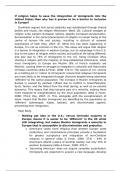
If religion helps to ease the integration of immigrants into the
United States then why has it proven to be a barrier to inclusion
in Europe?
Durkheim argued that social solidarity was established through shared
beliefs and rituals, like religion (McGovern: Week 10). Cultural vestiges of
religion unite western European nations, despite increased secularisation.
Secularisation is the social phenomenon of religion no longer being at the
centre of human life and society, resulting in distrust of outward
expressions of faith (Roy, 2007: 8). While this has been happening in
Europe, it is not as common in the U.S. This essay will argue that religion
is a barrier to integration in western Europe, but an advantage in the U.S.
due to the place of religion within society and political life being different;
and also due to 75% of immigrants to the U.S. being Christian (thus
sharing a religion with the majority of long-established Americans), while
most immigrants to Europe are Muslim (8% of French residents are
Muslim), causing them to struggle to integrate in culturally and historically
Christian countries (Alba & Foner, 2008: 374-5). The nature of U.S. society
as a melting pot or ‘nation of immigrants’ means that religious immigrants
are more likely to be integrated through churches despite being otherwise
‘different’ to the native population. The increase in Muslim immigrants to
Europe is caused by postwar inflows due to conflict in Israel-Palestine,
Syria, Yemen, and the fallout from the Arab Spring; as well as ex-colonial
dynamics. This means that they become part of a minority, making them
more exposed to marginalisation by the local population (Alba & Foner,
2008: 374-5; Roy, 2007: 2). This, alongside with the exceptionalism of
Islam, means that Muslim immigrants are identified by the population as
‘different’ (phenotype, hijabs, beards), and discriminated against,
preventing their integration.
Main Body:
- Melting pot idea in the U.S.; versus Christian majority in
Europe means it is easier to be ‘different’ in the US while
still integrating, but makes Muslim immigrants a minority in
Europe that is susceptible to discrimination and prejudice.
o Americans vastly more religious than western Europe: state
institutions and constitutional principles provide a foundation
for greater acceptance and integration of non-Christian
religions in general (Alba & Foner, 2008: 374) – 44% of
Americans attend a place of worship weekly; but only 15% of
western Europeans (Alba & Foner, 2008: 376-7)
o ‘becoming American’ does not require complete assimilation:
immigrants are expected to acquire a new language, develop
, new loyalties, and learn basic tenets of political culture; but
they aren’t required to change their religion to assimilate
(Hirschman, 2004: 1209)
o Europe: Muslim immigrants confront mainly secular majority
populations, making them suspicious of claims based on the
requirements of their religion; also, societal institutions and
national identities remain anchored to an important extent in
Christianity, failing to make equal room for Islam (Alba &
Foner, 2008: 374)
Majority of holidays in western European countries are
Christian [6/10 in France (Tolan, 2017: 48)], but Jewish or
Muslims are criticised for not integrating if they ask for
days off to observe religious holidays
Added component of secularisation – means Europe
remains culturally Christian even if it is less official
Harder to integrate as Muslim immigrants don’t join
native European church communities
anti-headscarf policy not simply manifestation of racism
or Islamophobia – they also betray a deep historical
distrust of public manifestation of religion: transference
of hostility traditionally aimed at the Church and
Catholics to Muslims and Islam (Tolan, 2017: 45-6)
also means that religious immigrants are more likely to
be discriminated against regardless of their
denomination.
o No established national religion in the U.S. (even if Christianity
has the most influence); while there is usually an established
national religion, even if it is just historically (i.e. Catholic
schools; or ‘Church of England’ with the monarch at its head
meaning it has a political/nationalist element)
o The resurgence of religion in public debate attributed to
settlement of post-colonial migrants in Europe, majority
Muslim; esp. in the context of post-9/11 and the 2015 terrorist
attacks in France and western Europe as a whole (Germany,
London) (Kastoroyano, 2004: 1234; Tolan, 2017: 47)
- Exceptionalism of Islam – question of whether it is
compatible with ‘western values’ and ‘culture’ (Lucassen,
2004: 4): cause increased Islamophobia and make it harder to
integrate in a hostile culture.
o Popular discourse in western Europe – stress problems and
conflict engendered by immigrants’ religion, and the
perceived difficulties Islam poses for integration; Europe sees
United States then why has it proven to be a barrier to inclusion
in Europe?
Durkheim argued that social solidarity was established through shared
beliefs and rituals, like religion (McGovern: Week 10). Cultural vestiges of
religion unite western European nations, despite increased secularisation.
Secularisation is the social phenomenon of religion no longer being at the
centre of human life and society, resulting in distrust of outward
expressions of faith (Roy, 2007: 8). While this has been happening in
Europe, it is not as common in the U.S. This essay will argue that religion
is a barrier to integration in western Europe, but an advantage in the U.S.
due to the place of religion within society and political life being different;
and also due to 75% of immigrants to the U.S. being Christian (thus
sharing a religion with the majority of long-established Americans), while
most immigrants to Europe are Muslim (8% of French residents are
Muslim), causing them to struggle to integrate in culturally and historically
Christian countries (Alba & Foner, 2008: 374-5). The nature of U.S. society
as a melting pot or ‘nation of immigrants’ means that religious immigrants
are more likely to be integrated through churches despite being otherwise
‘different’ to the native population. The increase in Muslim immigrants to
Europe is caused by postwar inflows due to conflict in Israel-Palestine,
Syria, Yemen, and the fallout from the Arab Spring; as well as ex-colonial
dynamics. This means that they become part of a minority, making them
more exposed to marginalisation by the local population (Alba & Foner,
2008: 374-5; Roy, 2007: 2). This, alongside with the exceptionalism of
Islam, means that Muslim immigrants are identified by the population as
‘different’ (phenotype, hijabs, beards), and discriminated against,
preventing their integration.
Main Body:
- Melting pot idea in the U.S.; versus Christian majority in
Europe means it is easier to be ‘different’ in the US while
still integrating, but makes Muslim immigrants a minority in
Europe that is susceptible to discrimination and prejudice.
o Americans vastly more religious than western Europe: state
institutions and constitutional principles provide a foundation
for greater acceptance and integration of non-Christian
religions in general (Alba & Foner, 2008: 374) – 44% of
Americans attend a place of worship weekly; but only 15% of
western Europeans (Alba & Foner, 2008: 376-7)
o ‘becoming American’ does not require complete assimilation:
immigrants are expected to acquire a new language, develop
, new loyalties, and learn basic tenets of political culture; but
they aren’t required to change their religion to assimilate
(Hirschman, 2004: 1209)
o Europe: Muslim immigrants confront mainly secular majority
populations, making them suspicious of claims based on the
requirements of their religion; also, societal institutions and
national identities remain anchored to an important extent in
Christianity, failing to make equal room for Islam (Alba &
Foner, 2008: 374)
Majority of holidays in western European countries are
Christian [6/10 in France (Tolan, 2017: 48)], but Jewish or
Muslims are criticised for not integrating if they ask for
days off to observe religious holidays
Added component of secularisation – means Europe
remains culturally Christian even if it is less official
Harder to integrate as Muslim immigrants don’t join
native European church communities
anti-headscarf policy not simply manifestation of racism
or Islamophobia – they also betray a deep historical
distrust of public manifestation of religion: transference
of hostility traditionally aimed at the Church and
Catholics to Muslims and Islam (Tolan, 2017: 45-6)
also means that religious immigrants are more likely to
be discriminated against regardless of their
denomination.
o No established national religion in the U.S. (even if Christianity
has the most influence); while there is usually an established
national religion, even if it is just historically (i.e. Catholic
schools; or ‘Church of England’ with the monarch at its head
meaning it has a political/nationalist element)
o The resurgence of religion in public debate attributed to
settlement of post-colonial migrants in Europe, majority
Muslim; esp. in the context of post-9/11 and the 2015 terrorist
attacks in France and western Europe as a whole (Germany,
London) (Kastoroyano, 2004: 1234; Tolan, 2017: 47)
- Exceptionalism of Islam – question of whether it is
compatible with ‘western values’ and ‘culture’ (Lucassen,
2004: 4): cause increased Islamophobia and make it harder to
integrate in a hostile culture.
o Popular discourse in western Europe – stress problems and
conflict engendered by immigrants’ religion, and the
perceived difficulties Islam poses for integration; Europe sees