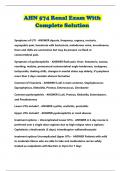
AHN 574 Renal Exam With
Complete Solution
Symptoms of UTI - ANSWER dysuria, frequency, urgency, nocturia,
suprapubic pain, hematuria with bacteriuria, malodorous urine, incontinence,
fever and chills are uncommon but may be present, no flank or
costovertebral pain.
Symptoms of pyelonephritis - ANSWER flank pain, fever, hematuria, nausea,
vomiting, malaise, pronounced costovertebral angle tenderness, tachypnea,
tachycardia, shaking chills, changes in mental status esp elderly, if symptoms
more than 3 days consider abscess formation
Common UTI bacteria - ANSWER E.coli is most common, Staphylococcus
Saprophyticus, Klebsiella, Proteus, Enterococcus, Citrobacter
Common pyelonephritis - ANSWER E.coli, Proteus, Klebsiella, Enterobacter,
and Pseudomonas
Lower UTIs include? - ANSWER cystitis, urethritis, prostatitis
Upper UTIs Include? - ANSWER pyelonephritis or renal abscess
treatment options • Uncomplicated Lower UTIs - ANSWER A 3-day course is
preferred over a single dose regimen due to high relapse rates o options:
Cephalexin, nitrofurantin (5 days), trimethoprim-sulfamethoxazole
treatment options Uncomplicated Upper UTIs - ANSWER Patients with mild
to moderate illness who are able to take oral medications can be safely
treated as outpatients with Bactrim or Cipro for 7 days
, Patients with more severe illness, those who are nauseated or vomiting, and
pregnant patients should be treated initially with parenteral therapy.
May use third-generation cephalosporins, fluoroquinolones, or
aminoglycosides. o Patients of advanced age or with toxemia should be
hospitalized and initiated on aminoglycoside therapy
treatment for pyelonephritis - ANSWER Inpatient- ampicillin and an
aminoglycoside though you will also see a third generation cephalasporin
used IV
Outpatient: Cipro, levofloxacin, trimethoprim-sulfamethaxazole
Do NOT use this antibiotic for pyelonephritis - ANSWER Nitrofurantoin
When do Men need further urologic work up from uti - ANSWER when
treatment fails, in the event of recurrence, or when pyelonephritis occurs
Patients who fail initial empiric treatment in 48 hours - ANSWER
antimicrobial therapy should be changed to treat the pathogen detected by
the initial urine culture and the presence of an anatomic abnormality should
be considered
Treatment for urinary retentino - ANSWER Phenazopyridine hydrocholride
(Pyridium) 200mg PO TID for 48 hours
Avoid these antibiotics during pregnancy and near delivery - ANSWER
Quinolones and Sulfonamides
Antibiotic of choice for pregnancy - ANSWER Cephalexin
prophylactic treatment for uti may be used for who? - ANSWER those with
frequent reinfections (3 or more per year)
,prophylactic UTI treatment includes - ANSWER TMP/SMX, 80mg/400mg or
cephalexin 250mg after coitus.
TMP/SMX, 40mg/200mg QD or QOD for recurrences unrelated to coitus.
additional work up for pyelonephritis includes - ANSWER failure to respond
within 48 hours warrants imaging (CT or ultrasound) to exclude complicating
factors that may require intervention.
Indications for IVP - ANSWER The intravenous pyelogram (IVP) had been the
standard imaging procedure for evaluating the urinary tract because it
provides an assessment of the kidneys, ureters, and bladder.
Useful in diagnosing certain disorders such as medullary sponge kidney and
papillary necrosis
Contraindications for IVP - ANSWER An IVP necessitates the injection of
contrast, however, and is relatively contraindicated in patients at increased
risk for AKI (eg, diabetes mellitus with serum creatinine greater than 2
mg/dL, severe volume depletion, or prerenal azotemia), CKD, and plasma cell
myeloma.
Ultrasonography often replaces IVP to avoid dye administration, and helical
CT scanning often replaces IVP for stone evaluation
If hematuria is present - ANSWER need cystoscopy and excretory urography
AKI is defined as - ANSWER absolute increase in serum creatinine by
0.3mg/dL or more within 48 hours or a relative increase of > or = 1.5 times
baseline that is known or presumed to have occurred within 7 days
Causes of Prerenal AKI - ANSWER Hypovolemia - vomiting, diarrhea,
hyperglycemia with polyuria
, Decreased cardiac output/Decreased effective circulating volume - CHF,
cardiogenic shock, pulmonary embolism, pericardial tamponade,
arrhythmias, valvular disease, liver failure
Changes in systemic vascular resistance - sepsis, anaphylaxis, anesthesia,
after-load reducing drugs
Impaired renal autoregulation -NSAIDS, ACE-I/ARBS, cyclosporines
Treatment of prerenal AKI - ANSWER Goals of therapy include maintain
euvolemia while avoiding overload (LR > NS), monitor & correct electrolytes,
and discontinue & avoid nephrotoxic drugs.
Causes of postrenal AKI - ANSWER Postrenal injury may be caused by
obstruction of the ureters or renal pelvises, bladder dysfunction or
obstruction, or urethral obstruction.
Typically, with unilateral upper urinary tract (kidneys & ureters) obstructions,
the contralateral kidney will compensate.
However, postrenal uropathies can occur when a single kidney is obstructed
if the contralateral kidney can not compensate for the loss in function (as
with advanced CKD)
Physical reasons for post renal aki - ANSWER Retroperitoneal fibrosis
Bilateral ureteral stones
BPH (most common cause in men)
Bladder, prostate, or cervical cancers
Neurogenic bladder
Obstructed Foley catheter
Complete Solution
Symptoms of UTI - ANSWER dysuria, frequency, urgency, nocturia,
suprapubic pain, hematuria with bacteriuria, malodorous urine, incontinence,
fever and chills are uncommon but may be present, no flank or
costovertebral pain.
Symptoms of pyelonephritis - ANSWER flank pain, fever, hematuria, nausea,
vomiting, malaise, pronounced costovertebral angle tenderness, tachypnea,
tachycardia, shaking chills, changes in mental status esp elderly, if symptoms
more than 3 days consider abscess formation
Common UTI bacteria - ANSWER E.coli is most common, Staphylococcus
Saprophyticus, Klebsiella, Proteus, Enterococcus, Citrobacter
Common pyelonephritis - ANSWER E.coli, Proteus, Klebsiella, Enterobacter,
and Pseudomonas
Lower UTIs include? - ANSWER cystitis, urethritis, prostatitis
Upper UTIs Include? - ANSWER pyelonephritis or renal abscess
treatment options • Uncomplicated Lower UTIs - ANSWER A 3-day course is
preferred over a single dose regimen due to high relapse rates o options:
Cephalexin, nitrofurantin (5 days), trimethoprim-sulfamethoxazole
treatment options Uncomplicated Upper UTIs - ANSWER Patients with mild
to moderate illness who are able to take oral medications can be safely
treated as outpatients with Bactrim or Cipro for 7 days
, Patients with more severe illness, those who are nauseated or vomiting, and
pregnant patients should be treated initially with parenteral therapy.
May use third-generation cephalosporins, fluoroquinolones, or
aminoglycosides. o Patients of advanced age or with toxemia should be
hospitalized and initiated on aminoglycoside therapy
treatment for pyelonephritis - ANSWER Inpatient- ampicillin and an
aminoglycoside though you will also see a third generation cephalasporin
used IV
Outpatient: Cipro, levofloxacin, trimethoprim-sulfamethaxazole
Do NOT use this antibiotic for pyelonephritis - ANSWER Nitrofurantoin
When do Men need further urologic work up from uti - ANSWER when
treatment fails, in the event of recurrence, or when pyelonephritis occurs
Patients who fail initial empiric treatment in 48 hours - ANSWER
antimicrobial therapy should be changed to treat the pathogen detected by
the initial urine culture and the presence of an anatomic abnormality should
be considered
Treatment for urinary retentino - ANSWER Phenazopyridine hydrocholride
(Pyridium) 200mg PO TID for 48 hours
Avoid these antibiotics during pregnancy and near delivery - ANSWER
Quinolones and Sulfonamides
Antibiotic of choice for pregnancy - ANSWER Cephalexin
prophylactic treatment for uti may be used for who? - ANSWER those with
frequent reinfections (3 or more per year)
,prophylactic UTI treatment includes - ANSWER TMP/SMX, 80mg/400mg or
cephalexin 250mg after coitus.
TMP/SMX, 40mg/200mg QD or QOD for recurrences unrelated to coitus.
additional work up for pyelonephritis includes - ANSWER failure to respond
within 48 hours warrants imaging (CT or ultrasound) to exclude complicating
factors that may require intervention.
Indications for IVP - ANSWER The intravenous pyelogram (IVP) had been the
standard imaging procedure for evaluating the urinary tract because it
provides an assessment of the kidneys, ureters, and bladder.
Useful in diagnosing certain disorders such as medullary sponge kidney and
papillary necrosis
Contraindications for IVP - ANSWER An IVP necessitates the injection of
contrast, however, and is relatively contraindicated in patients at increased
risk for AKI (eg, diabetes mellitus with serum creatinine greater than 2
mg/dL, severe volume depletion, or prerenal azotemia), CKD, and plasma cell
myeloma.
Ultrasonography often replaces IVP to avoid dye administration, and helical
CT scanning often replaces IVP for stone evaluation
If hematuria is present - ANSWER need cystoscopy and excretory urography
AKI is defined as - ANSWER absolute increase in serum creatinine by
0.3mg/dL or more within 48 hours or a relative increase of > or = 1.5 times
baseline that is known or presumed to have occurred within 7 days
Causes of Prerenal AKI - ANSWER Hypovolemia - vomiting, diarrhea,
hyperglycemia with polyuria
, Decreased cardiac output/Decreased effective circulating volume - CHF,
cardiogenic shock, pulmonary embolism, pericardial tamponade,
arrhythmias, valvular disease, liver failure
Changes in systemic vascular resistance - sepsis, anaphylaxis, anesthesia,
after-load reducing drugs
Impaired renal autoregulation -NSAIDS, ACE-I/ARBS, cyclosporines
Treatment of prerenal AKI - ANSWER Goals of therapy include maintain
euvolemia while avoiding overload (LR > NS), monitor & correct electrolytes,
and discontinue & avoid nephrotoxic drugs.
Causes of postrenal AKI - ANSWER Postrenal injury may be caused by
obstruction of the ureters or renal pelvises, bladder dysfunction or
obstruction, or urethral obstruction.
Typically, with unilateral upper urinary tract (kidneys & ureters) obstructions,
the contralateral kidney will compensate.
However, postrenal uropathies can occur when a single kidney is obstructed
if the contralateral kidney can not compensate for the loss in function (as
with advanced CKD)
Physical reasons for post renal aki - ANSWER Retroperitoneal fibrosis
Bilateral ureteral stones
BPH (most common cause in men)
Bladder, prostate, or cervical cancers
Neurogenic bladder
Obstructed Foley catheter