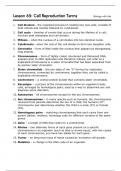
Lesson 65: Cell Reproduction Terms Biology with Lab
1. Cell division – the organized process of creating two new cells; consists of
both mitosis and meiosis followed by cytokinesis.
2. Cell cycle – timeline of events that occurs during the lifetime of a cell;
involves both interphase and cell division.
3. Mitosis – when the nucleus of a cell divides into two identical nuclei.
4. Cytokinesis – when the rest of the cell divides to form two daughter cells.
5. Chromatin – form of DNA inside the nucleus that appears as disorganized,
long strands.
6. Chromosomes – form of tightly coiled, shortened and thickened DNA;
appears prior to DNA replication and therefore mitosis; can refer to a
duplicated chromosome or a sister chromatid that has been separated from
its partner sister chromatid.
7. Sister chromatids – the two sides of the “X” formed by replicated
chromosomes; connected by centromere; together they can be called a
duplicated chromosome.
8. Centromere – a central protein bundle that connects sister chromatids.
9. Karyotype – a picture of the chromosomes within an organism’s body
cells, arranged by homologous pairs; used as a way to determine sex and
diagnose some disorders.
10. Autosomes – all chromosomes except for the sex chromosomes.
11. Sex chromosomes – in many species such as humans, the chromosomes
received from parents determine the sex of a child; the human’s 23 rd
chromosome pair determines whether the child is a male (XY) or female
(XX).
12. Homologous pairs – matching chromosomes that each came from one
parent (father, mother); homologs code for different versions of the same
genes.
13. Gene – a length of DNA that codes for a protein/trait.
14. Alleles – two alternate forms of each gene present on a specific
chromosome in an organism (such as blue or brown eyes); with two copies
of each chromosome, you have two alleles for each gene.
15. Tumor – an abnormal mass of tissue caused by excessive cell growth.
16. Mutation – a change in the DNA code of an organism.
1. Cell division – the organized process of creating two new cells; consists of
both mitosis and meiosis followed by cytokinesis.
2. Cell cycle – timeline of events that occurs during the lifetime of a cell;
involves both interphase and cell division.
3. Mitosis – when the nucleus of a cell divides into two identical nuclei.
4. Cytokinesis – when the rest of the cell divides to form two daughter cells.
5. Chromatin – form of DNA inside the nucleus that appears as disorganized,
long strands.
6. Chromosomes – form of tightly coiled, shortened and thickened DNA;
appears prior to DNA replication and therefore mitosis; can refer to a
duplicated chromosome or a sister chromatid that has been separated from
its partner sister chromatid.
7. Sister chromatids – the two sides of the “X” formed by replicated
chromosomes; connected by centromere; together they can be called a
duplicated chromosome.
8. Centromere – a central protein bundle that connects sister chromatids.
9. Karyotype – a picture of the chromosomes within an organism’s body
cells, arranged by homologous pairs; used as a way to determine sex and
diagnose some disorders.
10. Autosomes – all chromosomes except for the sex chromosomes.
11. Sex chromosomes – in many species such as humans, the chromosomes
received from parents determine the sex of a child; the human’s 23 rd
chromosome pair determines whether the child is a male (XY) or female
(XX).
12. Homologous pairs – matching chromosomes that each came from one
parent (father, mother); homologs code for different versions of the same
genes.
13. Gene – a length of DNA that codes for a protein/trait.
14. Alleles – two alternate forms of each gene present on a specific
chromosome in an organism (such as blue or brown eyes); with two copies
of each chromosome, you have two alleles for each gene.
15. Tumor – an abnormal mass of tissue caused by excessive cell growth.
16. Mutation – a change in the DNA code of an organism.