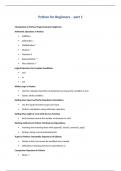
Python for Beginners – part 1
Introduction to Python Programming for Beginners
Arithmetic Operators in Python
Addition +
Subtraction -
Multiplication *
Division /
Modulus %
Exponentiation **
Floor division //
Logical Operators for Complex Conditions
and
or
not
While Loops in Python
Used for repeated execution of statements as long as the condition is true
Syntax: while condition:
Getting User Input and Performing Basic Calculations
Use the input() function to get user input
Perform calculations using arithmetic operators
Getting the Length of a List with the Len Function
len() function returns the number of elements in a list
Working with Lists in Python: Methods and Operations
Inserting and removing items with append(), insert(), remove(), pop()
Sorting, slicing, and concatenating lists
Tuples in Python: Immutable Sequences of Objects
Similar to lists, but cannot be modified once created
Defined by enclosing elements in parentheses ()
Comparison Operators in Python
Equal ==
, Not equal !=
Greater than >
Less than <
Greater than or equal to >=
Less than or equal to <=
Decision Making with If Statements in Python
Executing different blocks of code based on a condition
Syntax: if condition:
Understanding Primitive and Complex Data Types in Python
Primitive: numbers, strings, Booleans
Complex: lists, tuples, dictionaries
Type Conversion and Manipulation in Python
Converting between data types: int(), float(), str()
Using the For Loop to Iterate Over Lists in Python
Use the for loop to iterate through elements of a list
Syntax: for i in list:
Understanding the Range Function in Python
Generates a sequence of numbers
Syntax: range(start, stop, step)
Checking for Existence of Items in Lists with the In Operator
in operator checks if an element exists in a sequence
not in operator checks if an element does not exist in a sequence
Setting Up Python Environment and Code Editor
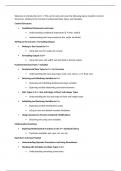
Topics to be covered
Introduction to Python Programming for Beginners
Basic Data Types in Python: Numbers, Strings, and Booleans
Arithmetic Operations and Operators in Python
Understanding Primitive and Complex Data Types in Python
Type Conversion and Manipulation in Python
Understanding Arithmetic Operators in Python
While Loops in Python
, Using the While Loop to Iterate Over Lists in Python
Understanding the Range Function in Python
Getting User Input and Performing Basic Calculations
Checking for Existence of Items in Lists with the In Operator
Working with Lists in Python
Getting the Length of a List with the Len Function
Working with Lists in Python: Methods and Operations
Tuples in Python: Immutable Sequences of Objects
Understanding Comparison Operators in Python
Decision Making with If Statements in Python
Using the For Loop to Iterate Over Lists in Python
String Manipulation and Operations in Python
No longer covered
Logical Operators for Complex Conditions
Looping with While Loops in Python
Type Conversion and Manipulation in Python
Introduction to Arithmetic Operators in Python
Working with Lists in Python: Methods and Operations
Tuples in Python: Immutable Sequences of Objects
Understanding Comparison Operators in Python
Decision Making with If Statements in Python
Working with Lists in Python
Understanding Primitive and Complex Data Types in Python
Basic Data Types in Python: Numbers, Strings, and Booleans
Numbers
Python supports various types of numbers, including:
Integers (e.g. 4, 20, -15)
Floating point numbers (e.g. 3.14, 0.0, -2.5)
Complex numbers (e.g. 3+4j, 5j, -2-3j)
Arithmetic operations can be performed using arithmetic operators such as:
Addition (+)
Introduction to Python Programming for Beginners
Arithmetic Operators in Python
Addition +
Subtraction -
Multiplication *
Division /
Modulus %
Exponentiation **
Floor division //
Logical Operators for Complex Conditions
and
or
not
While Loops in Python
Used for repeated execution of statements as long as the condition is true
Syntax: while condition:
Getting User Input and Performing Basic Calculations
Use the input() function to get user input
Perform calculations using arithmetic operators
Getting the Length of a List with the Len Function
len() function returns the number of elements in a list
Working with Lists in Python: Methods and Operations
Inserting and removing items with append(), insert(), remove(), pop()
Sorting, slicing, and concatenating lists
Tuples in Python: Immutable Sequences of Objects
Similar to lists, but cannot be modified once created
Defined by enclosing elements in parentheses ()
Comparison Operators in Python
Equal ==
, Not equal !=
Greater than >
Less than <
Greater than or equal to >=
Less than or equal to <=
Decision Making with If Statements in Python
Executing different blocks of code based on a condition
Syntax: if condition:
Understanding Primitive and Complex Data Types in Python
Primitive: numbers, strings, Booleans
Complex: lists, tuples, dictionaries
Type Conversion and Manipulation in Python
Converting between data types: int(), float(), str()
Using the For Loop to Iterate Over Lists in Python
Use the for loop to iterate through elements of a list
Syntax: for i in list:
Understanding the Range Function in Python
Generates a sequence of numbers
Syntax: range(start, stop, step)
Checking for Existence of Items in Lists with the In Operator
in operator checks if an element exists in a sequence
not in operator checks if an element does not exist in a sequence
Setting Up Python Environment and Code Editor
Topics to be covered
Introduction to Python Programming for Beginners
Basic Data Types in Python: Numbers, Strings, and Booleans
Arithmetic Operations and Operators in Python
Understanding Primitive and Complex Data Types in Python
Type Conversion and Manipulation in Python
Understanding Arithmetic Operators in Python
While Loops in Python
, Using the While Loop to Iterate Over Lists in Python
Understanding the Range Function in Python
Getting User Input and Performing Basic Calculations
Checking for Existence of Items in Lists with the In Operator
Working with Lists in Python
Getting the Length of a List with the Len Function
Working with Lists in Python: Methods and Operations
Tuples in Python: Immutable Sequences of Objects
Understanding Comparison Operators in Python
Decision Making with If Statements in Python
Using the For Loop to Iterate Over Lists in Python
String Manipulation and Operations in Python
No longer covered
Logical Operators for Complex Conditions
Looping with While Loops in Python
Type Conversion and Manipulation in Python
Introduction to Arithmetic Operators in Python
Working with Lists in Python: Methods and Operations
Tuples in Python: Immutable Sequences of Objects
Understanding Comparison Operators in Python
Decision Making with If Statements in Python
Working with Lists in Python
Understanding Primitive and Complex Data Types in Python
Basic Data Types in Python: Numbers, Strings, and Booleans
Numbers
Python supports various types of numbers, including:
Integers (e.g. 4, 20, -15)
Floating point numbers (e.g. 3.14, 0.0, -2.5)
Complex numbers (e.g. 3+4j, 5j, -2-3j)
Arithmetic operations can be performed using arithmetic operators such as:
Addition (+)