

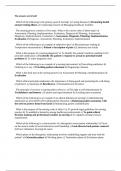
The answers are in bold
Which of the following is the primary goal of nursing? a) Curing diseases b) Promoting health
and preventing illness c) Conducting research d) Managing healthcare facilities
The nursing process consists of five steps. What is the correct order of these steps? a)
Assessment, Planning, Implementation, Evaluation, Diagnosis b) Planning, Assessment,
Diagnosis, Implementation, Evaluation c) Assessment, Diagnosis, Planning, Implementation,
Evaluation d) Diagnosis, Assessment, Planning, Evaluation, Implementation
Which of the following is an example of subjective data? a) Blood pressure reading b)
Temperature measurement c) Patient's description of pain d) Laboratory test results
What is the purpose of a nursing diagnosis? a) To identify the patient's medical condition b) To
prescribe medication c) To identify the patient's response to actual or potential health
problems d) To order diagnostic tests
Which of the following is an example of a nursing intervention? a) Prescribing antibiotics b)
Ordering an x-ray c) Providing patient education d) Diagnosing a disease
What is the final step in the nursing process? a) Assessment b) Planning c) Implementation d)
Evaluation
Which ethical principle emphasizes the importance of doing good and promoting the well-being
of patients? a) Autonomy b) Beneficence c) Nonmaleficence d) Justice
The principle of veracity in nursing ethics refers to: a) The right to self-determination b)
Truthfulness and honesty c) Fairness and equal treatment d) Avoiding harm to patients
Which of the following is an example of an ethical dilemma in nursing? a) Administering
medication as prescribed b) Providing patient education c) Balancing patient autonomy with
the need to protect them from harm d) Maintaining patient confidentiality
What is the purpose of the nursing code of ethics? a) To provide legal guidelines for nursing
practice b) To establish a hierarchy among healthcare professionals c) To guide ethical
decision-making and professional conduct in nursing d) To regulate nursing licensure
requirements
Which of the following is a characteristic of a therapeutic nurse-patient relationship? a) Focus
on the nurse's needs b) Social interaction and friendship c) Goal-directed and patient-centered
d) Power imbalance favoring the nurse
Which phase of the therapeutic relationship involves establishing rapport and trust with the
patient? a) Orientation phase b) Working phase c) Termination phase d) Evaluation phase
, Which communication technique involves restating the patient's message in your own words to
verify understanding? a) Reflection b) Paraphrasing c) Summarizing d) Clarifying
Which of the following is a barrier to effective communication? a) Active listening b) Using
medical jargon c) Open-ended questions d) Empathy
Which of the following is an example of nonverbal communication? a) Spoken words b)
Written messages c) Facial expressions d) Tone of voice
What is the purpose of HIPAA (Health Insurance Portability and Accountability Act)? a) To
ensure healthcare providers are adequately trained b) To regulate the cost of healthcare services
c) To protect the privacy and security of patient health information d) To provide healthcare
access to all individuals
Which of the following is NOT a component of informed consent? a) Explanation of the
procedure or treatment b) Guarantee of a successful outcome c) Discussion of potential risks
and benefits d) Opportunity for the patient to ask questions
Which legal term refers to a nurse's failure to meet the standard of care, resulting in patient
harm? a) Assault b) Battery c) Negligence d) Malpractice
Which of the following is a nursing responsibility related to delegation? a) Delegating tasks
only to other nurses b) Ensuring the delegatee is competent to perform the task c) Avoiding
delegation whenever possible d) Delegating tasks that are outside the delegatee's scope of
practice
Which of the following is an example of a nursing intervention to promote patient safety? a)
Performing hand hygiene before and after patient contact b) Leaving medications at the
bedside for the patient to take later c) Using restraints on all confused patients d) Ignoring patient
complaints of pain
Which of the following is NOT a vital sign? a) Temperature b) Pulse c) Pain d) Blood pressure
What is the normal range for an adult's oral temperature? a) 96.6°F to 98.6°F b) 97.6°F to
99.6°F c) 98.6°F to 100.4°F d) 99.6°F to 101.6°F
Which pulse site is located on the inner aspect of the wrist, thumb side? a) Radial b) Brachial
c) Carotid d) Femoral
What is the normal range for an adult's respiratory rate? a) 8-12 breaths per minute b) 12-20
breaths per minute c) 20-30 breaths per minute d) 30-40 breaths per minute
Which of the following blood pressure readings would be considered hypertensive? a) 110/70
mmHg b) 120/80 mmHg c) 140/90 mmHg d) 130/85 mmHg
Which of the following is the primary goal of nursing? a) Curing diseases b) Promoting health
and preventing illness c) Conducting research d) Managing healthcare facilities
The nursing process consists of five steps. What is the correct order of these steps? a)
Assessment, Planning, Implementation, Evaluation, Diagnosis b) Planning, Assessment,
Diagnosis, Implementation, Evaluation c) Assessment, Diagnosis, Planning, Implementation,
Evaluation d) Diagnosis, Assessment, Planning, Evaluation, Implementation
Which of the following is an example of subjective data? a) Blood pressure reading b)
Temperature measurement c) Patient's description of pain d) Laboratory test results
What is the purpose of a nursing diagnosis? a) To identify the patient's medical condition b) To
prescribe medication c) To identify the patient's response to actual or potential health
problems d) To order diagnostic tests
Which of the following is an example of a nursing intervention? a) Prescribing antibiotics b)
Ordering an x-ray c) Providing patient education d) Diagnosing a disease
What is the final step in the nursing process? a) Assessment b) Planning c) Implementation d)
Evaluation
Which ethical principle emphasizes the importance of doing good and promoting the well-being
of patients? a) Autonomy b) Beneficence c) Nonmaleficence d) Justice
The principle of veracity in nursing ethics refers to: a) The right to self-determination b)
Truthfulness and honesty c) Fairness and equal treatment d) Avoiding harm to patients
Which of the following is an example of an ethical dilemma in nursing? a) Administering
medication as prescribed b) Providing patient education c) Balancing patient autonomy with
the need to protect them from harm d) Maintaining patient confidentiality
What is the purpose of the nursing code of ethics? a) To provide legal guidelines for nursing
practice b) To establish a hierarchy among healthcare professionals c) To guide ethical
decision-making and professional conduct in nursing d) To regulate nursing licensure
requirements
Which of the following is a characteristic of a therapeutic nurse-patient relationship? a) Focus
on the nurse's needs b) Social interaction and friendship c) Goal-directed and patient-centered
d) Power imbalance favoring the nurse
Which phase of the therapeutic relationship involves establishing rapport and trust with the
patient? a) Orientation phase b) Working phase c) Termination phase d) Evaluation phase
, Which communication technique involves restating the patient's message in your own words to
verify understanding? a) Reflection b) Paraphrasing c) Summarizing d) Clarifying
Which of the following is a barrier to effective communication? a) Active listening b) Using
medical jargon c) Open-ended questions d) Empathy
Which of the following is an example of nonverbal communication? a) Spoken words b)
Written messages c) Facial expressions d) Tone of voice
What is the purpose of HIPAA (Health Insurance Portability and Accountability Act)? a) To
ensure healthcare providers are adequately trained b) To regulate the cost of healthcare services
c) To protect the privacy and security of patient health information d) To provide healthcare
access to all individuals
Which of the following is NOT a component of informed consent? a) Explanation of the
procedure or treatment b) Guarantee of a successful outcome c) Discussion of potential risks
and benefits d) Opportunity for the patient to ask questions
Which legal term refers to a nurse's failure to meet the standard of care, resulting in patient
harm? a) Assault b) Battery c) Negligence d) Malpractice
Which of the following is a nursing responsibility related to delegation? a) Delegating tasks
only to other nurses b) Ensuring the delegatee is competent to perform the task c) Avoiding
delegation whenever possible d) Delegating tasks that are outside the delegatee's scope of
practice
Which of the following is an example of a nursing intervention to promote patient safety? a)
Performing hand hygiene before and after patient contact b) Leaving medications at the
bedside for the patient to take later c) Using restraints on all confused patients d) Ignoring patient
complaints of pain
Which of the following is NOT a vital sign? a) Temperature b) Pulse c) Pain d) Blood pressure
What is the normal range for an adult's oral temperature? a) 96.6°F to 98.6°F b) 97.6°F to
99.6°F c) 98.6°F to 100.4°F d) 99.6°F to 101.6°F
Which pulse site is located on the inner aspect of the wrist, thumb side? a) Radial b) Brachial
c) Carotid d) Femoral
What is the normal range for an adult's respiratory rate? a) 8-12 breaths per minute b) 12-20
breaths per minute c) 20-30 breaths per minute d) 30-40 breaths per minute
Which of the following blood pressure readings would be considered hypertensive? a) 110/70
mmHg b) 120/80 mmHg c) 140/90 mmHg d) 130/85 mmHg

