

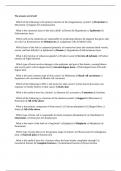
The answers are in bold
Which of the following is the primary function of the integumentary system? a) Protection b)
Movement c) Support d) Communication
What is the outermost layer of the skin called? a) Dermis b) Hypodermis c) Epidermis d)
Subcutaneous layer
Which cells in the epidermis are responsible for producing melanin, the pigment that gives skin
its color? a) Keratinocytes b) Melanocytes c) Langerhans cells d) Merkel cells
Which layer of the skin is composed primarily of connective tissue and contains blood vessels,
nerves, and hair follicles? a) Epidermis b) Dermis c) Hypodermis d) Subcutaneous layer
What is the function of sebaceous glands? a) Produce sweat b) Secrete oil (sebum) c) Produce
melanin d) Fight infection
Which type of burn involves damage to the epidermis and part of the dermis, causing blisters
and severe pain? a) First-degree burn b) Second-degree burn c) Third-degree burn d) Fourth-
degree burn
What is the most common type of skin cancer? a) Melanoma b) Basal cell carcinoma c)
Squamous cell carcinoma d) Merkel cell carcinoma
Which of the following is NOT a risk factor for skin cancer? a) Fair skin b) Excessive sun
exposure c) Family history of skin cancer d) Dark skin
What is the medical term for a bruise? a) Abrasion b) Laceration c) Contusion d) Avulsion
Which of the following is a function of the skeletal system? a) Support b) Movement c)
Protection d) All of the above
What is the primary component of bone tissue? a) Calcium phosphate b) Collagen fibers c)
Water d) All of the above
Which type of bone cell is responsible for bone resorption (breakdown)? a) Osteoblasts b)
Osteoclasts c) Osteocytes d) Chondrocytes
What is the name of the shaft of a long bone? a) Epiphysis b) Diaphysis c) Metaphysis d)
Periosteum
Which type of joint allows for the greatest range of motion? a) Fibrous joint b) Cartilaginous
joint c) Synovial joint d) Sutural joint
What is the medical term for a fracture where the bone breaks completely through? a)
Greenstick fracture b) Complete fracture c) Comminuted fracture d) Stress fracture
, Which of the following is NOT a function of the muscular system? a) Movement b)
Production of blood cells c) Maintenance of posture d) Generation of heat
Which type of muscle tissue is under voluntary control? a) Skeletal muscle b) Smooth muscle
c) Cardiac muscle d) All of the above
What is the name of the connective tissue that attaches muscle to bone? a) Ligament b) Tendon
c) Cartilage d) Fascia
Which of the following is the contractile unit of a muscle fiber? a) Myofibril b) Sarcomere c)
Actin d) Myosin
What is the name of the neurotransmitter that stimulates muscle contraction? a) Dopamine b)
Serotonin c) Acetylcholine d) Norepinephrine
Which of the following is NOT a common symptom of a musculoskeletal disorder? a) Pain b)
Stiffness c) Fever d) Swelling
What is the medical term for inflammation of a joint? a) Arthritis b) Osteoporosis c)
Arthrocentesis d) Bursitis
Which of the following is a risk factor for osteoporosis? a) Menopause b) Regular weight-
bearing exercise c) Adequate calcium intake d) High levels of estrogen
What is the primary function of the nervous system? a) Control and coordination of body
functions b) Support and protection of organs c) Transportation of nutrients and oxygen d)
Production of hormones
Which part of the neuron receives signals from other neurons? a) Axon b) Dendrites c) Cell
body d) Synapse
What is the name of the gap between two neurons where signals are transmitted? a) Myelin
sheath b) Node of Ranvier c) Synapse d) Axon terminal
Which part of the brain is responsible for higher-order thinking, such as planning and decision-
making? a) Brainstem b) Cerebellum c) Cerebral cortex d) Thalamus
Which of the following is NOT a lobe of the cerebral cortex? a) Frontal lobe b) Parietal lobe c)
Temporal lobe d) Cerebellar lobe
What is the medical term for a stroke? a) Myocardial infarction b) Cerebrovascular accident
c) Transient ischemic attack d) Epilepsy
Which of the following is a function of the endocrine system? a) Production of hormones b)
Regulation of body temperature c) Protection against infection d) Movement
Which of the following is the primary function of the integumentary system? a) Protection b)
Movement c) Support d) Communication
What is the outermost layer of the skin called? a) Dermis b) Hypodermis c) Epidermis d)
Subcutaneous layer
Which cells in the epidermis are responsible for producing melanin, the pigment that gives skin
its color? a) Keratinocytes b) Melanocytes c) Langerhans cells d) Merkel cells
Which layer of the skin is composed primarily of connective tissue and contains blood vessels,
nerves, and hair follicles? a) Epidermis b) Dermis c) Hypodermis d) Subcutaneous layer
What is the function of sebaceous glands? a) Produce sweat b) Secrete oil (sebum) c) Produce
melanin d) Fight infection
Which type of burn involves damage to the epidermis and part of the dermis, causing blisters
and severe pain? a) First-degree burn b) Second-degree burn c) Third-degree burn d) Fourth-
degree burn
What is the most common type of skin cancer? a) Melanoma b) Basal cell carcinoma c)
Squamous cell carcinoma d) Merkel cell carcinoma
Which of the following is NOT a risk factor for skin cancer? a) Fair skin b) Excessive sun
exposure c) Family history of skin cancer d) Dark skin
What is the medical term for a bruise? a) Abrasion b) Laceration c) Contusion d) Avulsion
Which of the following is a function of the skeletal system? a) Support b) Movement c)
Protection d) All of the above
What is the primary component of bone tissue? a) Calcium phosphate b) Collagen fibers c)
Water d) All of the above
Which type of bone cell is responsible for bone resorption (breakdown)? a) Osteoblasts b)
Osteoclasts c) Osteocytes d) Chondrocytes
What is the name of the shaft of a long bone? a) Epiphysis b) Diaphysis c) Metaphysis d)
Periosteum
Which type of joint allows for the greatest range of motion? a) Fibrous joint b) Cartilaginous
joint c) Synovial joint d) Sutural joint
What is the medical term for a fracture where the bone breaks completely through? a)
Greenstick fracture b) Complete fracture c) Comminuted fracture d) Stress fracture
, Which of the following is NOT a function of the muscular system? a) Movement b)
Production of blood cells c) Maintenance of posture d) Generation of heat
Which type of muscle tissue is under voluntary control? a) Skeletal muscle b) Smooth muscle
c) Cardiac muscle d) All of the above
What is the name of the connective tissue that attaches muscle to bone? a) Ligament b) Tendon
c) Cartilage d) Fascia
Which of the following is the contractile unit of a muscle fiber? a) Myofibril b) Sarcomere c)
Actin d) Myosin
What is the name of the neurotransmitter that stimulates muscle contraction? a) Dopamine b)
Serotonin c) Acetylcholine d) Norepinephrine
Which of the following is NOT a common symptom of a musculoskeletal disorder? a) Pain b)
Stiffness c) Fever d) Swelling
What is the medical term for inflammation of a joint? a) Arthritis b) Osteoporosis c)
Arthrocentesis d) Bursitis
Which of the following is a risk factor for osteoporosis? a) Menopause b) Regular weight-
bearing exercise c) Adequate calcium intake d) High levels of estrogen
What is the primary function of the nervous system? a) Control and coordination of body
functions b) Support and protection of organs c) Transportation of nutrients and oxygen d)
Production of hormones
Which part of the neuron receives signals from other neurons? a) Axon b) Dendrites c) Cell
body d) Synapse
What is the name of the gap between two neurons where signals are transmitted? a) Myelin
sheath b) Node of Ranvier c) Synapse d) Axon terminal
Which part of the brain is responsible for higher-order thinking, such as planning and decision-
making? a) Brainstem b) Cerebellum c) Cerebral cortex d) Thalamus
Which of the following is NOT a lobe of the cerebral cortex? a) Frontal lobe b) Parietal lobe c)
Temporal lobe d) Cerebellar lobe
What is the medical term for a stroke? a) Myocardial infarction b) Cerebrovascular accident
c) Transient ischemic attack d) Epilepsy
Which of the following is a function of the endocrine system? a) Production of hormones b)
Regulation of body temperature c) Protection against infection d) Movement

