Summary Intermediate Microeconomics: games and behavior
Preliminaries
- Positive analysis: describing relationships of cause and effect, about what is
- Normative analysis: analyzing what ought to be
- Methodological individualism: for methodological reasons we look at the level of individual
actor. Eventually we aggregate to explain the problem on the collective level
- Rational choice theory: assume that people make choices to achieve goals, the choice
process is their behavior.
- Method of decreasing abstraction: start simple and abstract and by analysis introduce more
realistic assumptions.
Risk and uncertainty
- Uncertainty: likelihood of outcomes unknown
- Risk: likelihood of outcomes known
- Expected value: payoffs times their respective probabilities
- Utility of expected value: utility times the expected value U[E(Y)]
- Expected utility: utility per payoff times their respective probabilities E(U(Y))
o U[E(Y)] does not consider risk, while E(U(Y)) does
- A rational decision chooses an action with the maximum expected utility
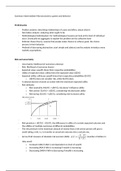
- Risk attitudes
o Risk neutrality: E(U(Y)) = U[E(Y)], risk doesn’t influence utility
o Risk averse: E(U(Y)) < U[E(Y)], considering risk decreases utility
o Risk loving: E(U(Y)) > U[E(Y)], considering risk increases utility
-
- Risk premium = U[E(Y)] – E(U(Y)), the difference in utility of a certain expected outcome and
the utilities of multiple outcomes at different probabilities
- The risk premium is the maximum amount of money that a risk-averse person will pay to
avoid taking a risk, i.e. to transfer an uncertain outcome into a certain one.
−U ' ' (Y )
- Arrow-Pratt measure of absolute risk aversion (ARA): A ( Y )= (number of dollars in
U '(Y )
risky asset)
o Constant CARA if ARA is not dependent on level of wealth
o Increasing IARA if ARA is increasing if wealth is increasing
o Decreasing DARA if ARA is decreasing if wealth is increasing
, U ' ' (Y )
- Arrow-Pratt measure of relative risk aversion (RRA): R ( Y )=−Y (fraction of portfolio
U ' (Y )
in risky asset
o Constant CRRA if RRA is not dependent on level of wealth
o Increasing IRRA if RRA is increasing if wealth is increasing
o Decreasing DRRA if RRA is decreasing if wealth is increasing
Prospect theory
Evaluate outcomes in terms of gains and losses with respect to a reference points, and the
values of gains and losses are weighted with decisions weights (instead of probabilities)
V =π ¿
P=probability, π=decision weight, v=value attached to a
change in Y
Diminishing sensitivity: impact of incremental gains or
losses on value diminishes as gains or losses become larger
Loss averseness: valuation of outcome is more sensitive to
losses than to gains
People tend to overestimate small probabilities and
moderately underestimate average and large probabilities
Decision making over time
- For decisions involving tradeoffs among costs and benefits occurring at different times
- Discounted utility theory: introduce discount factor δ
- For one good x with price 1 and income K over two times: x 2 = K2 + 1 / δ (K1 – x1)
- Intertemporal budget constraint goes from 1/δ * K 1 + K2 (just x2) to K1 + δ * K2 (just x1)
du ( x 1, x 2 )
−
dx 1 −1
- Slope is MRS (marginal rate of substitution) = =
du ( x 1 , x 2 ) δ
dx 2
∞
t
- Discounted utility model: U0 = u0 + δu1 + δ2u2 + … + δtut = ∑ δ ut
t =0
o Time-consistent behavior
- If preferences are instable over time: introduce hyperbolic discounting factor β:
∞
∑ u 0+ β δ t ut
t =0
Preliminaries
- Positive analysis: describing relationships of cause and effect, about what is
- Normative analysis: analyzing what ought to be
- Methodological individualism: for methodological reasons we look at the level of individual
actor. Eventually we aggregate to explain the problem on the collective level
- Rational choice theory: assume that people make choices to achieve goals, the choice
process is their behavior.
- Method of decreasing abstraction: start simple and abstract and by analysis introduce more
realistic assumptions.
Risk and uncertainty
- Uncertainty: likelihood of outcomes unknown
- Risk: likelihood of outcomes known
- Expected value: payoffs times their respective probabilities
- Utility of expected value: utility times the expected value U[E(Y)]
- Expected utility: utility per payoff times their respective probabilities E(U(Y))
o U[E(Y)] does not consider risk, while E(U(Y)) does
- A rational decision chooses an action with the maximum expected utility
- Risk attitudes
o Risk neutrality: E(U(Y)) = U[E(Y)], risk doesn’t influence utility
o Risk averse: E(U(Y)) < U[E(Y)], considering risk decreases utility
o Risk loving: E(U(Y)) > U[E(Y)], considering risk increases utility
-
- Risk premium = U[E(Y)] – E(U(Y)), the difference in utility of a certain expected outcome and
the utilities of multiple outcomes at different probabilities
- The risk premium is the maximum amount of money that a risk-averse person will pay to
avoid taking a risk, i.e. to transfer an uncertain outcome into a certain one.
−U ' ' (Y )
- Arrow-Pratt measure of absolute risk aversion (ARA): A ( Y )= (number of dollars in
U '(Y )
risky asset)
o Constant CARA if ARA is not dependent on level of wealth
o Increasing IARA if ARA is increasing if wealth is increasing
o Decreasing DARA if ARA is decreasing if wealth is increasing
, U ' ' (Y )
- Arrow-Pratt measure of relative risk aversion (RRA): R ( Y )=−Y (fraction of portfolio
U ' (Y )
in risky asset
o Constant CRRA if RRA is not dependent on level of wealth
o Increasing IRRA if RRA is increasing if wealth is increasing
o Decreasing DRRA if RRA is decreasing if wealth is increasing
Prospect theory
Evaluate outcomes in terms of gains and losses with respect to a reference points, and the
values of gains and losses are weighted with decisions weights (instead of probabilities)
V =π ¿
P=probability, π=decision weight, v=value attached to a
change in Y
Diminishing sensitivity: impact of incremental gains or
losses on value diminishes as gains or losses become larger
Loss averseness: valuation of outcome is more sensitive to
losses than to gains
People tend to overestimate small probabilities and
moderately underestimate average and large probabilities
Decision making over time
- For decisions involving tradeoffs among costs and benefits occurring at different times
- Discounted utility theory: introduce discount factor δ
- For one good x with price 1 and income K over two times: x 2 = K2 + 1 / δ (K1 – x1)
- Intertemporal budget constraint goes from 1/δ * K 1 + K2 (just x2) to K1 + δ * K2 (just x1)
du ( x 1, x 2 )
−
dx 1 −1
- Slope is MRS (marginal rate of substitution) = =
du ( x 1 , x 2 ) δ
dx 2
∞
t
- Discounted utility model: U0 = u0 + δu1 + δ2u2 + … + δtut = ∑ δ ut
t =0
o Time-consistent behavior
- If preferences are instable over time: introduce hyperbolic discounting factor β:
∞
∑ u 0+ β δ t ut
t =0