LG 1: When is something a group or a team? Characteristics?
Teams (= a more groupy group; teams are more evolved than groups but groups are the start):
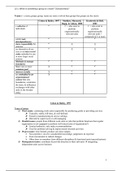
Cohen & Bailey, 1997 Mathieu, Maynard, Kozlowski & Bell,
Rapp, & Gilson, 2008 2001
a collective of + who exist to + who exist to
individuals perform perform
organizationally organizationally
relevant tasks relevant tasks +
composed of 2 or more
exhibit task
interdependencies
share responsibility for X X
outcome
see themselves & are X X
seen as an intact social
entity embedded in one
or more larger social
systems
Maintain & manage
boundaries
Share one or more X
common goal
interact socially X
are embedded in an X
organizational
context that sets
boundaries, constrains
the team, & influences
exchanges with other
units in the broader
entity
Cohen & Bailey, 1997
Types of teams:
1) Work teams: continuing work units responsible for producing goods or providing services
Typically, stable, full-time, & well-defined
Found in manufacturing & service settings
Directed by supervisors or self-managing
2) Parallel teams: people from different work units or jobs that perform functions that regular
organization is not equipped to perform well (microcosm of organization?)
Limited authority, only make recommendations
Used for problem-solving & improvement-oriented activities
3) Project teams: time limited, produce one-time outputs
Non-repetitive, involve considerable knowledge, judgement, & expertise
From incremental to radical changes
Often draw on members from different disciplines & functional units (specializations)
4) Management teams: coordinate & provide direction to their sub-units integrating
independent units across business
1
, LG 1: When is something a group or a team? Characteristics?
Kozlowski & Bell, 2001 - Work Groups & Teams in Organizations
Conceptual issues critical in investigating & understanding work teams:
1) Task or workflow interdependence
2) Contextual creation and constraint
3) Multilevel influences
4) Temporal dynamics
Types of Work Teams
- General Typologies: effort to distinguish a broad range of team types;
e.g.: six team categories of:
1) Production
2) Service
3) Management
4) Project (e.g. consulting)
5) Action & performing (e.g. military unit)
6) Advisory
- More Specific Classifications: e.g.:
Crews: distinguishing characteristic is the capability and necessity for crews to form
and be immediately prepared to perform together effectively
Top management teams (TMT): based on level in the organizational hierarchy
Cross-cultural, mixed-culture, and transnational teams
Virtual teams: collocation in time and space
- Complex teams are characterized by
1) tasks that are externally driven, dynamic, & structured
2) common goals that require specific individual contributions that may shift over time
3) roles that are specified & differentiated (e.g. require specialized knowledge & skill)
4) a focus on task-based roles & interaction, & performance coordination; and
5) performance demands that require coordinated individual performance, the capability to
adapt to shifting goals & contingencies, and a capacity to continually improve over time
- Simple teams are characterized by
1) tasks that are internally oriented, static, & unstructured (lack explicit workflows)
2) common & fixed goals that make no specific demands for individual contributions
3) roles that are unspecified & undifferentiated (everyone has equivalent knowledge & skill)
4) a focus on social roles, social interaction, normative behavior, & conflict; and
Mathieu, Maynard, Rapp, & Gilson, 2008
Important to realize that the categories for teams are simply proxies for more substantive issues! E.g.:
- some teams contain fairly functionally homogeneous members, whereas others are usually
more functionally heterogeneous
- certain teams operate in intense and complex environments, others’ environments are more
stable
critically important to remember that different types of teams face different demands and as a
result function quite differently
often there is as much heterogeneity within team types as there is across types
Teams can be described across typology or characteristics!!!
2
Teams (= a more groupy group; teams are more evolved than groups but groups are the start):
Cohen & Bailey, 1997 Mathieu, Maynard, Kozlowski & Bell,
Rapp, & Gilson, 2008 2001
a collective of + who exist to + who exist to
individuals perform perform
organizationally organizationally
relevant tasks relevant tasks +
composed of 2 or more
exhibit task
interdependencies
share responsibility for X X
outcome
see themselves & are X X
seen as an intact social
entity embedded in one
or more larger social
systems
Maintain & manage
boundaries
Share one or more X
common goal
interact socially X
are embedded in an X
organizational
context that sets
boundaries, constrains
the team, & influences
exchanges with other
units in the broader
entity
Cohen & Bailey, 1997
Types of teams:
1) Work teams: continuing work units responsible for producing goods or providing services
Typically, stable, full-time, & well-defined
Found in manufacturing & service settings
Directed by supervisors or self-managing
2) Parallel teams: people from different work units or jobs that perform functions that regular
organization is not equipped to perform well (microcosm of organization?)
Limited authority, only make recommendations
Used for problem-solving & improvement-oriented activities
3) Project teams: time limited, produce one-time outputs
Non-repetitive, involve considerable knowledge, judgement, & expertise
From incremental to radical changes
Often draw on members from different disciplines & functional units (specializations)
4) Management teams: coordinate & provide direction to their sub-units integrating
independent units across business
1
, LG 1: When is something a group or a team? Characteristics?
Kozlowski & Bell, 2001 - Work Groups & Teams in Organizations
Conceptual issues critical in investigating & understanding work teams:
1) Task or workflow interdependence
2) Contextual creation and constraint
3) Multilevel influences
4) Temporal dynamics
Types of Work Teams
- General Typologies: effort to distinguish a broad range of team types;
e.g.: six team categories of:
1) Production
2) Service
3) Management
4) Project (e.g. consulting)
5) Action & performing (e.g. military unit)
6) Advisory
- More Specific Classifications: e.g.:
Crews: distinguishing characteristic is the capability and necessity for crews to form
and be immediately prepared to perform together effectively
Top management teams (TMT): based on level in the organizational hierarchy
Cross-cultural, mixed-culture, and transnational teams
Virtual teams: collocation in time and space
- Complex teams are characterized by
1) tasks that are externally driven, dynamic, & structured
2) common goals that require specific individual contributions that may shift over time
3) roles that are specified & differentiated (e.g. require specialized knowledge & skill)
4) a focus on task-based roles & interaction, & performance coordination; and
5) performance demands that require coordinated individual performance, the capability to
adapt to shifting goals & contingencies, and a capacity to continually improve over time
- Simple teams are characterized by
1) tasks that are internally oriented, static, & unstructured (lack explicit workflows)
2) common & fixed goals that make no specific demands for individual contributions
3) roles that are unspecified & undifferentiated (everyone has equivalent knowledge & skill)
4) a focus on social roles, social interaction, normative behavior, & conflict; and
Mathieu, Maynard, Rapp, & Gilson, 2008
Important to realize that the categories for teams are simply proxies for more substantive issues! E.g.:
- some teams contain fairly functionally homogeneous members, whereas others are usually
more functionally heterogeneous
- certain teams operate in intense and complex environments, others’ environments are more
stable
critically important to remember that different types of teams face different demands and as a
result function quite differently
often there is as much heterogeneity within team types as there is across types
Teams can be described across typology or characteristics!!!
2